

5.3 Space-Time Reference Based on Newtonian Mechanics
285
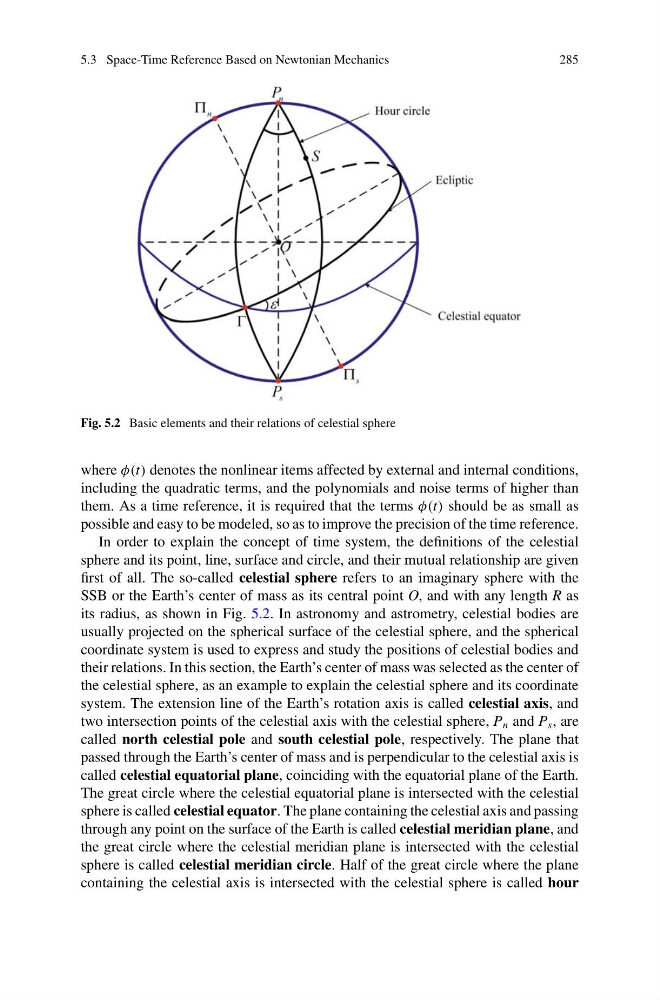
Fig. 5.2 Basic elements and their relations of celestial sphere
where φ(t) denotes the nonlinear items affected by external and internal conditions,
including the quadratic terms, and the polynomials and noise terms of higher than
them. As a time reference, it is required that the terms φ(t) should be as small as
possible and easy to be modeled, so as to improve the precision of the time reference.
In order to explain the concept of time system, the definitions of the celestial
sphere and its point, line, surface and circle, and their mutual relationship are given
first of all. The so-called celestial sphere refers to an imaginary sphere with the
SSB or the Earth’s center of mass as its central point O, and with any length R as
its radius, as shown in Fig. 5.2. In astronomy and astrometry, celestial bodies are
usually projected on the spherical surface of the celestial sphere, and the spherical
coordinate system is used to express and study the positions of celestial bodies and
their relations. In this section, the Earth’s center of mass was selected as the center of
the celestial sphere, as an example to explain the celestial sphere and its coordinate
system. The extension line of the Earth’s rotation axis is called celestial axis, and
two intersection points of the celestial axis with the celestial sphere, P n and P s , are
called north celestial pole and south celestial pole, respectively. The plane that
passed through the Earth’s center of mass and is perpendicular to the celestial axis is
called celestial equatorial plane, coinciding with the equatorial plane of the Earth.
The great circle where the celestial equatorial plane is intersected with the celestial
sphere is called celestial equator. The plane containing the celestial axis and passing
through any point on the surface of the Earth is called celestial meridian plane, and
the great circle where the celestial meridian plane is intersected with the celestial
sphere is called celestial meridian circle. Half of the great circle where the plane
containing the celestial axis is intersected with the celestial sphere is called hour
285
Fig. 5.2 Basic elements and their relations of celestial sphere
where φ(t) denotes the nonlinear items affected by external and internal conditions,
including the quadratic terms, and the polynomials and noise terms of higher than
them. As a time reference, it is required that the terms φ(t) should be as small as
possible and easy to be modeled, so as to improve the precision of the time reference.
In order to explain the concept of time system, the definitions of the celestial
sphere and its point, line, surface and circle, and their mutual relationship are given
first of all. The so-called celestial sphere refers to an imaginary sphere with the
SSB or the Earth’s center of mass as its central point O, and with any length R as
its radius, as shown in Fig. 5.2. In astronomy and astrometry, celestial bodies are
usually projected on the spherical surface of the celestial sphere, and the spherical
coordinate system is used to express and study the positions of celestial bodies and
their relations. In this section, the Earth’s center of mass was selected as the center of
the celestial sphere, as an example to explain the celestial sphere and its coordinate
system. The extension line of the Earth’s rotation axis is called celestial axis, and
two intersection points of the celestial axis with the celestial sphere, P n and P s , are
called north celestial pole and south celestial pole, respectively. The plane that
passed through the Earth’s center of mass and is perpendicular to the celestial axis is
called celestial equatorial plane, coinciding with the equatorial plane of the Earth.
The great circle where the celestial equatorial plane is intersected with the celestial
sphere is called celestial equator. The plane containing the celestial axis and passing
through any point on the surface of the Earth is called celestial meridian plane, and
the great circle where the celestial meridian plane is intersected with the celestial
sphere is called celestial meridian circle. Half of the great circle where the plane
containing the celestial axis is intersected with the celestial sphere is called hour