

282
5 X-ray Pulsar-Based Navigation: Theories and Experiments
5.3 Space-Time Reference Based on Newtonian Mechanics
5.3.1 Description for Particle Motion
The Newtonian mechanics takes particles as research objects, and the motion state
of the entire particle system can be inferred by studying the forces on each particle.
The theoretical framework of classic mechanics is composed of Newton’s three laws
of motion and its law of universal gravitation, which is applicable to the study on the
laws of motion of the macroscopic objects whose moving speeds are far less than
the velocity of light. In the framework of classic Newtonian mechanics, time is a
parameter to describe the movement and change of substance, which is independent
of space; the coordinate values of the same space-time point given by different
reference systems may be different, while the time and space intervals between two
space-time points are unchanged, which is known as Newton’s absolute space-time
view. In other words, time is completely independent of space. The clock of the timekeeping system is an ideal standard clock, and the scale of the length measurement
system is an ideal standard measurement bar. Both have nothing to do with the
motion form of specific substance and the selected reference system and are with
absoluteness.
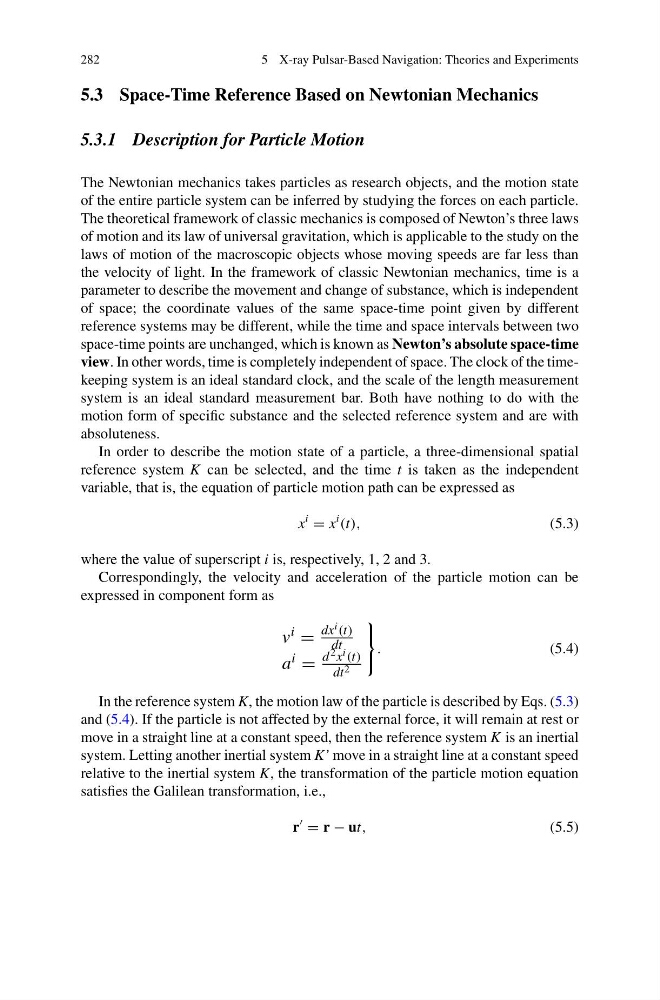
In order to describe the motion state of a particle, a three-dimensional spatial
reference system K can be selected, and the time t is taken as the independent
variable, that is, the equation of particle motion path can be expressed as
x
i
= x
i
(t),
(5.3)
where the value of superscript i is, respectively, 1, 2 and 3.
Correspondingly, the velocity and acceleration of the particle motion can be
expressed in component form as
v i =
dx i (t)
dt
a i =
d 2 x i (t)
dt 2
⎫
⎬
⎭
.
(5.4)
In the reference system K, the motion law of the particle is described by Eqs. (5.3)
and (5.4). If the particle is not affected by the external force, it will remain at rest or
move in a straight line at a constant speed, then the reference system K is an inertial
system. Letting another inertial system K’ move in a straight line at a constant speed
relative to the inertial system K, the transformation of the particle motion equation
satisfies the Galilean transformation, i.e.,
r
= r − ut,
(5.5)
5 X-ray Pulsar-Based Navigation: Theories and Experiments
5.3 Space-Time Reference Based on Newtonian Mechanics
5.3.1 Description for Particle Motion
The Newtonian mechanics takes particles as research objects, and the motion state
of the entire particle system can be inferred by studying the forces on each particle.
The theoretical framework of classic mechanics is composed of Newton’s three laws
of motion and its law of universal gravitation, which is applicable to the study on the
laws of motion of the macroscopic objects whose moving speeds are far less than
the velocity of light. In the framework of classic Newtonian mechanics, time is a
parameter to describe the movement and change of substance, which is independent
of space; the coordinate values of the same space-time point given by different
reference systems may be different, while the time and space intervals between two
space-time points are unchanged, which is known as Newton’s absolute space-time
view. In other words, time is completely independent of space. The clock of the timekeeping system is an ideal standard clock, and the scale of the length measurement
system is an ideal standard measurement bar. Both have nothing to do with the
motion form of specific substance and the selected reference system and are with
absoluteness.
In order to describe the motion state of a particle, a three-dimensional spatial
reference system K can be selected, and the time t is taken as the independent
variable, that is, the equation of particle motion path can be expressed as
x
i
= x
i
(t),
(5.3)
where the value of superscript i is, respectively, 1, 2 and 3.
Correspondingly, the velocity and acceleration of the particle motion can be
expressed in component form as
v i =
dx i (t)
dt
a i =
d 2 x i (t)
dt 2
⎫
⎬
⎭
.
(5.4)
In the reference system K, the motion law of the particle is described by Eqs. (5.3)
and (5.4). If the particle is not affected by the external force, it will remain at rest or
move in a straight line at a constant speed, then the reference system K is an inertial
system. Letting another inertial system K’ move in a straight line at a constant speed
relative to the inertial system K, the transformation of the particle motion equation
satisfies the Galilean transformation, i.e.,
r
= r − ut,
(5.5)