

266
4 Navigations from Ground to Space
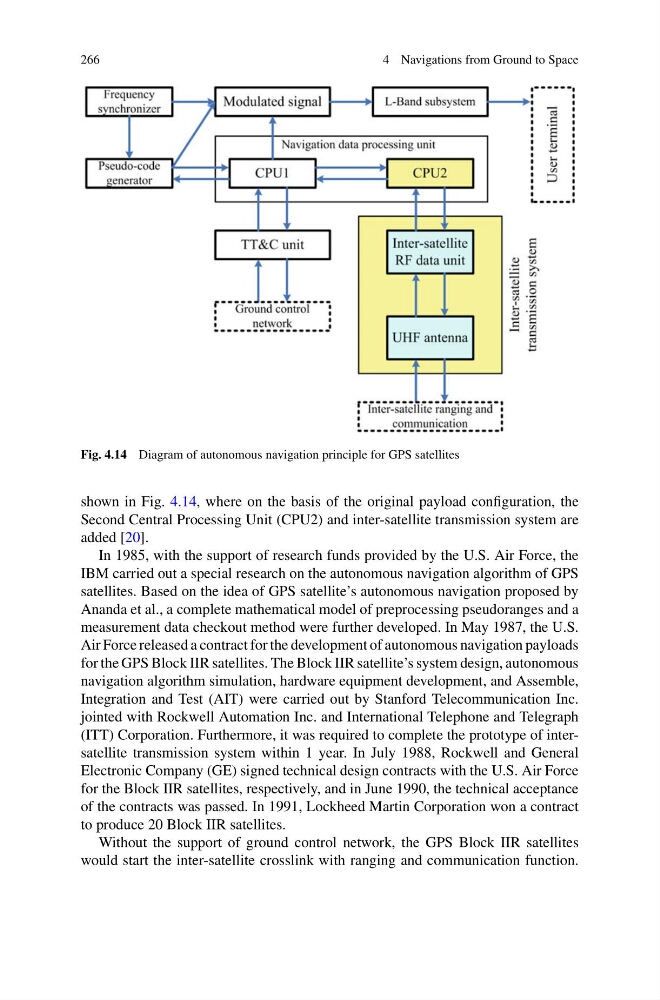
Fig. 4.14 Diagram of autonomous navigation principle for GPS satellites
shown in Fig. 4.14, where on the basis of the original payload configuration, the
Second Central Processing Unit (CPU2) and inter-satellite transmission system are
added [20].
In 1985, with the support of research funds provided by the U.S. Air Force, the
IBM carried out a special research on the autonomous navigation algorithm of GPS
satellites. Based on the idea of GPS satellite’s autonomous navigation proposed by
Ananda et al., a complete mathematical model of preprocessing pseudoranges and a
measurement data checkout method were further developed. In May 1987, the U.S.
Air Force released a contract for the development of autonomous navigation payloads
for the GPS Block IIR satellites. The Block IIR satellite’s system design, autonomous
navigation algorithm simulation, hardware equipment development, and Assemble,
Integration and Test (AIT) were carried out by Stanford Telecommunication Inc.
jointed with Rockwell Automation Inc. and International Telephone and Telegraph
(ITT) Corporation. Furthermore, it was required to complete the prototype of intersatellite transmission system within 1 year. In July 1988, Rockwell and General
Electronic Company (GE) signed technical design contracts with the U.S. Air Force
for the Block IIR satellites, respectively, and in June 1990, the technical acceptance
of the contracts was passed. In 1991, Lockheed Martin Corporation won a contract
to produce 20 Block IIR satellites.
Without the support of ground control network, the GPS Block IIR satellites
would start the inter-satellite crosslink with ranging and communication function.
4 Navigations from Ground to Space
Fig. 4.14 Diagram of autonomous navigation principle for GPS satellites
shown in Fig. 4.14, where on the basis of the original payload configuration, the
Second Central Processing Unit (CPU2) and inter-satellite transmission system are
added [20].
In 1985, with the support of research funds provided by the U.S. Air Force, the
IBM carried out a special research on the autonomous navigation algorithm of GPS
satellites. Based on the idea of GPS satellite’s autonomous navigation proposed by
Ananda et al., a complete mathematical model of preprocessing pseudoranges and a
measurement data checkout method were further developed. In May 1987, the U.S.
Air Force released a contract for the development of autonomous navigation payloads
for the GPS Block IIR satellites. The Block IIR satellite’s system design, autonomous
navigation algorithm simulation, hardware equipment development, and Assemble,
Integration and Test (AIT) were carried out by Stanford Telecommunication Inc.
jointed with Rockwell Automation Inc. and International Telephone and Telegraph
(ITT) Corporation. Furthermore, it was required to complete the prototype of intersatellite transmission system within 1 year. In July 1988, Rockwell and General
Electronic Company (GE) signed technical design contracts with the U.S. Air Force
for the Block IIR satellites, respectively, and in June 1990, the technical acceptance
of the contracts was passed. In 1991, Lockheed Martin Corporation won a contract
to produce 20 Block IIR satellites.
Without the support of ground control network, the GPS Block IIR satellites
would start the inter-satellite crosslink with ranging and communication function.