

262
4 Navigations from Ground to Space
The leading candidate for 70-m replacement had been an array of smaller dishes,
but more recently the decision was taken to expand the provision of 34-m beam
waveguide antennas at each station to a total of four. As of 2020, the DSN is required
to support twice the number of missions compared with that in 2005. However, due
to the limited finance support, and the decay and lack of replacement of the existing
antennas, the support for the increased spaceflight missions will continue to be an
ongoing problem. For this reason, the new spacecrafts intended for missions beyond
geocentric orbits are being equipped to use the beacon mode service, which allows
such missions to operate without the DSN most of the time.
For the radio navigation in ultra-deep space, the navigation error increases linearly
with the increase of TT&C distance. As increasing one Astronomical Unit in the
TT&C distance each, the ranging error will increase by 4 km. Furthermore, the
TT&C delay for the DSN is so great that the DSN lacks the capability of real-time
navigation and control for deep-space crafts. Before 2030, the navigation accuracy
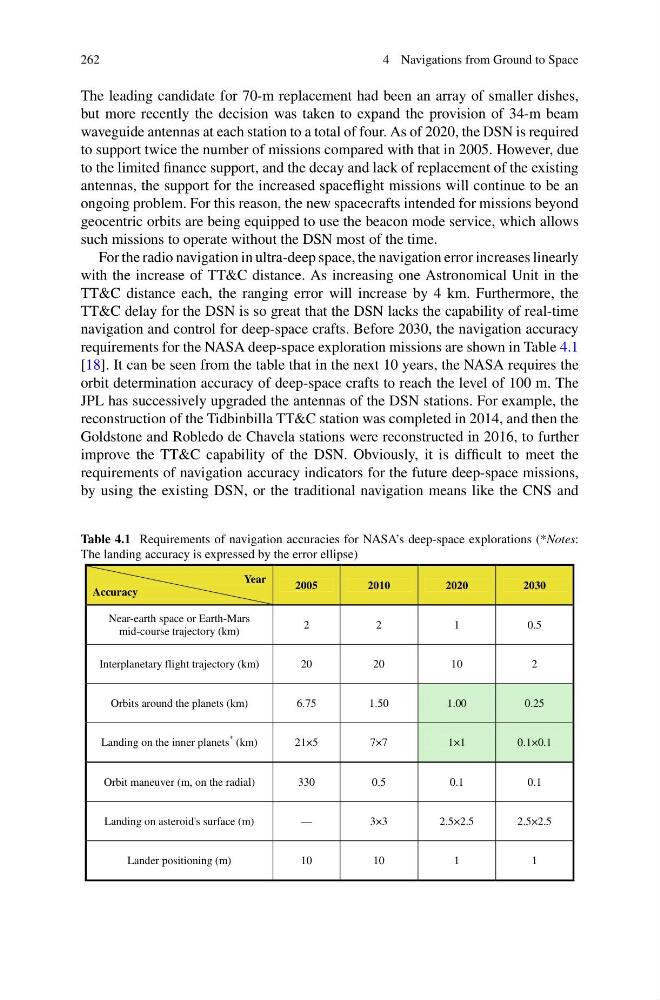
requirements for the NASA deep-space exploration missions are shown in Table 4.1
[18]. It can be seen from the table that in the next 10 years, the NASA requires the
orbit determination accuracy of deep-space crafts to reach the level of 100 m. The
JPL has successively upgraded the antennas of the DSN stations. For example, the
reconstruction of the Tidbinbilla TT&C station was completed in 2014, and then the
Goldstone and Robledo de Chavela stations were reconstructed in 2016, to further
improve the TT&C capability of the DSN. Obviously, it is difficult to meet the
requirements of navigation accuracy indicators for the future deep-space missions,
by using the existing DSN, or the traditional navigation means like the CNS and
Table 4.1 Requirements of navigation accuracies for NASA’s deep-space explorations (*Notes:
The landing accuracy is expressed by the error ellipse)
Year
Accuracy
2005
2010
2020
2030
Near-earth space or Earth-Mars
mid-course trajectory (km)
2
2
1
0.5
Interplanetary flight trajectory (km)
20
20
10
2
Orbits around the planets (km)
6.75
1.50
1.00
0.25
Landing on the inner planets
* (km)
21×5
7×7
1×1
0.1×0.1
Orbit maneuver (m, on the radial)
330
0.5
0.1
0.1
Landing on asteroid's surface (m)
—
3×3
2.5×2.5
2.5×2.5
Lander positioning (m)
10
10
1
1
4 Navigations from Ground to Space
The leading candidate for 70-m replacement had been an array of smaller dishes,
but more recently the decision was taken to expand the provision of 34-m beam
waveguide antennas at each station to a total of four. As of 2020, the DSN is required
to support twice the number of missions compared with that in 2005. However, due
to the limited finance support, and the decay and lack of replacement of the existing
antennas, the support for the increased spaceflight missions will continue to be an
ongoing problem. For this reason, the new spacecrafts intended for missions beyond
geocentric orbits are being equipped to use the beacon mode service, which allows
such missions to operate without the DSN most of the time.
For the radio navigation in ultra-deep space, the navigation error increases linearly
with the increase of TT&C distance. As increasing one Astronomical Unit in the
TT&C distance each, the ranging error will increase by 4 km. Furthermore, the
TT&C delay for the DSN is so great that the DSN lacks the capability of real-time
navigation and control for deep-space crafts. Before 2030, the navigation accuracy
requirements for the NASA deep-space exploration missions are shown in Table 4.1
[18]. It can be seen from the table that in the next 10 years, the NASA requires the
orbit determination accuracy of deep-space crafts to reach the level of 100 m. The
JPL has successively upgraded the antennas of the DSN stations. For example, the
reconstruction of the Tidbinbilla TT&C station was completed in 2014, and then the
Goldstone and Robledo de Chavela stations were reconstructed in 2016, to further
improve the TT&C capability of the DSN. Obviously, it is difficult to meet the
requirements of navigation accuracy indicators for the future deep-space missions,
by using the existing DSN, or the traditional navigation means like the CNS and
Table 4.1 Requirements of navigation accuracies for NASA’s deep-space explorations (*Notes:
The landing accuracy is expressed by the error ellipse)
Year
Accuracy
2005
2010
2020
2030
Near-earth space or Earth-Mars
mid-course trajectory (km)
2
2
1
0.5
Interplanetary flight trajectory (km)
20
20
10
2
Orbits around the planets (km)
6.75
1.50
1.00
0.25
Landing on the inner planets
* (km)
21×5
7×7
1×1
0.1×0.1
Orbit maneuver (m, on the radial)
330
0.5
0.1
0.1
Landing on asteroid's surface (m)
—
3×3
2.5×2.5
2.5×2.5
Lander positioning (m)
10
10
1
1