

258
4 Navigations from Ground to Space
and clock parameters, and uploading them to the satellites twice a day. Its network
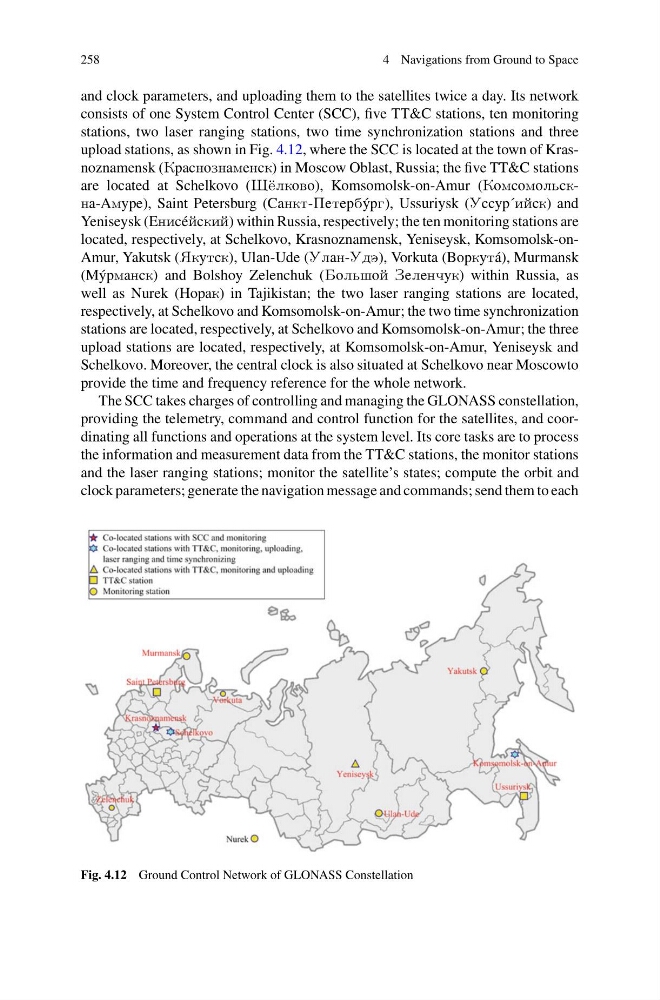
consists of one System Control Center (SCC), five TT&C stations, ten monitoring
stations, two laser ranging stations, two time synchronization stations and three
upload stations, as shown in Fig. 4.12, where the SCC is located at the town of Krasnoznamensk (Kpacnoznamenck) in Moscow Oblast, Russia; the five TT&C stations
are located at Schelkovo (WWlkovo), Komsomolsk-on-Amur (Komcomollckna-Amype), Saint Petersburg (Cankt-Petepb´ ypg), Ussuriysk (Uccyp´iick) and
Yeniseysk (Enic´ eckii) within Russia, respectively; the ten monitoring stations are
located, respectively, at Schelkovo, Krasnoznamensk, Yeniseysk, Komsomolsk-onAmur, Yakutsk (kytck), Ulan-Ude (Ulan-Udd), Vorkuta (Bopkyt´ a), Murmansk
(M´ ypmanck) and Bolshoy Zelenchuk (Bollxo Zelenqyk) within Russia, as
well as Nurek (Hopak) in Tajikistan; the two laser ranging stations are located,
respectively, at Schelkovo and Komsomolsk-on-Amur; the two time synchronization
stations are located, respectively, at Schelkovo and Komsomolsk-on-Amur; the three
upload stations are located, respectively, at Komsomolsk-on-Amur, Yeniseysk and
Schelkovo. Moreover, the central clock is also situated at Schelkovo near Moscowto
provide the time and frequency reference for the whole network.
The SCC takes charges of controlling and managing the GLONASS constellation,
providing the telemetry, command and control function for the satellites, and coordinating all functions and operations at the system level. Its core tasks are to process
the information and measurement data from the TT&C stations, the monitor stations
and the laser ranging stations; monitor the satellite’s states; compute the orbit and
clock parameters; generate the navigation message and commands; send them to each
Fig. 4.12 Ground Control Network of GLONASS Constellation
4 Navigations from Ground to Space
and clock parameters, and uploading them to the satellites twice a day. Its network
consists of one System Control Center (SCC), five TT&C stations, ten monitoring
stations, two laser ranging stations, two time synchronization stations and three
upload stations, as shown in Fig. 4.12, where the SCC is located at the town of Krasnoznamensk (Kpacnoznamenck) in Moscow Oblast, Russia; the five TT&C stations
are located at Schelkovo (WWlkovo), Komsomolsk-on-Amur (Komcomollckna-Amype), Saint Petersburg (Cankt-Petepb´ ypg), Ussuriysk (Uccyp´iick) and
Yeniseysk (Enic´ eckii) within Russia, respectively; the ten monitoring stations are
located, respectively, at Schelkovo, Krasnoznamensk, Yeniseysk, Komsomolsk-onAmur, Yakutsk (kytck), Ulan-Ude (Ulan-Udd), Vorkuta (Bopkyt´ a), Murmansk
(M´ ypmanck) and Bolshoy Zelenchuk (Bollxo Zelenqyk) within Russia, as
well as Nurek (Hopak) in Tajikistan; the two laser ranging stations are located,
respectively, at Schelkovo and Komsomolsk-on-Amur; the two time synchronization
stations are located, respectively, at Schelkovo and Komsomolsk-on-Amur; the three
upload stations are located, respectively, at Komsomolsk-on-Amur, Yeniseysk and
Schelkovo. Moreover, the central clock is also situated at Schelkovo near Moscowto
provide the time and frequency reference for the whole network.
The SCC takes charges of controlling and managing the GLONASS constellation,
providing the telemetry, command and control function for the satellites, and coordinating all functions and operations at the system level. Its core tasks are to process
the information and measurement data from the TT&C stations, the monitor stations
and the laser ranging stations; monitor the satellite’s states; compute the orbit and
clock parameters; generate the navigation message and commands; send them to each
Fig. 4.12 Ground Control Network of GLONASS Constellation