

4.7 The Navigations for Spacecrafts
245
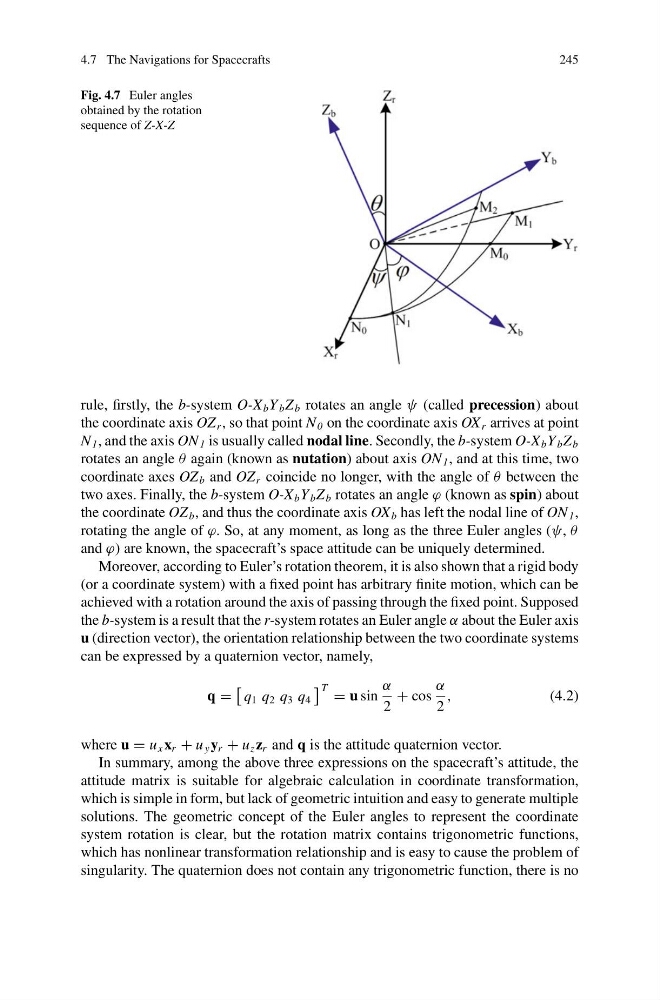
Fig. 4.7 Euler angles
obtained by the rotation
sequence of Z-X-Z
rule, firstly, the b-system O-X b Y b Z b rotates an angle ψ (called precession) about
the coordinate axis OZ r , so that point N 0 on the coordinate axis OX r arrives at point
N 1 , and the axis ON 1 is usually called nodal line. Secondly, the b-system O-X b Y b Z b
rotates an angle θ again (known as nutation) about axis ON 1 , and at this time, two
coordinate axes OZ b and OZ r coincide no longer, with the angle of θ between the
two axes. Finally, the b-system O-X b Y b Z b rotates an angle ϕ (known as spin) about
the coordinate OZ b , and thus the coordinate axis OX b has left the nodal line of ON 1 ,
rotating the angle of ϕ. So, at any moment, as long as the three Euler angles (ψ, θ
and ϕ) are known, the spacecraft’s space attitude can be uniquely determined.
Moreover, according to Euler’s rotation theorem, it is also shown that a rigid body
(or a coordinate system) with a fixed point has arbitrary finite motion, which can be
achieved with a rotation around the axis of passing through the fixed point. Supposed
the b-system is a result that the r-system rotates an Euler angle α about the Euler axis
u (direction vector), the orientation relationship between the two coordinate systems
can be expressed by a quaternion vector, namely,
q =
q 1 q 2 q 3 q 4
T = u sin
α
2
+ cos
α
2
,
(4.2)
where u = u x x r + u y y r + u z z r and q is the attitude quaternion vector.
In summary, among the above three expressions on the spacecraft’s attitude, the
attitude matrix is suitable for algebraic calculation in coordinate transformation,
which is simple in form, but lack of geometric intuition and easy to generate multiple
solutions. The geometric concept of the Euler angles to represent the coordinate
system rotation is clear, but the rotation matrix contains trigonometric functions,
which has nonlinear transformation relationship and is easy to cause the problem of
singularity. The quaternion does not contain any trigonometric function, there is no
245
Fig. 4.7 Euler angles
obtained by the rotation
sequence of Z-X-Z
rule, firstly, the b-system O-X b Y b Z b rotates an angle ψ (called precession) about
the coordinate axis OZ r , so that point N 0 on the coordinate axis OX r arrives at point
N 1 , and the axis ON 1 is usually called nodal line. Secondly, the b-system O-X b Y b Z b
rotates an angle θ again (known as nutation) about axis ON 1 , and at this time, two
coordinate axes OZ b and OZ r coincide no longer, with the angle of θ between the
two axes. Finally, the b-system O-X b Y b Z b rotates an angle ϕ (known as spin) about
the coordinate OZ b , and thus the coordinate axis OX b has left the nodal line of ON 1 ,
rotating the angle of ϕ. So, at any moment, as long as the three Euler angles (ψ, θ
and ϕ) are known, the spacecraft’s space attitude can be uniquely determined.
Moreover, according to Euler’s rotation theorem, it is also shown that a rigid body
(or a coordinate system) with a fixed point has arbitrary finite motion, which can be
achieved with a rotation around the axis of passing through the fixed point. Supposed
the b-system is a result that the r-system rotates an Euler angle α about the Euler axis
u (direction vector), the orientation relationship between the two coordinate systems
can be expressed by a quaternion vector, namely,
q =
q 1 q 2 q 3 q 4
T = u sin
α
2
+ cos
α
2
,
(4.2)
where u = u x x r + u y y r + u z z r and q is the attitude quaternion vector.
In summary, among the above three expressions on the spacecraft’s attitude, the
attitude matrix is suitable for algebraic calculation in coordinate transformation,
which is simple in form, but lack of geometric intuition and easy to generate multiple
solutions. The geometric concept of the Euler angles to represent the coordinate
system rotation is clear, but the rotation matrix contains trigonometric functions,
which has nonlinear transformation relationship and is easy to cause the problem of
singularity. The quaternion does not contain any trigonometric function, there is no