

242
4 Navigations from Ground to Space
orbital perturbations are brought up by the forces and the attitude disturbances by
the moments. The navigation for spacecraft refers to a technique and method to
guide the spacecraft along the designed orbit to fly to the target orbits or target
celestial- bodies in accordance with certain laws, also known as space navigation.
In order to effectively conduct the space navigation, safely guide the spacecraft for
the flight along the designed orbits and directions, and complete the scheduled space
flight missions in time, the top priority is to measure the orbit and attitude parameters
and carry out the orbit and attitude controls for spacecrafts [15, 16].
4.7.1 Orbit and Attitude Determinations
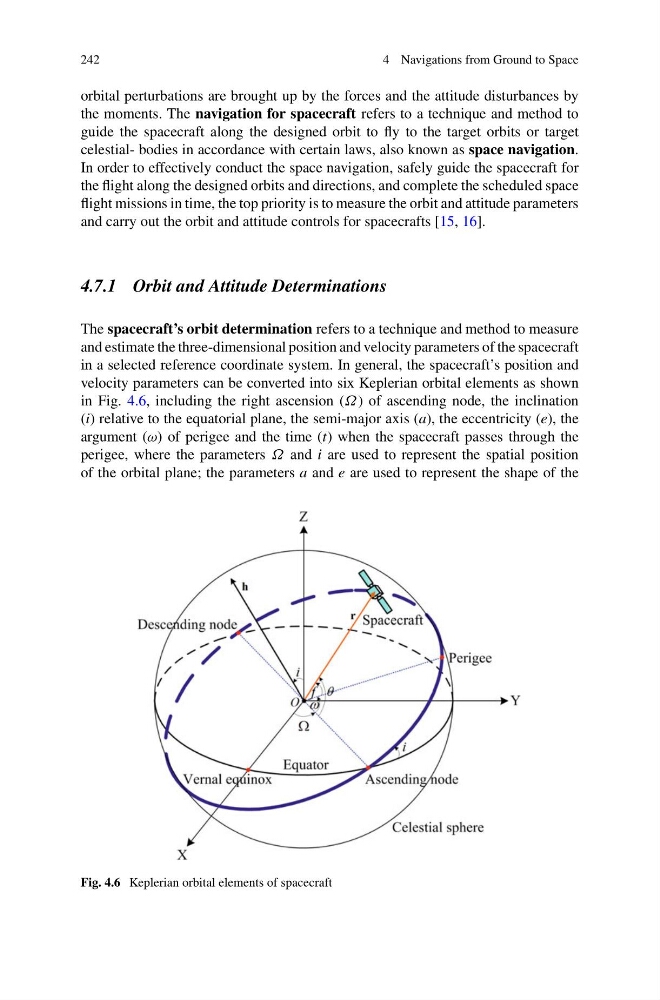
The spacecraft’s orbit determination refers to a technique and method to measure
and estimate the three-dimensional position and velocity parameters of the spacecraft
in a selected reference coordinate system. In general, the spacecraft’s position and
velocity parameters can be converted into six Keplerian orbital elements as shown
in Fig. 4.6, including the right ascension (Ω) of ascending node, the inclination
(i) relative to the equatorial plane, the semi-major axis (a), the eccentricity (e), the
argument (ω) of perigee and the time (t) when the spacecraft passes through the
perigee, where the parameters Ω and i are used to represent the spatial position
of the orbital plane; the parameters a and e are used to represent the shape of the
Fig. 4.6 Keplerian orbital elements of spacecraft
4 Navigations from Ground to Space
orbital perturbations are brought up by the forces and the attitude disturbances by
the moments. The navigation for spacecraft refers to a technique and method to
guide the spacecraft along the designed orbit to fly to the target orbits or target
celestial- bodies in accordance with certain laws, also known as space navigation.
In order to effectively conduct the space navigation, safely guide the spacecraft for
the flight along the designed orbits and directions, and complete the scheduled space
flight missions in time, the top priority is to measure the orbit and attitude parameters
and carry out the orbit and attitude controls for spacecrafts [15, 16].
4.7.1 Orbit and Attitude Determinations
The spacecraft’s orbit determination refers to a technique and method to measure
and estimate the three-dimensional position and velocity parameters of the spacecraft
in a selected reference coordinate system. In general, the spacecraft’s position and
velocity parameters can be converted into six Keplerian orbital elements as shown
in Fig. 4.6, including the right ascension (Ω) of ascending node, the inclination
(i) relative to the equatorial plane, the semi-major axis (a), the eccentricity (e), the
argument (ω) of perigee and the time (t) when the spacecraft passes through the
perigee, where the parameters Ω and i are used to represent the spatial position
of the orbital plane; the parameters a and e are used to represent the shape of the
Fig. 4.6 Keplerian orbital elements of spacecraft