

180
3 A Brief History of Space Flight
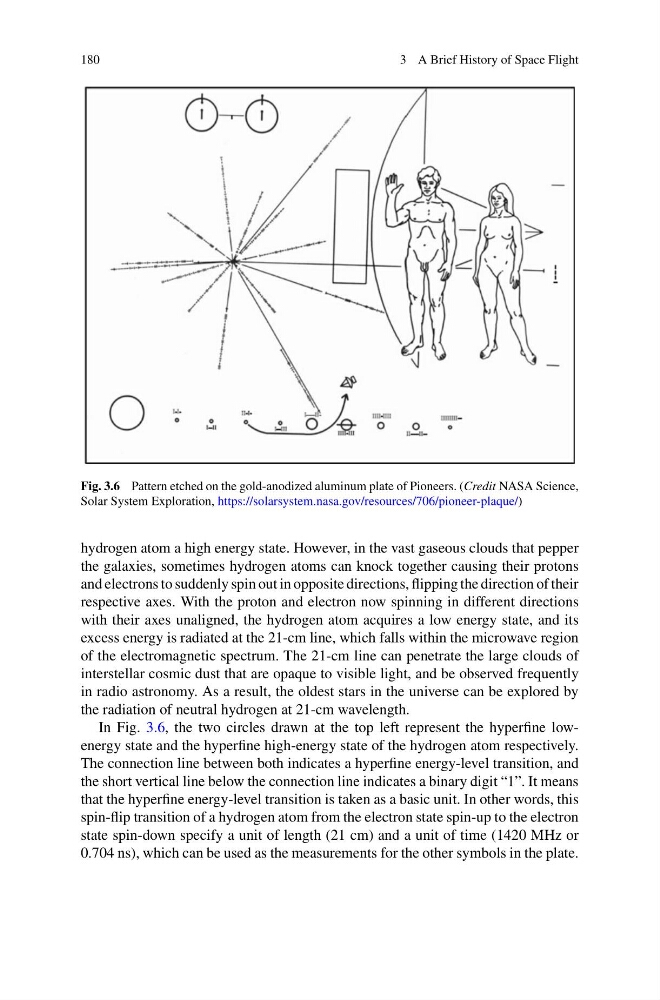
Fig. 3.6 Pattern etched on the gold-anodized aluminum plate of Pioneers. (Credit NASA Science,
Solar System Exploration, https://solarsystem.nasa.gov/resources/706/pioneer-plaque/)
hydrogen atom a high energy state. However, in the vast gaseous clouds that pepper
the galaxies, sometimes hydrogen atoms can knock together causing their protons
and electrons to suddenly spin out in opposite directions, flipping the direction of their
respective axes. With the proton and electron now spinning in different directions
with their axes unaligned, the hydrogen atom acquires a low energy state, and its
excess energy is radiated at the 21-cm line, which falls within the microwave region
of the electromagnetic spectrum. The 21-cm line can penetrate the large clouds of
interstellar cosmic dust that are opaque to visible light, and be observed frequently
in radio astronomy. As a result, the oldest stars in the universe can be explored by
the radiation of neutral hydrogen at 21-cm wavelength.
In Fig. 3.6, the two circles drawn at the top left represent the hyperfine lowenergy state and the hyperfine high-energy state of the hydrogen atom respectively.
The connection line between both indicates a hyperfine energy-level transition, and
the short vertical line below the connection line indicates a binary digit “1”. It means
that the hyperfine energy-level transition is taken as a basic unit. In other words, this
spin-flip transition of a hydrogen atom from the electron state spin-up to the electron
state spin-down specify a unit of length (21 cm) and a unit of time (1420 MHz or
0.704 ns), which can be used as the measurements for the other symbols in the plate.
3 A Brief History of Space Flight
Fig. 3.6 Pattern etched on the gold-anodized aluminum plate of Pioneers. (Credit NASA Science,
Solar System Exploration, https://solarsystem.nasa.gov/resources/706/pioneer-plaque/)
hydrogen atom a high energy state. However, in the vast gaseous clouds that pepper
the galaxies, sometimes hydrogen atoms can knock together causing their protons
and electrons to suddenly spin out in opposite directions, flipping the direction of their
respective axes. With the proton and electron now spinning in different directions
with their axes unaligned, the hydrogen atom acquires a low energy state, and its
excess energy is radiated at the 21-cm line, which falls within the microwave region
of the electromagnetic spectrum. The 21-cm line can penetrate the large clouds of
interstellar cosmic dust that are opaque to visible light, and be observed frequently
in radio astronomy. As a result, the oldest stars in the universe can be explored by
the radiation of neutral hydrogen at 21-cm wavelength.
In Fig. 3.6, the two circles drawn at the top left represent the hyperfine lowenergy state and the hyperfine high-energy state of the hydrogen atom respectively.
The connection line between both indicates a hyperfine energy-level transition, and
the short vertical line below the connection line indicates a binary digit “1”. It means
that the hyperfine energy-level transition is taken as a basic unit. In other words, this
spin-flip transition of a hydrogen atom from the electron state spin-up to the electron
state spin-down specify a unit of length (21 cm) and a unit of time (1420 MHz or
0.704 ns), which can be used as the measurements for the other symbols in the plate.