

6.3 Resonant States of 11 Li, Probability Distributions and β-decay of Halo Analog States
77
K
i j ( p, q; E) = i h i ( p)δ i j δ pq +
i j
d pdq qp(2π)
×
1
−1
d(cos θ)K i j (
p,
q; E) i, j = 1, 2, 3
(6.11)
6.3.1 Ground State of 11 Li
The condition η(E) = 1 yields the solution of the integral Eq. (6.8) in the negative
energy region and E corresponds to the bound state energy. Equation (6.10) has been
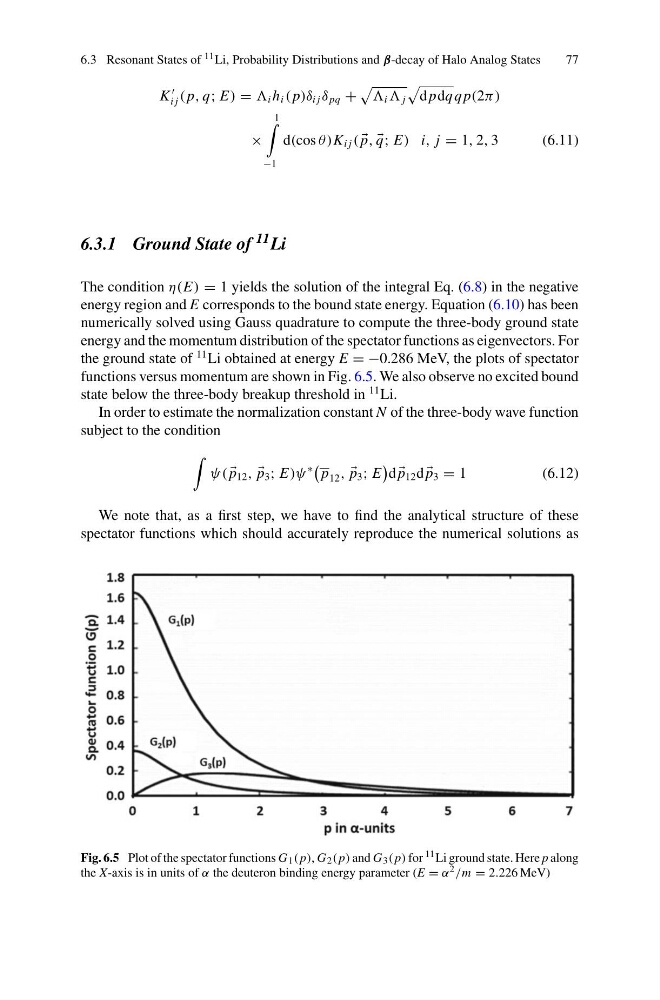
numerically solved using Gauss quadrature to compute the three-body ground state
energy and the momentum distribution of the spectator functions as eigenvectors. For
the ground state of
11 Li obtained at energy E = −0.286 MeV, the plots of spectator
functions versus momentum are shown in Fig. 6.5. We also observe no excited bound
state below the three-body breakup threshold in
11 Li.
In order to estimate the normalization constant N of the three-body wave function
subject to the condition
ψ(
p 12 ,
p 3 ; E)ψ
∗
p 12 ,
p 3 ; E
d
p 12 d
p 3 = 1
(6.12)
We note that, as a first step, we have to find the analytical structure of these
spectator functions which should accurately reproduce the numerical solutions as
Fig. 6.5 Plot of the spectator functions G 1 ( p), G 2 ( p) and G 3 ( p) for 11 Li ground state. Here p along
the X-axis is in units of α the deuteron binding energy parameter (E = α 2 /m = 2.226 MeV)
77
K
i j ( p, q; E) = i h i ( p)δ i j δ pq +
i j
d pdq qp(2π)
×
1
−1
d(cos θ)K i j (
p,
q; E) i, j = 1, 2, 3
(6.11)
6.3.1 Ground State of 11 Li
The condition η(E) = 1 yields the solution of the integral Eq. (6.8) in the negative
energy region and E corresponds to the bound state energy. Equation (6.10) has been
numerically solved using Gauss quadrature to compute the three-body ground state
energy and the momentum distribution of the spectator functions as eigenvectors. For
the ground state of
11 Li obtained at energy E = −0.286 MeV, the plots of spectator
functions versus momentum are shown in Fig. 6.5. We also observe no excited bound
state below the three-body breakup threshold in
11 Li.
In order to estimate the normalization constant N of the three-body wave function
subject to the condition
ψ(
p 12 ,
p 3 ; E)ψ
∗
p 12 ,
p 3 ; E
d
p 12 d
p 3 = 1
(6.12)
We note that, as a first step, we have to find the analytical structure of these
spectator functions which should accurately reproduce the numerical solutions as
Fig. 6.5 Plot of the spectator functions G 1 ( p), G 2 ( p) and G 3 ( p) for 11 Li ground state. Here p along
the X-axis is in units of α the deuteron binding energy parameter (E = α 2 /m = 2.226 MeV)