

6.2 11 Li Halo Nucleus as a Three-Body System …
73
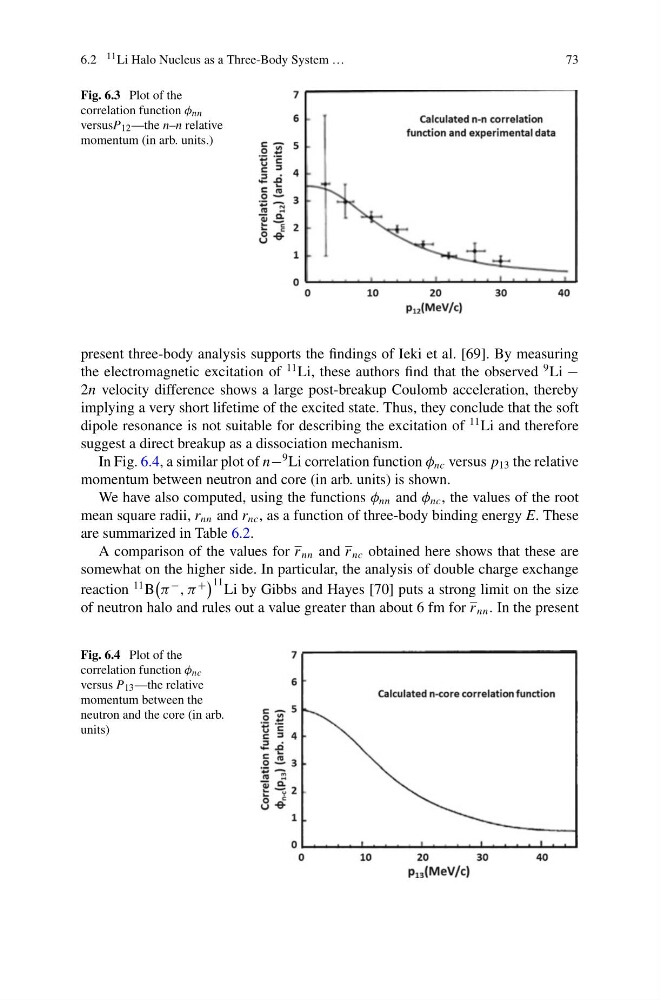
Fig. 6.3 Plot of the
correlation function φ nn
versusP 12 —the n–n relative
momentum (in arb. units.)
present three-body analysis supports the findings of Ieki et al. [69]. By measuring
the electromagnetic excitation of
11 Li, these authors find that the observed
9 Li −
2n velocity difference shows a large post-breakup Coulomb acceleration, thereby
implying a very short lifetime of the excited state. Thus, they conclude that the soft
dipole resonance is not suitable for describing the excitation of
11 Li and therefore
suggest a direct breakup as a dissociation mechanism.
In Fig. 6.4, a similar plot of n−
9 Li correlation function φ nc versus p 13 the relative
momentum between neutron and core (in arb. units) is shown.
We have also computed, using the functions φ nn and φ nc , the values of the root
mean square radii, r nn and r nc , as a function of three-body binding energy E. These
are summarized in Table 6.2.
A comparison of the values for r nn and r nc obtained here shows that these are
somewhat on the higher side. In particular, the analysis of double charge exchange
reaction
11 B
π
−
, π
+
11 Li by Gibbs and Hayes [70] puts a strong limit on the size
of neutron halo and rules out a value greater than about 6 fm for r nn . In the present
Fig. 6.4 Plot of the
correlation function φ nc
versus P 13 —the relative
momentum between the
neutron and the core (in arb.
units)
73
Fig. 6.3 Plot of the
correlation function φ nn
versusP 12 —the n–n relative
momentum (in arb. units.)
present three-body analysis supports the findings of Ieki et al. [69]. By measuring
the electromagnetic excitation of
11 Li, these authors find that the observed
9 Li −
2n velocity difference shows a large post-breakup Coulomb acceleration, thereby
implying a very short lifetime of the excited state. Thus, they conclude that the soft
dipole resonance is not suitable for describing the excitation of
11 Li and therefore
suggest a direct breakup as a dissociation mechanism.
In Fig. 6.4, a similar plot of n−
9 Li correlation function φ nc versus p 13 the relative
momentum between neutron and core (in arb. units) is shown.
We have also computed, using the functions φ nn and φ nc , the values of the root
mean square radii, r nn and r nc , as a function of three-body binding energy E. These
are summarized in Table 6.2.
A comparison of the values for r nn and r nc obtained here shows that these are
somewhat on the higher side. In particular, the analysis of double charge exchange
reaction
11 B
π
−
, π
+
11 Li by Gibbs and Hayes [70] puts a strong limit on the size
of neutron halo and rules out a value greater than about 6 fm for r nn . In the present
Fig. 6.4 Plot of the
correlation function φ nc
versus P 13 —the relative
momentum between the
neutron and the core (in arb.
units)