

5.2 Salient Structural Features of Halo Nuclei
61
Before we discuss these features any further it is in place to summarize the basic
conditions for
The halo formation. They are,
1. Small binding energy of the valence nucleon(s)
2. Small orbital angular momentum (most preferably l = 0 s-state)
3. Coulomb barrier hinders (proton) halo formation.
The pronounced spatial extent of the halo is obvious from the fact that the binding
energies of the halo neutrons are unusually small, enabling them to spread out of the
range of the nuclear interaction. It is well known that the separation energy of the last
nucleon in a stable nucleus is about 8–10 MeV. For example, the separation energy of
the last two neutrons in
18 O is about 12.2 MeV. In contrast, the separation energy of
the last two neutrons in
11 Li is about 370 keV. The valence neutron(s) spread out of
the range of the mean-field potential created by the rest of the nucleons forming the
core. This is, effectively, some sort of decoupling of the valence nucleon(s) from the
compact core. In more standard terms, a halo is said to be formed when more than 50%
of the probability density of the nucleon(s) falls outside the range of the potential.
In normal beta-stable nuclei, the Fermi energies of the protons and neutrons match.
In sharp contrast, there is great asymmetry between the Fermi surfaces in neutronrich drip line nuclei. The valence neutrons are near the edge of the potential well
that makes excitations to the continuum very significant. So, the halo formation is
definitely a threshold phenomenon. Most halo nuclei are generally in the ground
states of the nuclei and have not more than one bund state. An important exception is
that of
11 Be which has two bound states. We tabulate a few representative numbers
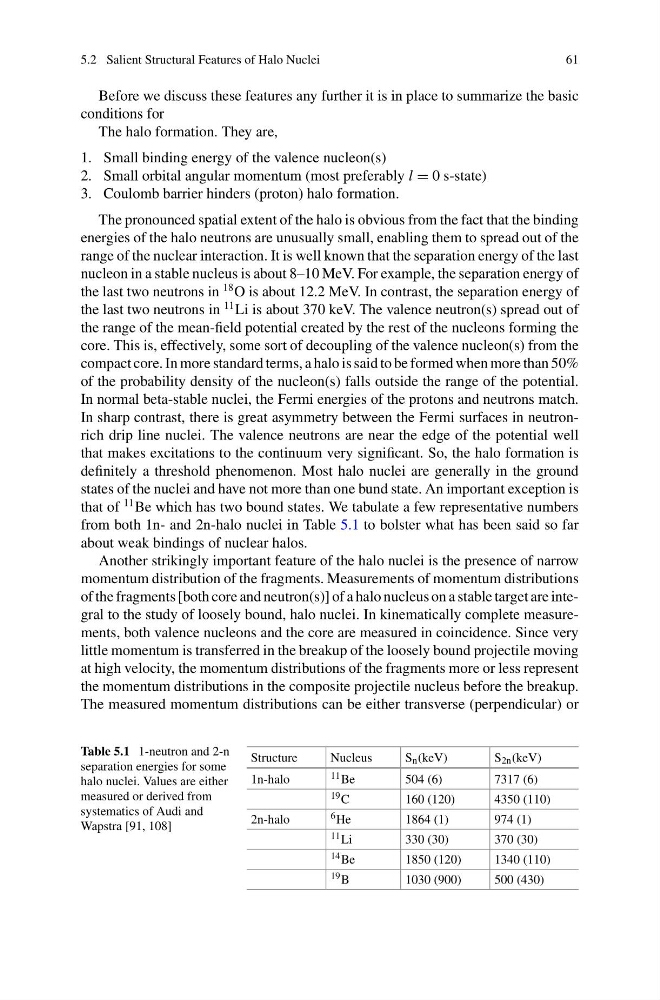
from both 1n- and 2n-halo nuclei in Table 5.1 to bolster what has been said so far
about weak bindings of nuclear halos.
Another strikingly important feature of the halo nuclei is the presence of narrow
momentum distribution of the fragments. Measurements of momentum distributions
of the fragments [both core and neutron(s)] of a halo nucleus on a stable target are integral to the study of loosely bound, halo nuclei. In kinematically complete measurements, both valence nucleons and the core are measured in coincidence. Since very
little momentum is transferred in the breakup of the loosely bound projectile moving
at high velocity, the momentum distributions of the fragments more or less represent
the momentum distributions in the composite projectile nucleus before the breakup.
The measured momentum distributions can be either transverse (perpendicular) or
Table 5.1 1-neutron and 2-n
separation energies for some
halo nuclei. Values are either
measured or derived from
systematics of Audi and
Wapstra [91, 108]
Structure
Nucleus
S n (keV)
S 2n (keV)
1n-halo
11 Be
504 (6)
7317 (6)
19 C
160 (120)
4350 (110)
2n-halo
6 He
1864 (1)
974 (1)
11 Li
330 (30)
370 (30)
14 Be
1850 (120)
1340 (110)
19 B
1030 (900)
500 (430)
61
Before we discuss these features any further it is in place to summarize the basic
conditions for
The halo formation. They are,
1. Small binding energy of the valence nucleon(s)
2. Small orbital angular momentum (most preferably l = 0 s-state)
3. Coulomb barrier hinders (proton) halo formation.
The pronounced spatial extent of the halo is obvious from the fact that the binding
energies of the halo neutrons are unusually small, enabling them to spread out of the
range of the nuclear interaction. It is well known that the separation energy of the last
nucleon in a stable nucleus is about 8–10 MeV. For example, the separation energy of
the last two neutrons in
18 O is about 12.2 MeV. In contrast, the separation energy of
the last two neutrons in
11 Li is about 370 keV. The valence neutron(s) spread out of
the range of the mean-field potential created by the rest of the nucleons forming the
core. This is, effectively, some sort of decoupling of the valence nucleon(s) from the
compact core. In more standard terms, a halo is said to be formed when more than 50%
of the probability density of the nucleon(s) falls outside the range of the potential.
In normal beta-stable nuclei, the Fermi energies of the protons and neutrons match.
In sharp contrast, there is great asymmetry between the Fermi surfaces in neutronrich drip line nuclei. The valence neutrons are near the edge of the potential well
that makes excitations to the continuum very significant. So, the halo formation is
definitely a threshold phenomenon. Most halo nuclei are generally in the ground
states of the nuclei and have not more than one bund state. An important exception is
that of
11 Be which has two bound states. We tabulate a few representative numbers
from both 1n- and 2n-halo nuclei in Table 5.1 to bolster what has been said so far
about weak bindings of nuclear halos.
Another strikingly important feature of the halo nuclei is the presence of narrow
momentum distribution of the fragments. Measurements of momentum distributions
of the fragments [both core and neutron(s)] of a halo nucleus on a stable target are integral to the study of loosely bound, halo nuclei. In kinematically complete measurements, both valence nucleons and the core are measured in coincidence. Since very
little momentum is transferred in the breakup of the loosely bound projectile moving
at high velocity, the momentum distributions of the fragments more or less represent
the momentum distributions in the composite projectile nucleus before the breakup.
The measured momentum distributions can be either transverse (perpendicular) or
Table 5.1 1-neutron and 2-n
separation energies for some
halo nuclei. Values are either
measured or derived from
systematics of Audi and
Wapstra [91, 108]
Structure
Nucleus
S n (keV)
S 2n (keV)
1n-halo
11 Be
504 (6)
7317 (6)
19 C
160 (120)
4350 (110)
2n-halo
6 He
1864 (1)
974 (1)
11 Li
330 (30)
370 (30)
14 Be
1850 (120)
1340 (110)
19 B
1030 (900)
500 (430)