

4.4 Derivation of Three-Body Scattering Amplitude …
49
(3/4)4π f k (
p 1 ) = 2(2π)
3 N
2 g(
p 1 +
k/2)g(
k + +
p 1 /2)
( p
2
1 + k 2 + +
p 1 .
k − m E)
+ 2(4π)
d q
g( q + +
p 1 /2)g(
p 1 + +
q/2) f k ( q)
( p
2
1 + q 2 + +
p 1 . q − m E)(H (3q 2 /4 − m E))(q 2 − k 2 − iε)
(4.19)
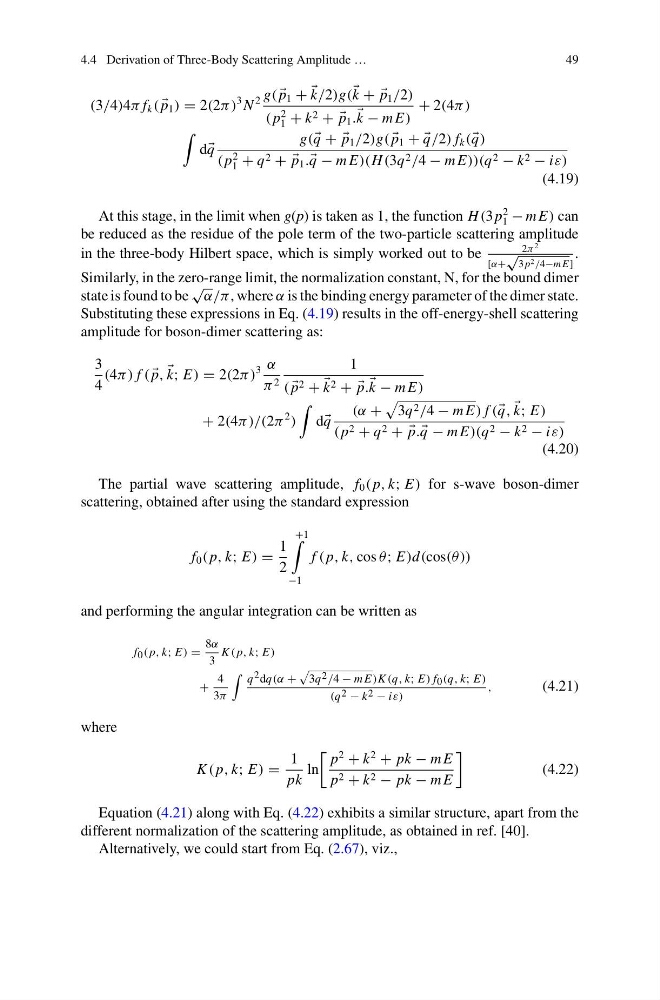
At this stage, in the limit when g(p) is taken as 1, the function H (3 p
2
1 − m E) can
be reduced as the residue of the pole term of the two-particle scattering amplitude
in the three-body Hilbert space, which is simply worked out to be
2π
2
[α+
√
3 p 2 /4−m E]
.
Similarly, in the zero-range limit, the normalization constant, N, for the bound dimer
state is found to be
√ α/π, where α is the binding energy parameter of the dimer state.
Substituting these expressions in Eq. (4.19) results in the off-energy-shell scattering
amplitude for boson-dimer scattering as:
3
4
(4π) f (
p,
k; E) = 2(2π)
3 α
π 2
1
(
p 2 +
k 2 + +
p.
k − m E)
+ 2(4π)/(2π
2
)
d q
(α +
3q 2 /4 − m E) f ( q,
k; E)
( p 2 + q 2 + +
p. q − m E)(q 2 − k 2 − iε)
(4.20)
The partial wave scattering amplitude, f 0 ( p, k; E) for s-wave boson-dimer
scattering, obtained after using the standard expression
f 0 ( p, k; E) =
1
2
+1
−1
f ( p, k, cos θ ; E)d(cos(θ ))
and performing the angular integration can be written as
f 0 ( p, k; E) =
8α
3
K ( p, k; E)
+
4
3π
q 2 dq(α +
3q 2 /4 − m E)K (q, k; E) f 0 (q, k; E)
(q 2 − k 2 − iε)
,
(4.21)
where
K ( p, k; E) =
1
pk
ln
p
2
+ k
2
+ pk − m E
p 2 + k 2 − pk − m E
(4.22)
Equation (4.21) along with Eq. (4.22) exhibits a similar structure, apart from the
different normalization of the scattering amplitude, as obtained in ref. [40].
Alternatively, we could start from Eq. (2.67), viz.,
49
(3/4)4π f k (
p 1 ) = 2(2π)
3 N
2 g(
p 1 +
k/2)g(
k + +
p 1 /2)
( p
2
1 + k 2 + +
p 1 .
k − m E)
+ 2(4π)
d q
g( q + +
p 1 /2)g(
p 1 + +
q/2) f k ( q)
( p
2
1 + q 2 + +
p 1 . q − m E)(H (3q 2 /4 − m E))(q 2 − k 2 − iε)
(4.19)
At this stage, in the limit when g(p) is taken as 1, the function H (3 p
2
1 − m E) can
be reduced as the residue of the pole term of the two-particle scattering amplitude
in the three-body Hilbert space, which is simply worked out to be
2π
2
[α+
√
3 p 2 /4−m E]
.
Similarly, in the zero-range limit, the normalization constant, N, for the bound dimer
state is found to be
√ α/π, where α is the binding energy parameter of the dimer state.
Substituting these expressions in Eq. (4.19) results in the off-energy-shell scattering
amplitude for boson-dimer scattering as:
3
4
(4π) f (
p,
k; E) = 2(2π)
3 α
π 2
1
(
p 2 +
k 2 + +
p.
k − m E)
+ 2(4π)/(2π
2
)
d q
(α +
3q 2 /4 − m E) f ( q,
k; E)
( p 2 + q 2 + +
p. q − m E)(q 2 − k 2 − iε)
(4.20)
The partial wave scattering amplitude, f 0 ( p, k; E) for s-wave boson-dimer
scattering, obtained after using the standard expression
f 0 ( p, k; E) =
1
2
+1
−1
f ( p, k, cos θ ; E)d(cos(θ ))
and performing the angular integration can be written as
f 0 ( p, k; E) =
8α
3
K ( p, k; E)
+
4
3π
q 2 dq(α +
3q 2 /4 − m E)K (q, k; E) f 0 (q, k; E)
(q 2 − k 2 − iε)
,
(4.21)
where
K ( p, k; E) =
1
pk
ln
p
2
+ k
2
+ pk − m E
p 2 + k 2 − pk − m E
(4.22)
Equation (4.21) along with Eq. (4.22) exhibits a similar structure, apart from the
different normalization of the scattering amplitude, as obtained in ref. [40].
Alternatively, we could start from Eq. (2.67), viz.,