

14
2 Scattering Theory of Three-Particle System
2.2 Three-Particle Hamiltonian, Channel Hamiltonian,
Matrix-Elements for the Green’s Functions
and T-Matrix
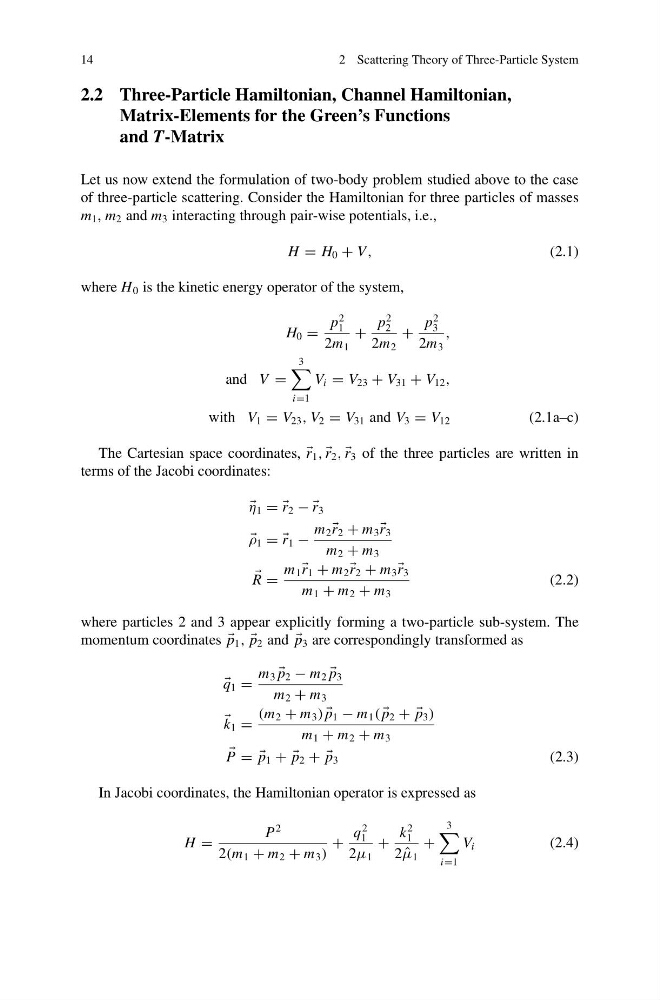
Let us now extend the formulation of two-body problem studied above to the case
of three-particle scattering. Consider the Hamiltonian for three particles of masses
m 1 , m 2 and m 3 interacting through pair-wise potentials, i.e.,
H = H 0 + V,
(2.1)
where H 0 is the kinetic energy operator of the system,
H 0 =
p
2
1
2m 1
+
p
2
2
2m 2
+
p
2
3
2m 3
,
and V =
3
i=1
V i = V 23 + V 31 + V 12 ,
with V 1 = V 23 , V 2 = V 31 and V 3 = V 12
(2.1a–c)
The Cartesian space coordinates,
r 1 ,
r 2 ,
r 3 of the three particles are written in
terms of the Jacobi coordinates:
η 1 = =
r 2 − −
r 3
ρ 1 = =
r 1 −
m 2
r 2 + m 3
r 3
m 2 + m 3
R =
m 1
r 1 + m 2
r 2 + m 3
r 3
m 1 + m 2 + m 3
(2.2)
where particles 2 and 3 appear explicitly forming a two-particle sub-system. The
momentum coordinates
p 1 ,
p 2 and
p 3 are correspondingly transformed as
q 1 =
m 3
p 2 − m 2
p 3
m 2 + m 3
k 1 =
(m 2 + m 3 )
p 1 − m 1 (
p 2 + +
p 3 )
m 1 + m 2 + m 3
P = =
p 1 + +
p 2 + +
p 3
(2.3)
In Jacobi coordinates, the Hamiltonian operator is expressed as
H =
P
2
2(m 1 + m 2 + m 3 )
+
q
2
1
2μ 1
+
k
2
1
2 ˆ
μ 1
+
3
i=1
V i
(2.4)
2 Scattering Theory of Three-Particle System
2.2 Three-Particle Hamiltonian, Channel Hamiltonian,
Matrix-Elements for the Green’s Functions
and T-Matrix
Let us now extend the formulation of two-body problem studied above to the case
of three-particle scattering. Consider the Hamiltonian for three particles of masses
m 1 , m 2 and m 3 interacting through pair-wise potentials, i.e.,
H = H 0 + V,
(2.1)
where H 0 is the kinetic energy operator of the system,
H 0 =
p
2
1
2m 1
+
p
2
2
2m 2
+
p
2
3
2m 3
,
and V =
3
i=1
V i = V 23 + V 31 + V 12 ,
with V 1 = V 23 , V 2 = V 31 and V 3 = V 12
(2.1a–c)
The Cartesian space coordinates,
r 1 ,
r 2 ,
r 3 of the three particles are written in
terms of the Jacobi coordinates:
η 1 = =
r 2 − −
r 3
ρ 1 = =
r 1 −
m 2
r 2 + m 3
r 3
m 2 + m 3
R =
m 1
r 1 + m 2
r 2 + m 3
r 3
m 1 + m 2 + m 3
(2.2)
where particles 2 and 3 appear explicitly forming a two-particle sub-system. The
momentum coordinates
p 1 ,
p 2 and
p 3 are correspondingly transformed as
q 1 =
m 3
p 2 − m 2
p 3
m 2 + m 3
k 1 =
(m 2 + m 3 )
p 1 − m 1 (
p 2 + +
p 3 )
m 1 + m 2 + m 3
P = =
p 1 + +
p 2 + +
p 3
(2.3)
In Jacobi coordinates, the Hamiltonian operator is expressed as
H =
P
2
2(m 1 + m 2 + m 3 )
+
q
2
1
2μ 1
+
k
2
1
2 ˆ
μ 1
+
3
i=1
V i
(2.4)