

106
6 Three-Body Approach to Structural Properties …
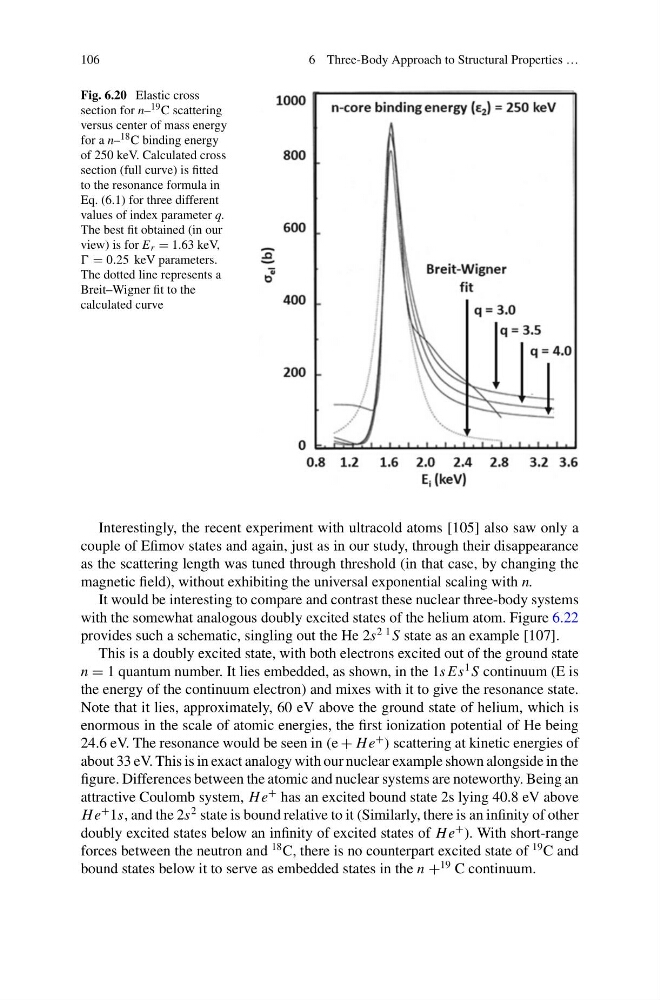
Fig. 6.20 Elastic cross
section for n– 19 C scattering
versus center of mass energy
for a n– 18 C binding energy
of 250 keV. Calculated cross
section (full curve) is fitted
to the resonance formula in
Eq. (6.1) for three different
values of index parameter q.
The best fit obtained (in our
view) is for E r = 1.63 keV,
= 0.25 keV parameters.
The dotted line represents a
Breit–Wigner fit to the
calculated curve
Interestingly, the recent experiment with ultracold atoms [105] also saw only a
couple of Efimov states and again, just as in our study, through their disappearance
as the scattering length was tuned through threshold (in that case, by changing the
magnetic field), without exhibiting the universal exponential scaling with n.
It would be interesting to compare and contrast these nuclear three-body systems
with the somewhat analogous doubly excited states of the helium atom. Figure 6.22
provides such a schematic, singling out the He 2s
2 1 S state as an example [107].
This is a doubly excited state, with both electrons excited out of the ground state
n = 1 quantum number. It lies embedded, as shown, in the 1s Es
1 S continuum (E is
the energy of the continuum electron) and mixes with it to give the resonance state.
Note that it lies, approximately, 60 eV above the ground state of helium, which is
enormous in the scale of atomic energies, the first ionization potential of He being
24.6 eV. The resonance would be seen in (e + He
+
) scattering at kinetic energies of
about 33 eV. This is in exact analogy with our nuclear example shown alongside in the
figure. Differences between the atomic and nuclear systems are noteworthy. Being an
attractive Coulomb system, He
+ has an excited bound state 2s lying 40.8 eV above
He
+ 1s, and the 2s
2 state is bound relative to it (Similarly, there is an infinity of other
doubly excited states below an infinity of excited states of He
+ ). With short-range
forces between the neutron and
18 C, there is no counterpart excited state of
19 C and
bound states below it to serve as embedded states in the n +
19 C continuum.
6 Three-Body Approach to Structural Properties …
Fig. 6.20 Elastic cross
section for n– 19 C scattering
versus center of mass energy
for a n– 18 C binding energy
of 250 keV. Calculated cross
section (full curve) is fitted
to the resonance formula in
Eq. (6.1) for three different
values of index parameter q.
The best fit obtained (in our
view) is for E r = 1.63 keV,
= 0.25 keV parameters.
The dotted line represents a
Breit–Wigner fit to the
calculated curve
Interestingly, the recent experiment with ultracold atoms [105] also saw only a
couple of Efimov states and again, just as in our study, through their disappearance
as the scattering length was tuned through threshold (in that case, by changing the
magnetic field), without exhibiting the universal exponential scaling with n.
It would be interesting to compare and contrast these nuclear three-body systems
with the somewhat analogous doubly excited states of the helium atom. Figure 6.22
provides such a schematic, singling out the He 2s
2 1 S state as an example [107].
This is a doubly excited state, with both electrons excited out of the ground state
n = 1 quantum number. It lies embedded, as shown, in the 1s Es
1 S continuum (E is
the energy of the continuum electron) and mixes with it to give the resonance state.
Note that it lies, approximately, 60 eV above the ground state of helium, which is
enormous in the scale of atomic energies, the first ionization potential of He being
24.6 eV. The resonance would be seen in (e + He
+
) scattering at kinetic energies of
about 33 eV. This is in exact analogy with our nuclear example shown alongside in the
figure. Differences between the atomic and nuclear systems are noteworthy. Being an
attractive Coulomb system, He
+ has an excited bound state 2s lying 40.8 eV above
He
+ 1s, and the 2s
2 state is bound relative to it (Similarly, there is an infinity of other
doubly excited states below an infinity of excited states of He
+ ). With short-range
forces between the neutron and
18 C, there is no counterpart excited state of
19 C and
bound states below it to serve as embedded states in the n +
19 C continuum.