

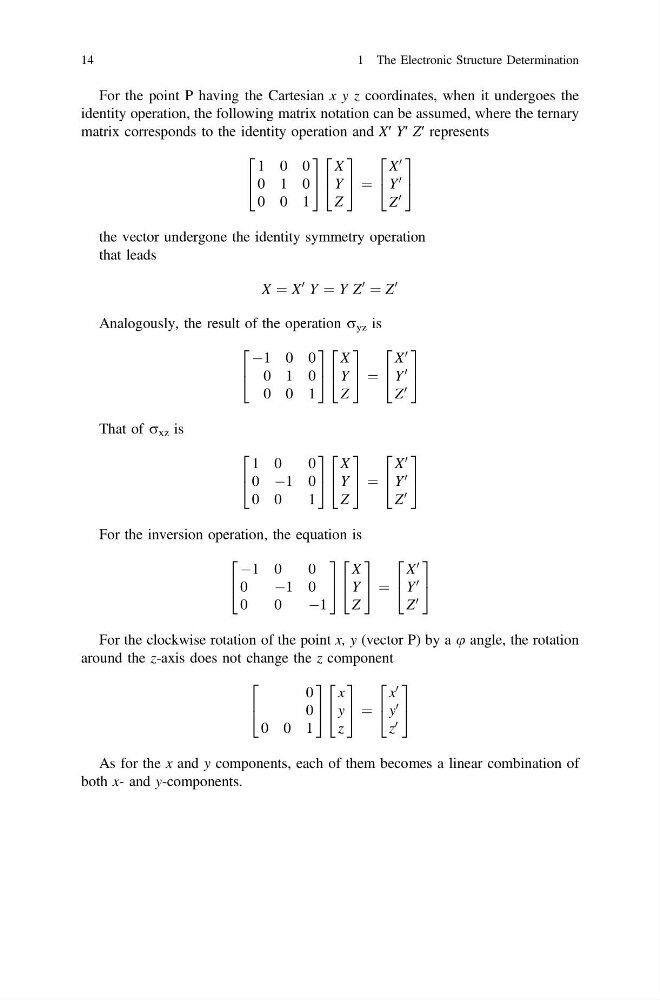
For the point P having the Cartesian x y z coordinates, when it undergoes the
identity operation, the following matrix notation can be assumed, where the ternary
matrix corresponds to the identity operation and X′ Y′ Z′ represents
1 0 0
0 1 0
0 0 1
2
4
3
5
X
Y
Z
2
4
3
5 ¼
X
0
Y
0
Z
0
2
4
3
5
the vector undergone the identity symmetry operation
that leads
X ¼ X
0 Y ¼ Y Z
0
¼ Z
0
Analogously, the result of the operation r yz is
À1 0 0
0 1 0
0 0 1
2
4
3
5
X
Y
Z
2
4
3
5 ¼
X
0
Y
0
Z
0
2
4
3
5
That of r xz is
1 0
0
0 À1 0
0 0
1
2
4
3
5
X
Y
Z
2
4
3
5 ¼
X
0
Y
0
Z
0
2
4
3
5
For the inversion operation, the equation is
À1 0
0
0
À1 0
0
0
À1
2
4
3
5
X
Y
Z
2
4
3
5 ¼
X
0
Y
0
Z
0
2
4
3
5
For the clockwise rotation of the point x, y (vector P) by a u angle, the rotation
around the z-axis does not change the z component
0
0
0 0 1
2
4
3
5
x
y
z
2
4
3
5 ¼
x
0
y
0
z
0
2
4
3
5
As for the x and y components, each of them becomes a linear combination of
both x- and y-components.
14
1 The Electronic Structure Determination
identity operation, the following matrix notation can be assumed, where the ternary
matrix corresponds to the identity operation and X′ Y′ Z′ represents
1 0 0
0 1 0
0 0 1
2
4
3
5
X
Y
Z
2
4
3
5 ¼
X
0
Y
0
Z
0
2
4
3
5
the vector undergone the identity symmetry operation
that leads
X ¼ X
0 Y ¼ Y Z
0
¼ Z
0
Analogously, the result of the operation r yz is
À1 0 0
0 1 0
0 0 1
2
4
3
5
X
Y
Z
2
4
3
5 ¼
X
0
Y
0
Z
0
2
4
3
5
That of r xz is
1 0
0
0 À1 0
0 0
1
2
4
3
5
X
Y
Z
2
4
3
5 ¼
X
0
Y
0
Z
0
2
4
3
5
For the inversion operation, the equation is
À1 0
0
0
À1 0
0
0
À1
2
4
3
5
X
Y
Z
2
4
3
5 ¼
X
0
Y
0
Z
0
2
4
3
5
For the clockwise rotation of the point x, y (vector P) by a u angle, the rotation
around the z-axis does not change the z component
0
0
0 0 1
2
4
3
5
x
y
z
2
4
3
5 ¼
x
0
y
0
z
0
2
4
3
5
As for the x and y components, each of them becomes a linear combination of
both x- and y-components.
14
1 The Electronic Structure Determination