

The elements in one group undergo rules as if they were numbers. The following
paragraphs describe the properties of the group elements.
1.5.1 Rules for the Elements Which Constitute a Group
1. The product of groups elements must still produce a group element.
For product, it is intended the combination of two operations, performed in a
given order.
e.g., C 2 x r v or r v x C 2
2. It is mandatory the existence of one operation commuting with the others and
leaving them unchanged. This is called identity element
E Â r 2 ¼ r 2 Â E ¼ r 2
3. The associative property must be applicable
AB(C) = A(BC)
4. Each element must have a reciprocal among the group elements. For each
symmetry operation, there will be another one which anneals the first. C 3 has C
2
3
as reciprocal element; thus, C 3 x C
2
3 = 1.
1.5.2 Group Multiplication Tables
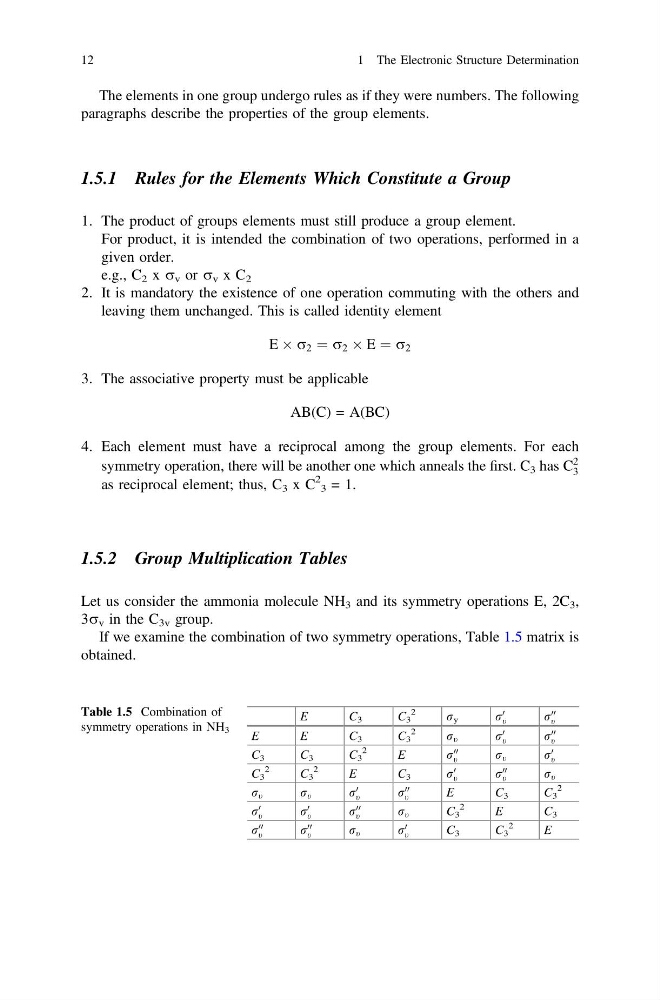
Let us consider the ammonia molecule NH 3 and its symmetry operations E, 2C 3 ,
3r v in the C 3v group.
If we examine the combination of two symmetry operations, Table 1.5 matrix is
obtained.
Table 1.5 Combination of
symmetry operations in NH 3
E
C 3
C 3
2
r y
r
0
t
r
00
t
E
E
C 3
C 3
2
r t
r
0
t
r
00
t
C 3
C 3
C 3
2
E
r
00
t
r t
r
0
t
C 3
2
C 3
2
E
C 3
r
0
t
r
00
t
r t
r t
r t
r
0
t
r
00
t
E
C 3
C 3
2
r
0
t
r
0
t
r
00
t
r t
C 3
2
E
C 3
r
00
t
r
00
t
r t
r
0
t
C 3
C 3
2
E
12
1 The Electronic Structure Determination
paragraphs describe the properties of the group elements.
1.5.1 Rules for the Elements Which Constitute a Group
1. The product of groups elements must still produce a group element.
For product, it is intended the combination of two operations, performed in a
given order.
e.g., C 2 x r v or r v x C 2
2. It is mandatory the existence of one operation commuting with the others and
leaving them unchanged. This is called identity element
E Â r 2 ¼ r 2 Â E ¼ r 2
3. The associative property must be applicable
AB(C) = A(BC)
4. Each element must have a reciprocal among the group elements. For each
symmetry operation, there will be another one which anneals the first. C 3 has C
2
3
as reciprocal element; thus, C 3 x C
2
3 = 1.
1.5.2 Group Multiplication Tables
Let us consider the ammonia molecule NH 3 and its symmetry operations E, 2C 3 ,
3r v in the C 3v group.
If we examine the combination of two symmetry operations, Table 1.5 matrix is
obtained.
Table 1.5 Combination of
symmetry operations in NH 3
E
C 3
C 3
2
r y
r
0
t
r
00
t
E
E
C 3
C 3
2
r t
r
0
t
r
00
t
C 3
C 3
C 3
2
E
r
00
t
r t
r
0
t
C 3
2
C 3
2
E
C 3
r
0
t
r
00
t
r t
r t
r t
r
0
t
r
00
t
E
C 3
C 3
2
r
0
t
r
0
t
r
00
t
r t
C 3
2
E
C 3
r
00
t
r
00
t
r t
r
0
t
C 3
C 3
2
E
12
1 The Electronic Structure Determination