

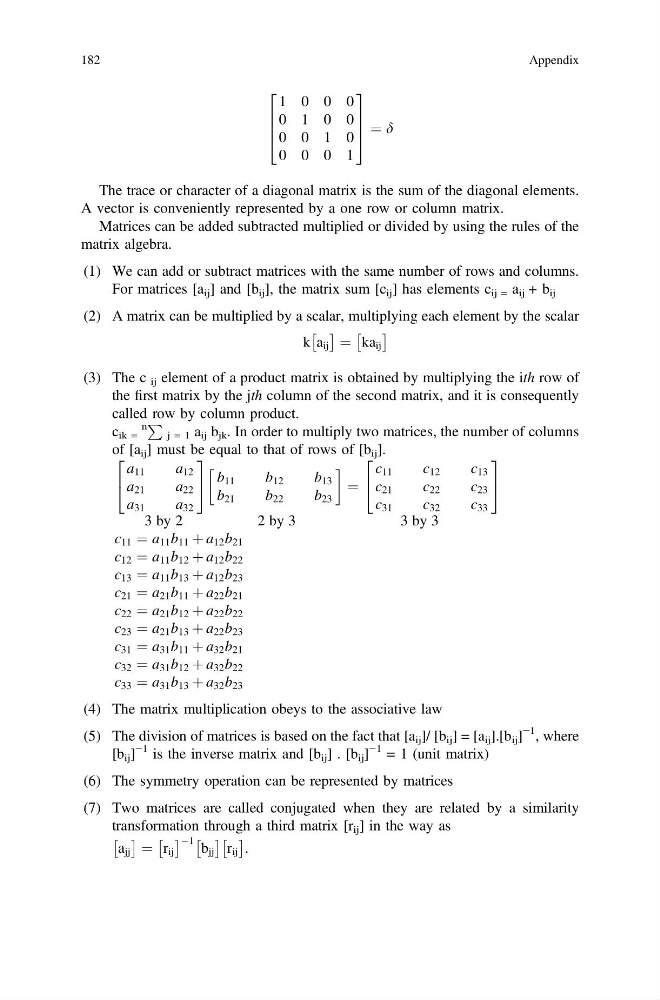
1 0 0 0
0 1 0 0
0 0 1 0
0 0 0 1
2
6
6
4
3
7
7
5 ¼ d
The trace or character of a diagonal matrix is the sum of the diagonal elements.
A vector is conveniently represented by a one row or column matrix.
Matrices can be added subtracted multiplied or divided by using the rules of the
matrix algebra.
(1) We can add or subtract matrices with the same number of rows and columns.
For matrices [a ij ] and [b ij ], the matrix sum [c ij ] has elements c ij = a ij + b ij
(2) A matrix can be multiplied by a scalar, multiplying each element by the scalar
k a ij
 à ¼ ka ij
 Ã
(3) The c ij element of a product matrix is obtained by multiplying the ith row of
the first matrix by the jth column of the second matrix, and it is consequently
called row by column product.
c ik =
n P
j = 1 a ij b jk . In order to multiply two matrices, the number of columns
of [a ij ] must be equal to that of rows of [b ij ].
a 11
a 12
a 21
a 22
a 31
a 32
2
4
3
5 b 11
b 12
b 13
b 21
b 22
b 23
!
¼
c 11
c 12
c 13
c 21
c 22
c 23
c 31
c 32
c 33
2
4
3
5
3 by 2
2 by 3
3 by 3
c 11 ¼ a 11 b 11 þ a 12 b 21
c 12 ¼ a 11 b 12 þ a 12 b 22
c 13 ¼ a 11 b 13 þ a 12 b 23
c 21 ¼ a 21 b 11 þ a 22 b 21
c 22 ¼ a 21 b 12 þ a 22 b 22
c 23 ¼ a 21 b 13 þ a 22 b 23
c 31 ¼ a 31 b 11 þ a 32 b 21
c 32 ¼ a 31 b 12 þ a 32 b 22
c 33 ¼ a 31 b 13 þ a 32 b 23
(4) The matrix multiplication obeys to the associative law
(5) The division of matrices is based on the fact that [a ij ]/ [b ij ] = [a ij ].[b ij ]
−1 , where
[b ij ]
−1 is the inverse matrix and [b ij ] . [b ij ]
−1 = 1 (unit matrix)
(6) The symmetry operation can be represented by matrices
(7) Two matrices are called conjugated when they are related by a similarity
transformation through a third matrix [r ij ] in the way as
a jj
 à ¼ r ij
 à À1 b jj
 Ã
r ij
 Ã
.
182
Appendix
0 1 0 0
0 0 1 0
0 0 0 1
2
6
6
4
3
7
7
5 ¼ d
The trace or character of a diagonal matrix is the sum of the diagonal elements.
A vector is conveniently represented by a one row or column matrix.
Matrices can be added subtracted multiplied or divided by using the rules of the
matrix algebra.
(1) We can add or subtract matrices with the same number of rows and columns.
For matrices [a ij ] and [b ij ], the matrix sum [c ij ] has elements c ij = a ij + b ij
(2) A matrix can be multiplied by a scalar, multiplying each element by the scalar
k a ij
 à ¼ ka ij
 Ã
(3) The c ij element of a product matrix is obtained by multiplying the ith row of
the first matrix by the jth column of the second matrix, and it is consequently
called row by column product.
c ik =
n P
j = 1 a ij b jk . In order to multiply two matrices, the number of columns
of [a ij ] must be equal to that of rows of [b ij ].
a 11
a 12
a 21
a 22
a 31
a 32
2
4
3
5 b 11
b 12
b 13
b 21
b 22
b 23
!
¼
c 11
c 12
c 13
c 21
c 22
c 23
c 31
c 32
c 33
2
4
3
5
3 by 2
2 by 3
3 by 3
c 11 ¼ a 11 b 11 þ a 12 b 21
c 12 ¼ a 11 b 12 þ a 12 b 22
c 13 ¼ a 11 b 13 þ a 12 b 23
c 21 ¼ a 21 b 11 þ a 22 b 21
c 22 ¼ a 21 b 12 þ a 22 b 22
c 23 ¼ a 21 b 13 þ a 22 b 23
c 31 ¼ a 31 b 11 þ a 32 b 21
c 32 ¼ a 31 b 12 þ a 32 b 22
c 33 ¼ a 31 b 13 þ a 32 b 23
(4) The matrix multiplication obeys to the associative law
(5) The division of matrices is based on the fact that [a ij ]/ [b ij ] = [a ij ].[b ij ]
−1 , where
[b ij ]
−1 is the inverse matrix and [b ij ] . [b ij ]
−1 = 1 (unit matrix)
(6) The symmetry operation can be represented by matrices
(7) Two matrices are called conjugated when they are related by a similarity
transformation through a third matrix [r ij ] in the way as
a jj
 à ¼ r ij
 à À1 b jj
 Ã
r ij
 Ã
.
182
Appendix