

3250 3300
Magnetic field / G
A
d)
g iso
g iso
g 1 P[I]
g 1 P[I]
P[I]
P[I]
g 1 P[II]
P[II]
P[II]
C-rad.
C-rad.
g 1 P[I-II]
g 1 P[II]
c)
b)
Ti
3+
Ti
3+
Ti
3+
interfacial
anatase
g- 1.979
g ┴ =1.989
Ti
3+ interfacial
anatase
g- 1.979
g ┴ =1.989
a)
d)
Exp.
Exp.
Sim.
Sim.
c)
b)
a)
B
C
Magnetic field / G
Magnetic field / G
3350 3400 3450
3250 3300 3350 3400 3450 3250
3300
3350
3400
i)
ii)
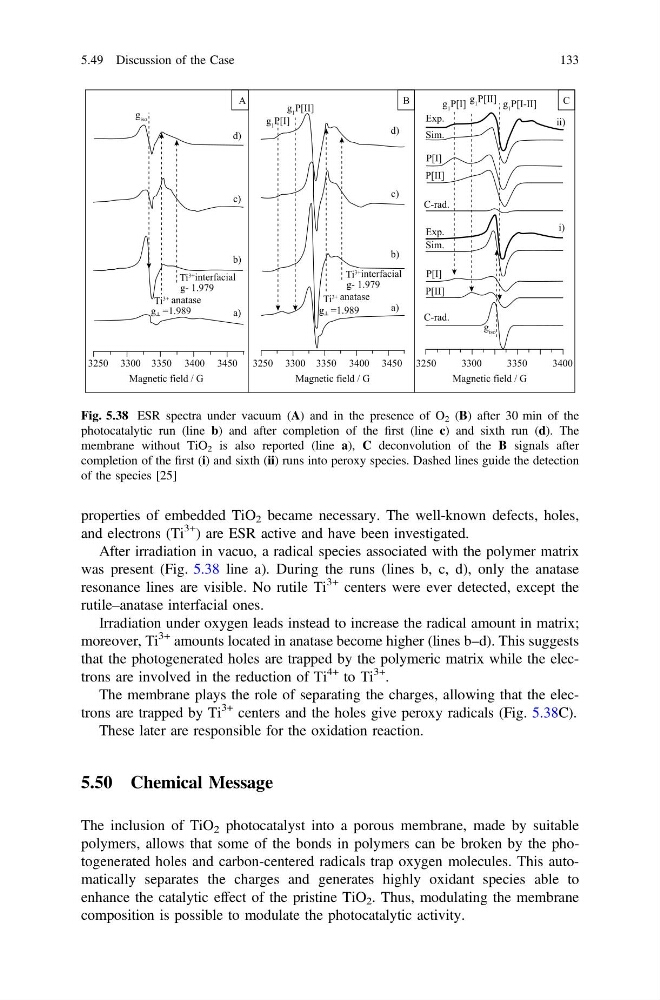
Fig. 5.38 ESR spectra under vacuum (A) and in the presence of O 2 (B) after 30 min of the
photocatalytic run (line b) and after completion of the first (line c) and sixth run (d). The
membrane without TiO 2 is also reported (line a), C deconvolution of the B signals after
completion of the first (i) and sixth (ii) runs into peroxy species. Dashed lines guide the detection
of the species [25]
properties of embedded TiO 2 became necessary. The well-known defects, holes,
and electrons (Ti
3+ ) are ESR active and have been investigated.
After irradiation in vacuo, a radical species associated with the polymer matrix
was present (Fig. 5.38 line a). During the runs (lines b, c, d), only the anatase
resonance lines are visible. No rutile Ti
3+ centers were ever detected, except the
rutile–anatase interfacial ones.
Irradiation under oxygen leads instead to increase the radical amount in matrix;
moreover, Ti
3+ amounts located in anatase become higher (lines b–d). This suggests
that the photogenerated holes are trapped by the polymeric matrix while the electrons are involved in the reduction of Ti
4+ to Ti
3+ .
The membrane plays the role of separating the charges, allowing that the electrons are trapped by Ti
3+ centers and the holes give peroxy radicals (Fig. 5.38C).
These later are responsible for the oxidation reaction.
5.50 Chemical Message
The inclusion of TiO 2 photocatalyst into a porous membrane, made by suitable
polymers, allows that some of the bonds in polymers can be broken by the photogenerated holes and carbon-centered radicals trap oxygen molecules. This automatically separates the charges and generates highly oxidant species able to
enhance the catalytic effect of the pristine TiO 2 . Thus, modulating the membrane
composition is possible to modulate the photocatalytic activity.
5.49 Discussion of the Case
133
Magnetic field / G
A
d)
g iso
g iso
g 1 P[I]
g 1 P[I]
P[I]
P[I]
g 1 P[II]
P[II]
P[II]
C-rad.
C-rad.
g 1 P[I-II]
g 1 P[II]
c)
b)
Ti
3+
Ti
3+
Ti
3+
interfacial
anatase
g- 1.979
g ┴ =1.989
Ti
3+ interfacial
anatase
g- 1.979
g ┴ =1.989
a)
d)
Exp.
Exp.
Sim.
Sim.
c)
b)
a)
B
C
Magnetic field / G
Magnetic field / G
3350 3400 3450
3250 3300 3350 3400 3450 3250
3300
3350
3400
i)
ii)
Fig. 5.38 ESR spectra under vacuum (A) and in the presence of O 2 (B) after 30 min of the
photocatalytic run (line b) and after completion of the first (line c) and sixth run (d). The
membrane without TiO 2 is also reported (line a), C deconvolution of the B signals after
completion of the first (i) and sixth (ii) runs into peroxy species. Dashed lines guide the detection
of the species [25]
properties of embedded TiO 2 became necessary. The well-known defects, holes,
and electrons (Ti
3+ ) are ESR active and have been investigated.
After irradiation in vacuo, a radical species associated with the polymer matrix
was present (Fig. 5.38 line a). During the runs (lines b, c, d), only the anatase
resonance lines are visible. No rutile Ti
3+ centers were ever detected, except the
rutile–anatase interfacial ones.
Irradiation under oxygen leads instead to increase the radical amount in matrix;
moreover, Ti
3+ amounts located in anatase become higher (lines b–d). This suggests
that the photogenerated holes are trapped by the polymeric matrix while the electrons are involved in the reduction of Ti
4+ to Ti
3+ .
The membrane plays the role of separating the charges, allowing that the electrons are trapped by Ti
3+ centers and the holes give peroxy radicals (Fig. 5.38C).
These later are responsible for the oxidation reaction.
5.50 Chemical Message
The inclusion of TiO 2 photocatalyst into a porous membrane, made by suitable
polymers, allows that some of the bonds in polymers can be broken by the photogenerated holes and carbon-centered radicals trap oxygen molecules. This automatically separates the charges and generates highly oxidant species able to
enhance the catalytic effect of the pristine TiO 2 . Thus, modulating the membrane
composition is possible to modulate the photocatalytic activity.
5.49 Discussion of the Case
133