

5.47 Chemical Message
The conclusion of the literature that preceded this topic was that the photocatalytic
activity depends on the rate of charge recombination within the semiconductor
oxide. Instead, our results demonstrate that there is strong attitude of the different
facets to give rise to defects, depending on the atom location. The recombination
rate is more properly depending on the shape of the facet. Thus, the crystal symmetry, once again, decides the activity of the catalysts. The preparation of innovative photocatalysts could realistically go through the orientation of the active
facets toward the fluid–solid interphase.
5.48 The Case of Charge Separation in TiO 2 Embedded
in Membrane
The use of TiO 2 requires, either in liquid or in gas phase reactions, to provide an
easy recovery of the catalyst [25]. Due to this reason, the powder oxide is not the
most suitable material for industrial applications. Different matrices have been
suggested for it, inorganic or polymeric, being careful that the host was able to fully
retain the catalyst allowing complete passage of products and light.
Among the innovative matrices, an important role is played by polymeric
membranes constituted by acrylates and metacrylates, copolymerized with other
monomers, and embedding TiO 2 by a grafting process. These membranes are
highly porous and permeable, allowing good interaction with the UV radiation and
the reactants, also having good mechanical properties.
The present example shows not only that the inclusion of TiO 2 into a polymeric
membrane (TPM) allows easy manipulation of the catalyst, but also that the catalyst
is assisted by the membrane and by O 2 in keeping holes separated from the
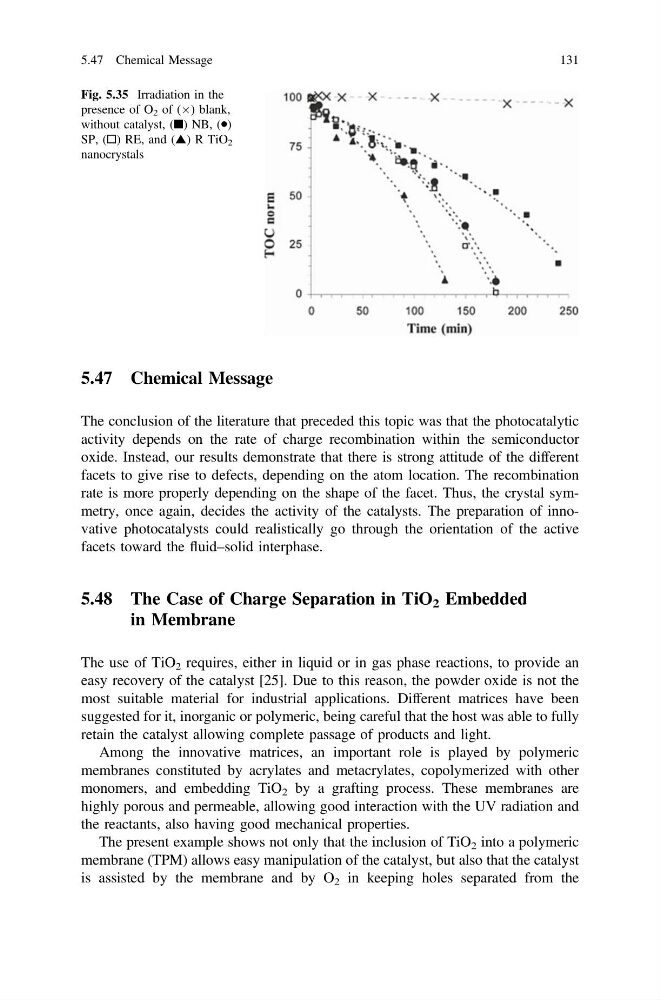
Fig. 5.35 Irradiation in the
presence of O 2 of (Â) blank,
without catalyst, (■) NB, (⚫)
SP, (□) RE, and (▲) R TiO 2
nanocrystals
5.47 Chemical Message
131
The conclusion of the literature that preceded this topic was that the photocatalytic
activity depends on the rate of charge recombination within the semiconductor
oxide. Instead, our results demonstrate that there is strong attitude of the different
facets to give rise to defects, depending on the atom location. The recombination
rate is more properly depending on the shape of the facet. Thus, the crystal symmetry, once again, decides the activity of the catalysts. The preparation of innovative photocatalysts could realistically go through the orientation of the active
facets toward the fluid–solid interphase.
5.48 The Case of Charge Separation in TiO 2 Embedded
in Membrane
The use of TiO 2 requires, either in liquid or in gas phase reactions, to provide an
easy recovery of the catalyst [25]. Due to this reason, the powder oxide is not the
most suitable material for industrial applications. Different matrices have been
suggested for it, inorganic or polymeric, being careful that the host was able to fully
retain the catalyst allowing complete passage of products and light.
Among the innovative matrices, an important role is played by polymeric
membranes constituted by acrylates and metacrylates, copolymerized with other
monomers, and embedding TiO 2 by a grafting process. These membranes are
highly porous and permeable, allowing good interaction with the UV radiation and
the reactants, also having good mechanical properties.
The present example shows not only that the inclusion of TiO 2 into a polymeric
membrane (TPM) allows easy manipulation of the catalyst, but also that the catalyst
is assisted by the membrane and by O 2 in keeping holes separated from the
Fig. 5.35 Irradiation in the
presence of O 2 of (Â) blank,
without catalyst, (■) NB, (⚫)
SP, (□) RE, and (▲) R TiO 2
nanocrystals
5.47 Chemical Message
131