

5.39 The Case of Sn-Doped Solgel Silica Glasses
Silica materials have been extensively studied as for the possibility of designing the
change of their light-induced refractive index [21]. This aims to prepare glasses
with different optical properties, to be used in optical fibers. Photorefractive
properties are generally associated with the defects related to silica-doped, typically
germanium-doped, that means three-coordinated Ge centers with one unpaired
electron in an sp
3 orbital. It is intended that the dopant element must be homogeneously dispersed in silica and located in substitutional position. Looking for
dopants different from Ge, a good candidate seemed to be tin, Sn basing on the
large increase in refractive index it showed co-doped with Ge. The solgel method of
synthesis has been used, as it allows to obtain Sn-doped silica glasses by a
low-temperature method, from the corresponding element molecular precursors
(alkoxides); instead, high temperature or melting procedure of the related oxides
leads to segregation of the dopant element. The optical absorption properties of
glasses have been studied by UV–visible absorption spectroscopy; the location of
Sn atoms has been checked by electron spin resonance.
Figure 5.29 shows the silica glasses with different Sn contents.
5.40 Discussion of the Case
Figure 5.30 shows the ESR spectra of Sn-doped silica glasses, after X-ray irradiation able to generate dangling bonds in the glass structure. ESR spectra show the
signals of the E
0 Sn centers that are three-coordinated Sn centers with one unpaired
electron in an sp
3 orbital. These have orthorhombic symmetry field with
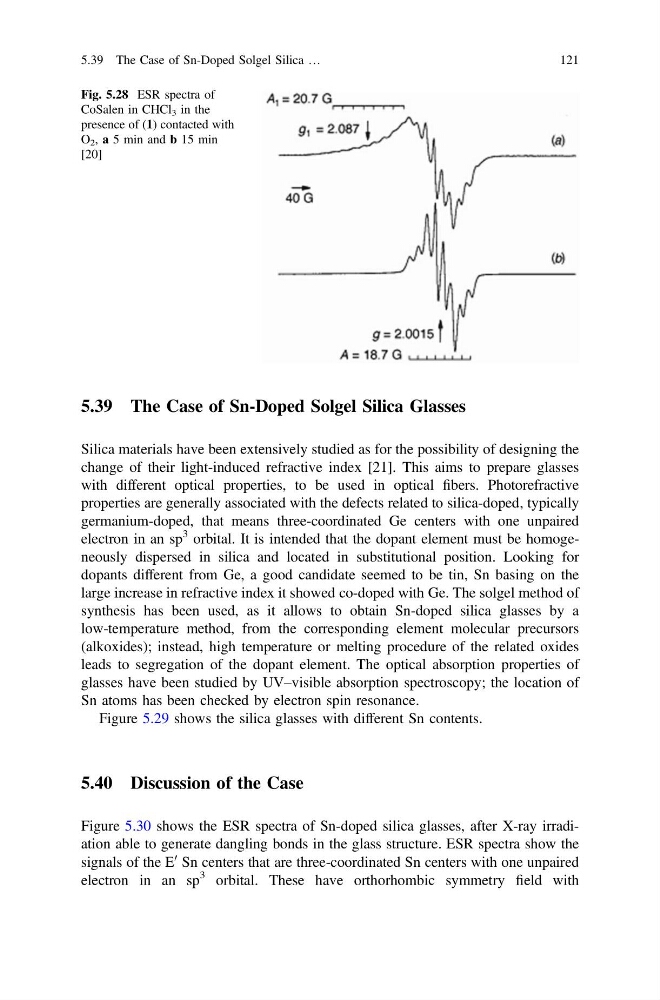
Fig. 5.28 ESR spectra of
CoSalen in CHCl 3 in the
presence of (1) contacted with
O 2 , a 5 min and b 15 min
[20]
5.39 The Case of Sn-Doped Solgel Silica …
121
Silica materials have been extensively studied as for the possibility of designing the
change of their light-induced refractive index [21]. This aims to prepare glasses
with different optical properties, to be used in optical fibers. Photorefractive
properties are generally associated with the defects related to silica-doped, typically
germanium-doped, that means three-coordinated Ge centers with one unpaired
electron in an sp
3 orbital. It is intended that the dopant element must be homogeneously dispersed in silica and located in substitutional position. Looking for
dopants different from Ge, a good candidate seemed to be tin, Sn basing on the
large increase in refractive index it showed co-doped with Ge. The solgel method of
synthesis has been used, as it allows to obtain Sn-doped silica glasses by a
low-temperature method, from the corresponding element molecular precursors
(alkoxides); instead, high temperature or melting procedure of the related oxides
leads to segregation of the dopant element. The optical absorption properties of
glasses have been studied by UV–visible absorption spectroscopy; the location of
Sn atoms has been checked by electron spin resonance.
Figure 5.29 shows the silica glasses with different Sn contents.
5.40 Discussion of the Case
Figure 5.30 shows the ESR spectra of Sn-doped silica glasses, after X-ray irradiation able to generate dangling bonds in the glass structure. ESR spectra show the
signals of the E
0 Sn centers that are three-coordinated Sn centers with one unpaired
electron in an sp
3 orbital. These have orthorhombic symmetry field with
Fig. 5.28 ESR spectra of
CoSalen in CHCl 3 in the
presence of (1) contacted with
O 2 , a 5 min and b 15 min
[20]
5.39 The Case of Sn-Doped Solgel Silica …
121