

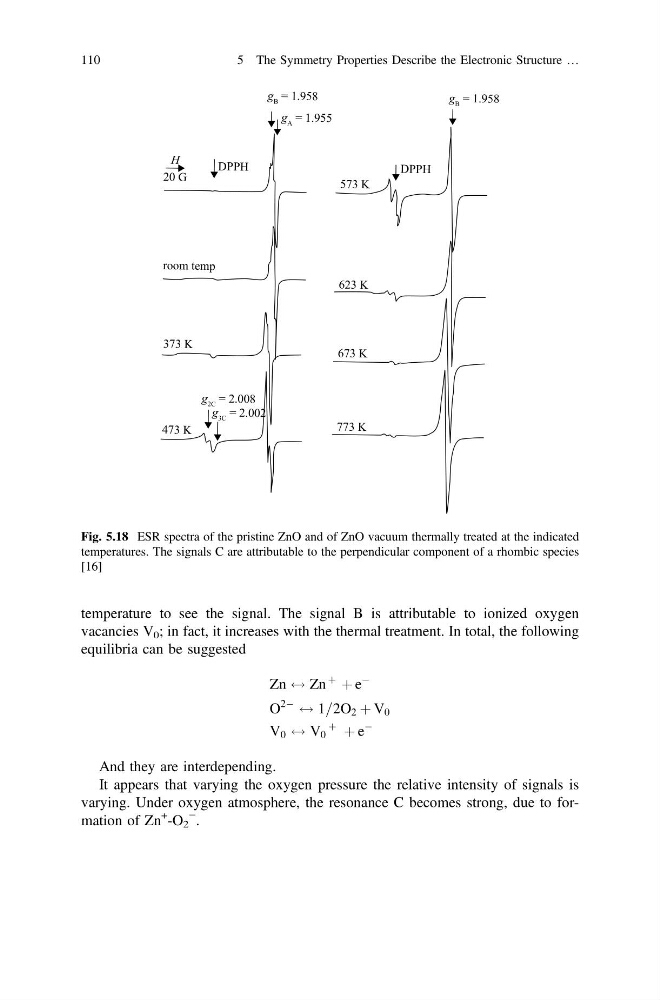
temperature to see the signal. The signal B is attributable to ionized oxygen
vacancies V 0 ; in fact, it increases with the thermal treatment. In total, the following
equilibria can be suggested
Zn $ Zn
þ
þ e
À
O
2À
$ 1=2O 2 þ V 0
V 0 $ V 0
þ
þ e
À
And they are interdepending.
It appears that varying the oxygen pressure the relative intensity of signals is
varying. Under oxygen atmosphere, the resonance C becomes strong, due to formation of Zn
+
-O 2
− .
g B = 1.958
g B = 1.958
g 2C = 2.008
g 3C = 2.002
g A = 1.955
H
20 G
DPPH
DPPH
623 K
373 K
473 K
573 K
room temp
673 K
773 K
Fig. 5.18 ESR spectra of the pristine ZnO and of ZnO vacuum thermally treated at the indicated
temperatures. The signals C are attributable to the perpendicular component of a rhombic species
[16]
110
5 The Symmetry Properties Describe the Electronic Structure …
vacancies V 0 ; in fact, it increases with the thermal treatment. In total, the following
equilibria can be suggested
Zn $ Zn
þ
þ e
À
O
2À
$ 1=2O 2 þ V 0
V 0 $ V 0
þ
þ e
À
And they are interdepending.
It appears that varying the oxygen pressure the relative intensity of signals is
varying. Under oxygen atmosphere, the resonance C becomes strong, due to formation of Zn
+
-O 2
− .
g B = 1.958
g B = 1.958
g 2C = 2.008
g 3C = 2.002
g A = 1.955
H
20 G
DPPH
DPPH
623 K
373 K
473 K
573 K
room temp
673 K
773 K
Fig. 5.18 ESR spectra of the pristine ZnO and of ZnO vacuum thermally treated at the indicated
temperatures. The signals C are attributable to the perpendicular component of a rhombic species
[16]
110
5 The Symmetry Properties Describe the Electronic Structure …