

5.14.4 Interaction with Carbon Monoxide and Oxygen
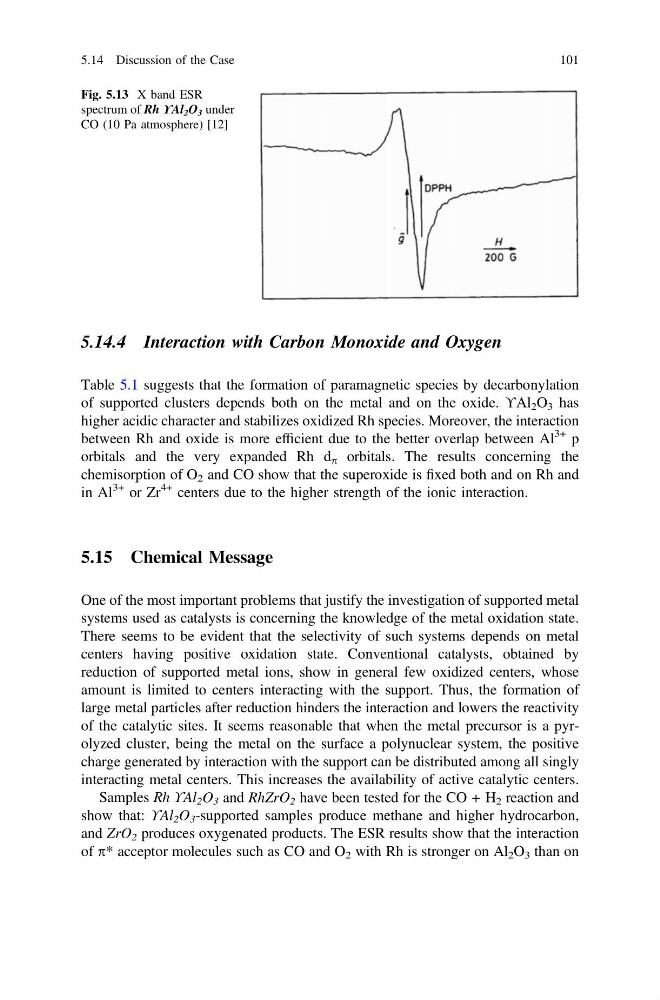
Table 5.1 suggests that the formation of paramagnetic species by decarbonylation
of supported clusters depends both on the metal and on the oxide. ϒAl 2 O 3 has
higher acidic character and stabilizes oxidized Rh species. Moreover, the interaction
between Rh and oxide is more efficient due to the better overlap between Al
3+ p
orbitals and the very expanded Rh d p orbitals. The results concerning the
chemisorption of O 2 and CO show that the superoxide is fixed both and on Rh and
in Al
3+ or Zr
4+ centers due to the higher strength of the ionic interaction.
5.15 Chemical Message
One of the most important problems that justify the investigation of supported metal
systems used as catalysts is concerning the knowledge of the metal oxidation state.
There seems to be evident that the selectivity of such systems depends on metal
centers having positive oxidation state. Conventional catalysts, obtained by
reduction of supported metal ions, show in general few oxidized centers, whose
amount is limited to centers interacting with the support. Thus, the formation of
large metal particles after reduction hinders the interaction and lowers the reactivity
of the catalytic sites. It seems reasonable that when the metal precursor is a pyrolyzed cluster, being the metal on the surface a polynuclear system, the positive
charge generated by interaction with the support can be distributed among all singly
interacting metal centers. This increases the availability of active catalytic centers.
Samples Rh ϒAl 2 O 3 and RhZrO 2 have been tested for the CO + H 2 reaction and
show that: ϒAl 2 O 3 -supported samples produce methane and higher hydrocarbon,
and ZrO 2 produces oxygenated products. The ESR results show that the interaction
of p* acceptor molecules such as CO and O 2 with Rh is stronger on Al 2 O 3 than on
Fig. 5.13 X band ESR
spectrum of Rh ϒAl 2 O 3 under
CO (10 Pa atmosphere) [12]
5.14 Discussion of the Case
101
Table 5.1 suggests that the formation of paramagnetic species by decarbonylation
of supported clusters depends both on the metal and on the oxide. ϒAl 2 O 3 has
higher acidic character and stabilizes oxidized Rh species. Moreover, the interaction
between Rh and oxide is more efficient due to the better overlap between Al
3+ p
orbitals and the very expanded Rh d p orbitals. The results concerning the
chemisorption of O 2 and CO show that the superoxide is fixed both and on Rh and
in Al
3+ or Zr
4+ centers due to the higher strength of the ionic interaction.
5.15 Chemical Message
One of the most important problems that justify the investigation of supported metal
systems used as catalysts is concerning the knowledge of the metal oxidation state.
There seems to be evident that the selectivity of such systems depends on metal
centers having positive oxidation state. Conventional catalysts, obtained by
reduction of supported metal ions, show in general few oxidized centers, whose
amount is limited to centers interacting with the support. Thus, the formation of
large metal particles after reduction hinders the interaction and lowers the reactivity
of the catalytic sites. It seems reasonable that when the metal precursor is a pyrolyzed cluster, being the metal on the surface a polynuclear system, the positive
charge generated by interaction with the support can be distributed among all singly
interacting metal centers. This increases the availability of active catalytic centers.
Samples Rh ϒAl 2 O 3 and RhZrO 2 have been tested for the CO + H 2 reaction and
show that: ϒAl 2 O 3 -supported samples produce methane and higher hydrocarbon,
and ZrO 2 produces oxygenated products. The ESR results show that the interaction
of p* acceptor molecules such as CO and O 2 with Rh is stronger on Al 2 O 3 than on
Fig. 5.13 X band ESR
spectrum of Rh ϒAl 2 O 3 under
CO (10 Pa atmosphere) [12]
5.14 Discussion of the Case
101