

5.7 The Case of Phthalocyaninato Co(II)
This Co(II) coordination compound has been widely studied due to its structural
similarity with the porphyrin complexes, which in turn are responsible for fundamental interaction with oxygen in human life [9, 10]. As it concerns the reaction
with oxygen, the most fascinating aspect stays in the electronic distribution between
O 2 and Co(II): in fact, it can be modeled as Co(II)-O 2 , with the unpaired electron on
the cobalt, or as Co(III)-O 2
− with the electron on the oxygen, to stabilize the
superoxide anion. The decision between the two options is an old scientific problem, and it begun since from the pristine work of L. Malatesta on cobalt amino
derivatives. The scientist suggested the following possibilities
CoðIIIÞ-O 2 -CoðIVÞ
½
5 þ
CoðIIIÞ-O 2 -CoðIIIÞ
½
5 þ
while he could not demonstrate on where the unpaired electron was located.
In general, this query is very important because porphyrin and porphyrin-like
compounds are able to reversibly adsorb oxygen and the electron transfer process is
a knowledge requirement.
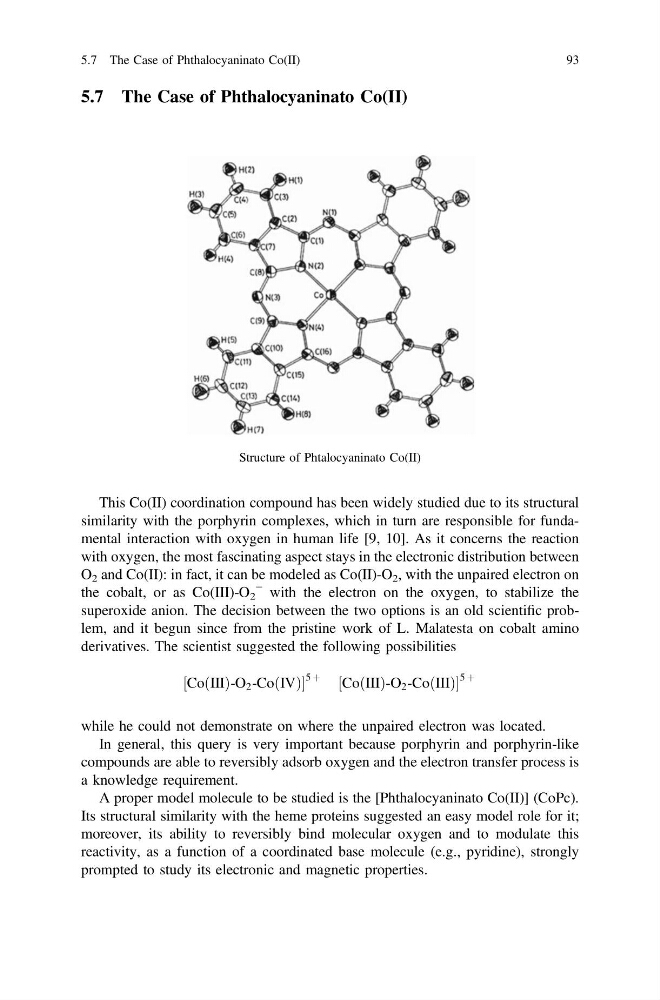
A proper model molecule to be studied is the [Phthalocyaninato Co(II)] (CoPc).
Its structural similarity with the heme proteins suggested an easy model role for it;
moreover, its ability to reversibly bind molecular oxygen and to modulate this
reactivity, as a function of a coordinated base molecule (e.g., pyridine), strongly
prompted to study its electronic and magnetic properties.
Structure of Phtalocyaninato Co(II)
5.7 The Case of Phthalocyaninato Co(II)
93
This Co(II) coordination compound has been widely studied due to its structural
similarity with the porphyrin complexes, which in turn are responsible for fundamental interaction with oxygen in human life [9, 10]. As it concerns the reaction
with oxygen, the most fascinating aspect stays in the electronic distribution between
O 2 and Co(II): in fact, it can be modeled as Co(II)-O 2 , with the unpaired electron on
the cobalt, or as Co(III)-O 2
− with the electron on the oxygen, to stabilize the
superoxide anion. The decision between the two options is an old scientific problem, and it begun since from the pristine work of L. Malatesta on cobalt amino
derivatives. The scientist suggested the following possibilities
CoðIIIÞ-O 2 -CoðIVÞ
½
5 þ
CoðIIIÞ-O 2 -CoðIIIÞ
½
5 þ
while he could not demonstrate on where the unpaired electron was located.
In general, this query is very important because porphyrin and porphyrin-like
compounds are able to reversibly adsorb oxygen and the electron transfer process is
a knowledge requirement.
A proper model molecule to be studied is the [Phthalocyaninato Co(II)] (CoPc).
Its structural similarity with the heme proteins suggested an easy model role for it;
moreover, its ability to reversibly bind molecular oxygen and to modulate this
reactivity, as a function of a coordinated base molecule (e.g., pyridine), strongly
prompted to study its electronic and magnetic properties.
Structure of Phtalocyaninato Co(II)
5.7 The Case of Phthalocyaninato Co(II)
93