

4.1. INTRODUCTION
73
NUMBER OF ATOMS RADIUS (nm)
1
10
1 o2
1 os
1 o4
10'
1 OB
MOLECULES
1
T
NANOPARTICLES
10
I
BULK
1
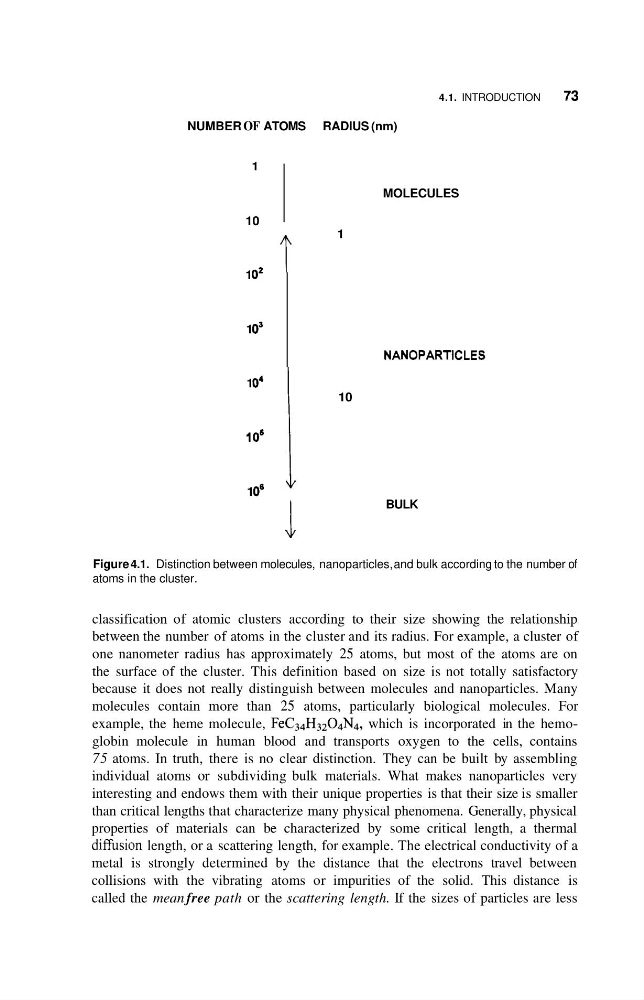
Figure 4.1. Distinction between molecules, nanoparticles, and bulk according to the number of
atoms in the cluster.
classification of atomic clusters according to their size showing the relationship
between the number of atoms in the cluster and its radius. For example, a cluster of
one nanometer radius has approximately 25 atoms, but most of the atoms are on
the surface of the cluster. This definition based on size is not totally satisfactory
because it does not really distinguish between molecules and nanoparticles. Many
molecules contain more than 25 atoms, particularly biological molecules. For
example, the heme molecule, FeC34H3204N4, which is incorporated in the hemoglobin molecule in human blood and transports oxygen to the cells, contains
75 atoms. In truth, there is no clear distinction. They can be built by assembling
individual atoms or subdividing bulk materials. What makes nanoparticles very
interesting and endows them with their unique properties is that their size is smaller
than critical lengths that characterize many physical phenomena. Generally, physical
properties of materials can be characterized by some critical length, a thermal
diffusion length, or a scattering length, for example. The electrical conductivity of a
metal is strongly determined by the distance that the electrons travel between
collisions with the vibrating atoms or impurities of the solid. This distance is
called the mean free path or the scattering length. If the sizes of particles are less
73
NUMBER OF ATOMS RADIUS (nm)
1
10
1 o2
1 os
1 o4
10'
1 OB
MOLECULES
1
T
NANOPARTICLES
10
I
BULK
1
Figure 4.1. Distinction between molecules, nanoparticles, and bulk according to the number of
atoms in the cluster.
classification of atomic clusters according to their size showing the relationship
between the number of atoms in the cluster and its radius. For example, a cluster of
one nanometer radius has approximately 25 atoms, but most of the atoms are on
the surface of the cluster. This definition based on size is not totally satisfactory
because it does not really distinguish between molecules and nanoparticles. Many
molecules contain more than 25 atoms, particularly biological molecules. For
example, the heme molecule, FeC34H3204N4, which is incorporated in the hemoglobin molecule in human blood and transports oxygen to the cells, contains
75 atoms. In truth, there is no clear distinction. They can be built by assembling
individual atoms or subdividing bulk materials. What makes nanoparticles very
interesting and endows them with their unique properties is that their size is smaller
than critical lengths that characterize many physical phenomena. Generally, physical
properties of materials can be characterized by some critical length, a thermal
diffusion length, or a scattering length, for example. The electrical conductivity of a
metal is strongly determined by the distance that the electrons travel between
collisions with the vibrating atoms or impurities of the solid. This distance is
called the mean free path or the scattering length. If the sizes of particles are less