

70
METHODS OF MEASURING PROPERTIES
W c , d
c;r) b, c
m a , b
: Hz
: 5000
; 6000
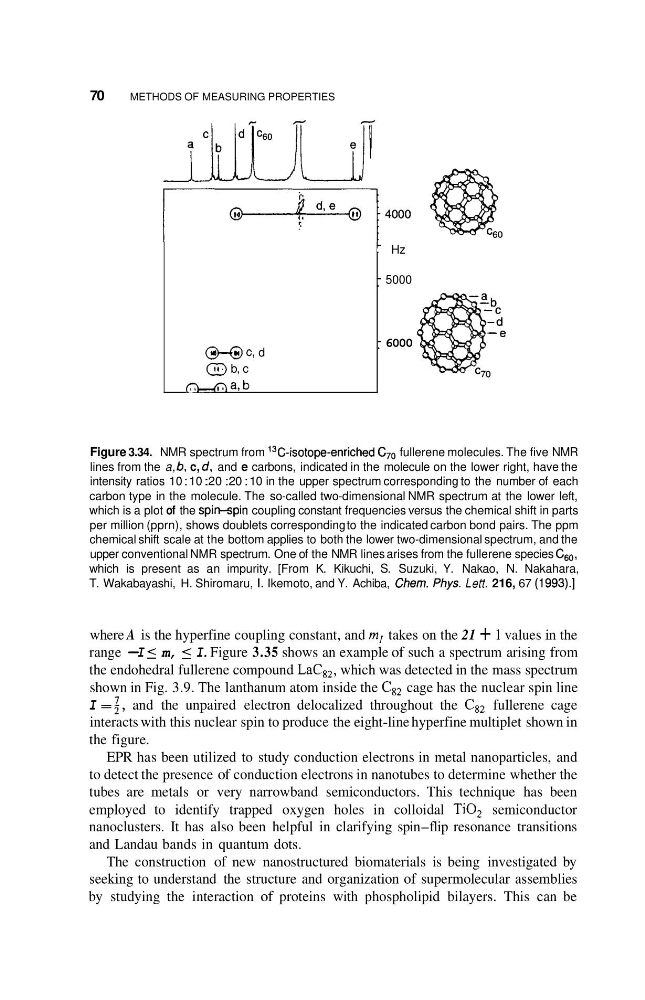
Figure 3.34. NMR spectrum from '3C-isotope-enriched C7, , fullerene molecules. The five NMR
lines from the a, b, c, d , and e carbons, indicated in the molecule on the lower right, have the
intensity ratios 10 : 10 : 20 : 20 : 10 in the upper spectrum corresponding to the number of each
carbon type in the molecule. The so-called two-dimensional NMR spectrum at the lower left,
which is a plot of the spin-spin coupling constant frequencies versus the chemical shift in parts
per million (pprn), shows doublets corresponding to the indicated carbon bond pairs. The ppm
chemical shift scale at the bottom applies to both the lower two-dimensional spectrum, and the
upper conventional NMR spectrum. One of the NMR lines arises from the fullerene species C ,
,
,
which is present as an impurity. [From K. Kikuchi, S. Suzuki, Y. Nakao, N. Nakahara,
T. Wakabayashi, H. Shiromaru, I. Ikemoto, and Y. Achiba, Chern. Phys. Len, 216, 67 (1993).]
where A is the hyperfine coupling constant, and m, takes on the 21 + 1 values in the
range -I 5 m, 5 I. Figure 3.35 shows an example of such a spectrum arising from
the endohedral fullerene compound Lac,,, which was detected in the mass spectrum
shown in Fig. 3.9. The lanthanum atom inside the C,, cage has the nuclear spin line
I = i, and the unpaired electron delocalized throughout the C8, fullerene cage
interacts with this nuclear spin to produce the eight-line hyperfine multiplet shown in
the figure.
EPR has been utilized to study conduction electrons in metal nanoparticles, and
to detect the presence of conduction electrons in nanotubes to determine whether the
tubes are metals or very narrowband semiconductors. This technique has been
employed to identify trapped oxygen holes in colloidal TiO, semiconductor
nanoclusters. It has also been helpful in clarifying spin-flip resonance transitions
and Landau bands in quantum dots.
The construction of new nanostructured biomaterials is being investigated by
seeking to understand the structure and organization of supermolecular assemblies
by studying the interaction of proteins with phospholipid bilayers. This can be
METHODS OF MEASURING PROPERTIES
W c , d
c;r) b, c
m a , b
: Hz
: 5000
; 6000
Figure 3.34. NMR spectrum from '3C-isotope-enriched C7, , fullerene molecules. The five NMR
lines from the a, b, c, d , and e carbons, indicated in the molecule on the lower right, have the
intensity ratios 10 : 10 : 20 : 20 : 10 in the upper spectrum corresponding to the number of each
carbon type in the molecule. The so-called two-dimensional NMR spectrum at the lower left,
which is a plot of the spin-spin coupling constant frequencies versus the chemical shift in parts
per million (pprn), shows doublets corresponding to the indicated carbon bond pairs. The ppm
chemical shift scale at the bottom applies to both the lower two-dimensional spectrum, and the
upper conventional NMR spectrum. One of the NMR lines arises from the fullerene species C ,
,
,
which is present as an impurity. [From K. Kikuchi, S. Suzuki, Y. Nakao, N. Nakahara,
T. Wakabayashi, H. Shiromaru, I. Ikemoto, and Y. Achiba, Chern. Phys. Len, 216, 67 (1993).]
where A is the hyperfine coupling constant, and m, takes on the 21 + 1 values in the
range -I 5 m, 5 I. Figure 3.35 shows an example of such a spectrum arising from
the endohedral fullerene compound Lac,,, which was detected in the mass spectrum
shown in Fig. 3.9. The lanthanum atom inside the C,, cage has the nuclear spin line
I = i, and the unpaired electron delocalized throughout the C8, fullerene cage
interacts with this nuclear spin to produce the eight-line hyperfine multiplet shown in
the figure.
EPR has been utilized to study conduction electrons in metal nanoparticles, and
to detect the presence of conduction electrons in nanotubes to determine whether the
tubes are metals or very narrowband semiconductors. This technique has been
employed to identify trapped oxygen holes in colloidal TiO, semiconductor
nanoclusters. It has also been helpful in clarifying spin-flip resonance transitions
and Landau bands in quantum dots.
The construction of new nanostructured biomaterials is being investigated by
seeking to understand the structure and organization of supermolecular assemblies
by studying the interaction of proteins with phospholipid bilayers. This can be