

2.3. LOCALIZED PARTICLES
33
1 meV
10 meV
100 meV
FJ
E
W
1 eV
10 eV
n = 4
n = 3
n = 2
n = l
Exciton
Positronium
Hydrogen
n = 5
n = 4
n = 5 -
n = 3
n = 4 -
n = 2
n = 3
n = 2
n = l
n = l
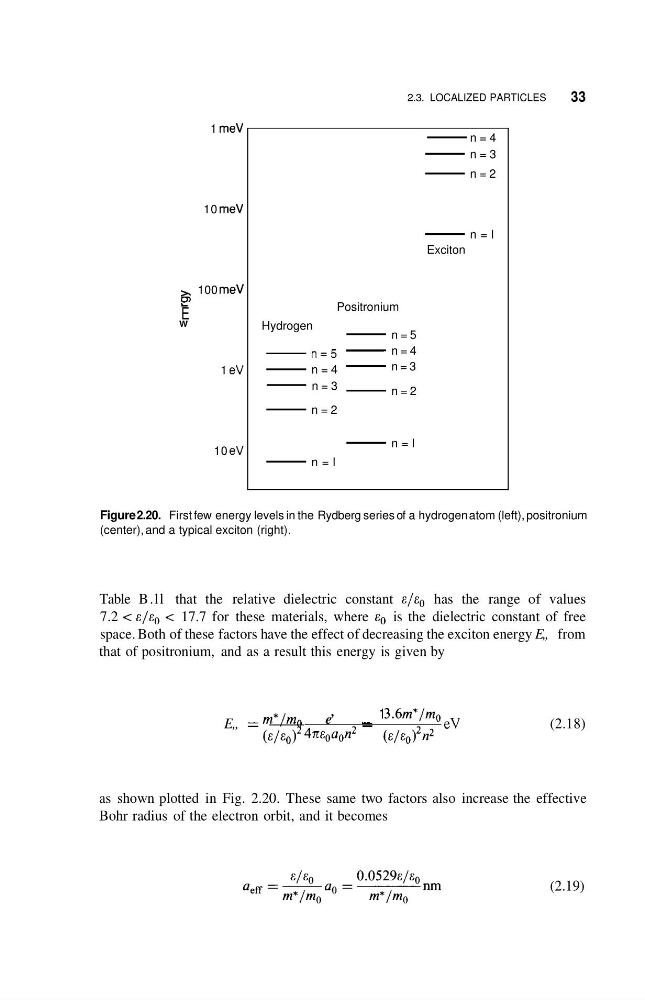
Figure 2.20. First few energy levels in the Rydberg series of a hydrogen atom (left), positronium
(center), and a typical exciton (right).
Table B.ll that the relative dielectric constant & / E O has the range of values
7.2 < &/eO < 17.7 for these materials, where c0 is the dielectric constant of free
space. Both of these factors have the effect of decreasing the exciton energy E,, from
that of positronium, and as a result this energy is given by
1 3.6m*/mo
eV
m*/mo e’
-
E,, = -
(&/Eo)’ 4n&oaon2 - (&/&o)’n’
(2.18)
as shown plotted in Fig. 2.20. These same two factors also increase the effective
Bohr radius of the electron orbit, and it becomes
(2.19)
33
1 meV
10 meV
100 meV
FJ
E
W
1 eV
10 eV
n = 4
n = 3
n = 2
n = l
Exciton
Positronium
Hydrogen
n = 5
n = 4
n = 5 -
n = 3
n = 4 -
n = 2
n = 3
n = 2
n = l
n = l
Figure 2.20. First few energy levels in the Rydberg series of a hydrogen atom (left), positronium
(center), and a typical exciton (right).
Table B.ll that the relative dielectric constant & / E O has the range of values
7.2 < &/eO < 17.7 for these materials, where c0 is the dielectric constant of free
space. Both of these factors have the effect of decreasing the exciton energy E,, from
that of positronium, and as a result this energy is given by
1 3.6m*/mo
eV
m*/mo e’
-
E,, = -
(&/Eo)’ 4n&oaon2 - (&/&o)’n’
(2.18)
as shown plotted in Fig. 2.20. These same two factors also increase the effective
Bohr radius of the electron orbit, and it becomes
(2.19)