

358
FORMULAS FOR DIMENSIONALITY
Table A.l. Properties of coordinate and k space in one, two, and three dimensions
Coordinate
k-Space
Fermi
Value
Region
Unit Cell
Region
of kz
Dimensions
Length L
2 4 L
2kF
k;
One
Area A = L2
(2./LI2
nkz
k: + k$
Two
Volume v = L~
(27l/LI3
47lk,/3
k,? + k; + k$
Three
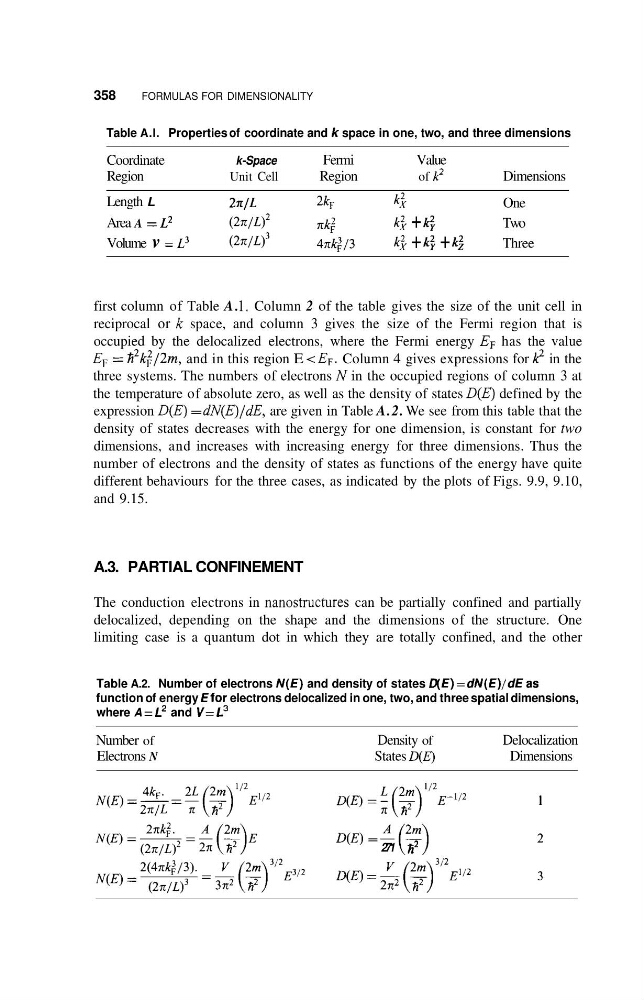
first column of Table A . 1. Column 2 of the table gives the size of the unit cell in
reciprocal or k space, and column 3 gives the size of the Fermi region that is
occupied by the delocalized electrons, where the Fermi energy E F has the value
EF = fi2k,/2m, and in this region E < E F . Column 4 gives expressions for I ? in the
three systems. The numbers of electrons N in the occupied regions of column 3 at
the temperature of absolute zero, as well as the density of states D(E) defined by the
expression D(E) = dN(E)/dE, are given in Table A.2. We see from this table that the
density of states decreases with the energy for one dimension, is constant for two
dimensions, and increases with increasing energy for three dimensions. Thus the
number of electrons and the density of states as functions of the energy have quite
different behaviours for the three cases, as indicated by the plots of Figs. 9.9, 9.10,
and 9.15.
A.3. PARTIAL CONFINEMENT
The conduction electrons in nanostructures can be partially confined and partially
delocalized, depending on the shape and the dimensions of the structure. One
limiting case is a quantum dot in which they are totally confined, and the other
Table A.2. Number of electrons N ( € ) and density of states Q€)= dN(E)/d€as
function of energy €for electrons delocalized in one, two, and three spatial dimensions,
where A = L2 and V = L3
Number of
Density of
Delocalization
Electrons N
States D(E)
Dimensions
N(E) = - =
D(E) = A (”)
271 h2
N(E) =
D(E) =- 2E2 (:)3’2E112 -
1
FORMULAS FOR DIMENSIONALITY
Table A.l. Properties of coordinate and k space in one, two, and three dimensions
Coordinate
k-Space
Fermi
Value
Region
Unit Cell
Region
of kz
Dimensions
Length L
2 4 L
2kF
k;
One
Area A = L2
(2./LI2
nkz
k: + k$
Two
Volume v = L~
(27l/LI3
47lk,/3
k,? + k; + k$
Three
first column of Table A . 1. Column 2 of the table gives the size of the unit cell in
reciprocal or k space, and column 3 gives the size of the Fermi region that is
occupied by the delocalized electrons, where the Fermi energy E F has the value
EF = fi2k,/2m, and in this region E < E F . Column 4 gives expressions for I ? in the
three systems. The numbers of electrons N in the occupied regions of column 3 at
the temperature of absolute zero, as well as the density of states D(E) defined by the
expression D(E) = dN(E)/dE, are given in Table A.2. We see from this table that the
density of states decreases with the energy for one dimension, is constant for two
dimensions, and increases with increasing energy for three dimensions. Thus the
number of electrons and the density of states as functions of the energy have quite
different behaviours for the three cases, as indicated by the plots of Figs. 9.9, 9.10,
and 9.15.
A.3. PARTIAL CONFINEMENT
The conduction electrons in nanostructures can be partially confined and partially
delocalized, depending on the shape and the dimensions of the structure. One
limiting case is a quantum dot in which they are totally confined, and the other
Table A.2. Number of electrons N ( € ) and density of states Q€)= dN(E)/d€as
function of energy €for electrons delocalized in one, two, and three spatial dimensions,
where A = L2 and V = L3
Number of
Density of
Delocalization
Electrons N
States D(E)
Dimensions
N(E) = - =
D(E) = A (”)
271 h2
N(E) =
D(E) =- 2E2 (:)3’2E112 -
1