

FURTHER READING
331
1 + L+~-&Iq#J + +
+ - -+
-
+ -
+
+
+
+
+
+ - -
+ - - +++
1 + \% g - p I-% g -3 g
-
- +
+ - - +++ - - +++
- +++ - -
+
+ -
+
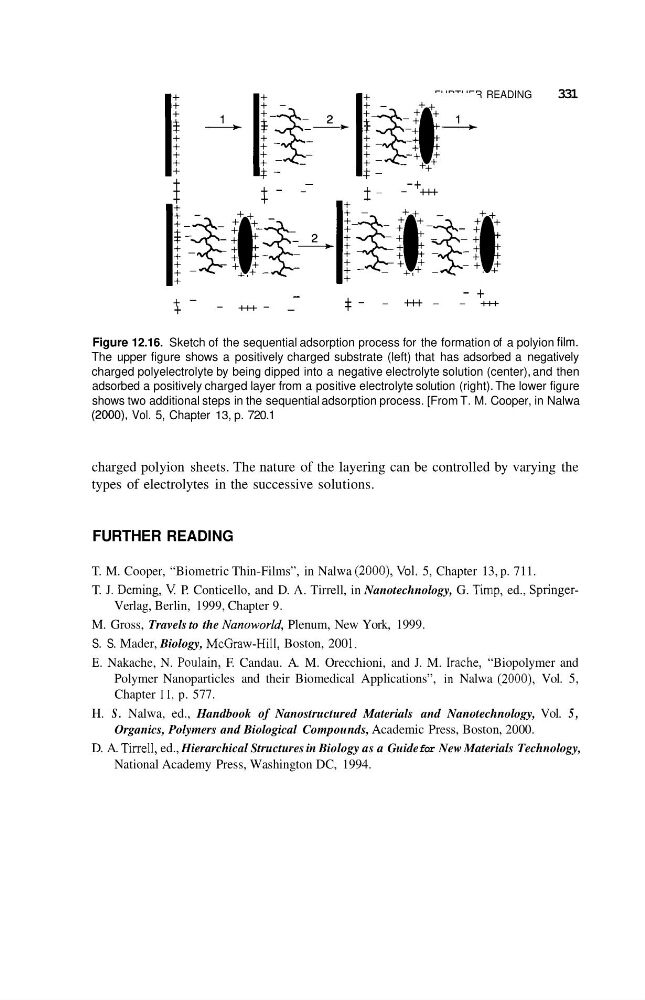
Figure 12.16. Sketch of the sequential adsorption process for the formation of a polyion film.
The upper figure shows a positively charged substrate (left) that has adsorbed a negatively
charged polyelectrolyte by being dipped into a negative electrolyte solution (center), and then
adsorbed a positively charged layer from a positive electrolyte solution (right). The lower figure
shows two additional steps in the sequential adsorption process. [From T. M. Cooper, in Nalwa
(2000), Vol. 5, Chapter 13, p. 720.1
charged polyion sheets. The nature of the layering can be controlled by varying the
types of electrolytes in the successive solutions.
FURTHER READING
T. M. Cooper, “Biometric Thin-Films”, in Nalwa (2000), Vol. 5, Chapter 13, p. 711.
T. J. Deming, v1 P. Conticello, and D. A. Tirrell, in Nanotechnology, G. Tirnp, ed., SpnngerM. Gross, Travels to the Nanoworld, Plenum, New York, 1999.
S. S. Mader, Biology, McGraw-Hill, Boston, 200 1.
E. Nakache, N. Poulain, F. Candau. A. M. Orecchioni, and J. M. Irache, “Biopolymer and
Polymer Nanoparticles and their Biomedical Applications”, in Nalwa (2000), Vol. 5,
Chapter I I , p. 577.
H. S . Nalwa, ed., Handbook of Nanostructured Materials and Nanotechnology, Vol. 5 ,
Organics, Polymers and Biological Compounds, Academic Press, Boston, 2000.
D. A. Tirrell, ed., Hierarchical Structures in Biology as a Guide for New Materials Technology,
National Academy Press, Washington DC, 1994.
Verlag, Berlin, 1999, Chapter 9.
331
1 + L+~-&Iq#J + +
+ - -+
-
+ -
+
+
+
+
+
+ - -
+ - - +++
1 + \% g - p I-% g -3 g
-
- +
+ - - +++ - - +++
- +++ - -
+
+ -
+
Figure 12.16. Sketch of the sequential adsorption process for the formation of a polyion film.
The upper figure shows a positively charged substrate (left) that has adsorbed a negatively
charged polyelectrolyte by being dipped into a negative electrolyte solution (center), and then
adsorbed a positively charged layer from a positive electrolyte solution (right). The lower figure
shows two additional steps in the sequential adsorption process. [From T. M. Cooper, in Nalwa
(2000), Vol. 5, Chapter 13, p. 720.1
charged polyion sheets. The nature of the layering can be controlled by varying the
types of electrolytes in the successive solutions.
FURTHER READING
T. M. Cooper, “Biometric Thin-Films”, in Nalwa (2000), Vol. 5, Chapter 13, p. 711.
T. J. Deming, v1 P. Conticello, and D. A. Tirrell, in Nanotechnology, G. Tirnp, ed., SpnngerM. Gross, Travels to the Nanoworld, Plenum, New York, 1999.
S. S. Mader, Biology, McGraw-Hill, Boston, 200 1.
E. Nakache, N. Poulain, F. Candau. A. M. Orecchioni, and J. M. Irache, “Biopolymer and
Polymer Nanoparticles and their Biomedical Applications”, in Nalwa (2000), Vol. 5,
Chapter I I , p. 577.
H. S . Nalwa, ed., Handbook of Nanostructured Materials and Nanotechnology, Vol. 5 ,
Organics, Polymers and Biological Compounds, Academic Press, Boston, 2000.
D. A. Tirrell, ed., Hierarchical Structures in Biology as a Guide for New Materials Technology,
National Academy Press, Washington DC, 1994.
Verlag, Berlin, 1999, Chapter 9.