

12.4. BIOLOGICAL NANOSTRUCTURES
329
' fatty acid chain of phospholipid
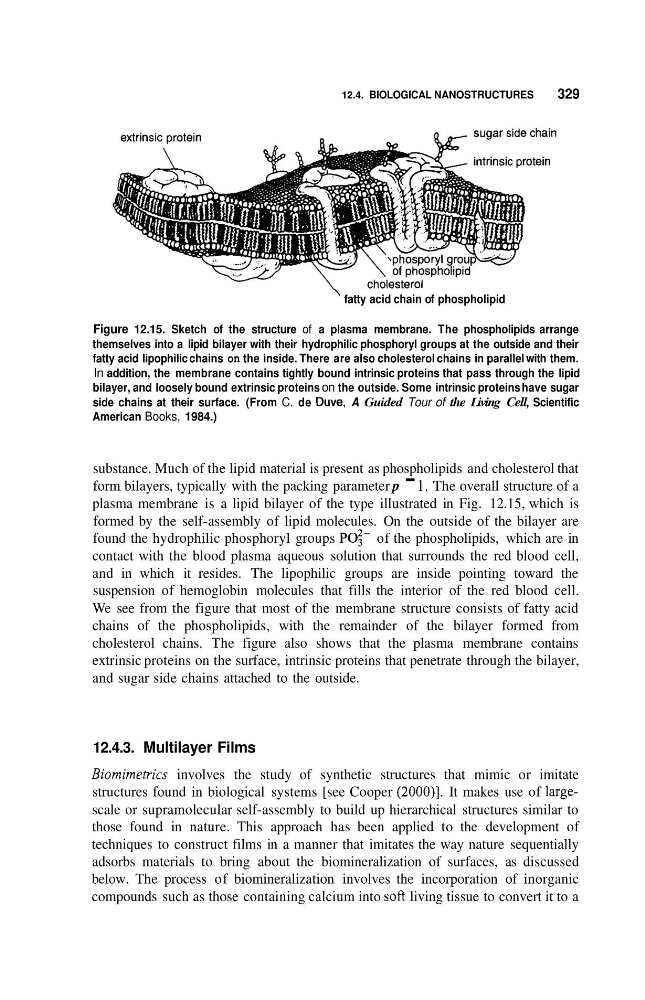
Figure 12.15. Sketch of the structure of a plasma membrane. The phospholipids arrange
themselves into a lipid bilayer with their hydrophilic phosphoryl groups at the outside and their
fatty acid lipophilic chains on the inside. There are also cholesterol chains in parallel with them.
In addition, the membrane contains tightly bound intrinsic proteins that pass through the lipid
bilayer, and loosely bound extrinsic proteins on the outside. Some intrinsic proteins have sugar
side chains at their surface. (From C. de Duve, A Guided Tour of the Living Cell, Scientific
American Books, 1984.)
substance. Much of the lipid material is present as phospholipids and cholesterol that
form bilayers, typically with the packing parameter p - 1. The overall structure of a
plasma membrane is a lipid bilayer of the type illustrated in Fig. 12.15, which is
formed by the self-assembly of lipid molecules. On the outside of the bilayer are
found the hydrophilic phosphoryl groups PO:- of the phospholipids, which are in
contact with the blood plasma aqueous solution that surrounds the red blood cell,
and in which it resides. The lipophilic groups are inside pointing toward the
suspension of hemoglobin molecules that fills the interior of the red blood cell.
We see from the figure that most of the membrane structure consists of fatty acid
chains of the phospholipids, with the remainder of the bilayer formed from
cholesterol chains. The figure also shows that the plasma membrane contains
extrinsic proteins on the surface, intrinsic proteins that penetrate through the bilayer,
and sugar side chains attached to the outside.
12.4.3. Multilayer Films
Biornirnetrics involves the study of synthetic structures that mimic or imitate
structures found in biological systems [see Cooper (2000)l. It makes use of largescale or supramolecular self-assembly to build up hierarchical structures similar to
those found in nature. This approach has been applied to the development of
techniques to construct films in a manner that imitates the way nature sequentially
adsorbs materials to bring about the biomineralization of surfaces, as discussed
below. The process of biomineralization involves the incorporation of inorganic
compounds such as those containing calcium into soft living tissue to convert it to a
329
' fatty acid chain of phospholipid
Figure 12.15. Sketch of the structure of a plasma membrane. The phospholipids arrange
themselves into a lipid bilayer with their hydrophilic phosphoryl groups at the outside and their
fatty acid lipophilic chains on the inside. There are also cholesterol chains in parallel with them.
In addition, the membrane contains tightly bound intrinsic proteins that pass through the lipid
bilayer, and loosely bound extrinsic proteins on the outside. Some intrinsic proteins have sugar
side chains at their surface. (From C. de Duve, A Guided Tour of the Living Cell, Scientific
American Books, 1984.)
substance. Much of the lipid material is present as phospholipids and cholesterol that
form bilayers, typically with the packing parameter p - 1. The overall structure of a
plasma membrane is a lipid bilayer of the type illustrated in Fig. 12.15, which is
formed by the self-assembly of lipid molecules. On the outside of the bilayer are
found the hydrophilic phosphoryl groups PO:- of the phospholipids, which are in
contact with the blood plasma aqueous solution that surrounds the red blood cell,
and in which it resides. The lipophilic groups are inside pointing toward the
suspension of hemoglobin molecules that fills the interior of the red blood cell.
We see from the figure that most of the membrane structure consists of fatty acid
chains of the phospholipids, with the remainder of the bilayer formed from
cholesterol chains. The figure also shows that the plasma membrane contains
extrinsic proteins on the surface, intrinsic proteins that penetrate through the bilayer,
and sugar side chains attached to the outside.
12.4.3. Multilayer Films
Biornirnetrics involves the study of synthetic structures that mimic or imitate
structures found in biological systems [see Cooper (2000)l. It makes use of largescale or supramolecular self-assembly to build up hierarchical structures similar to
those found in nature. This approach has been applied to the development of
techniques to construct films in a manner that imitates the way nature sequentially
adsorbs materials to bring about the biomineralization of surfaces, as discussed
below. The process of biomineralization involves the incorporation of inorganic
compounds such as those containing calcium into soft living tissue to convert it to a