

296
ORGANIC COMPOUNDS AND POLYMERS
\
H + Q ’ @ + A
Linear subunit
Angular subunit
Angular subunit
Self-Assem bly
n
n-1
c
n-1
Cyclic polygons
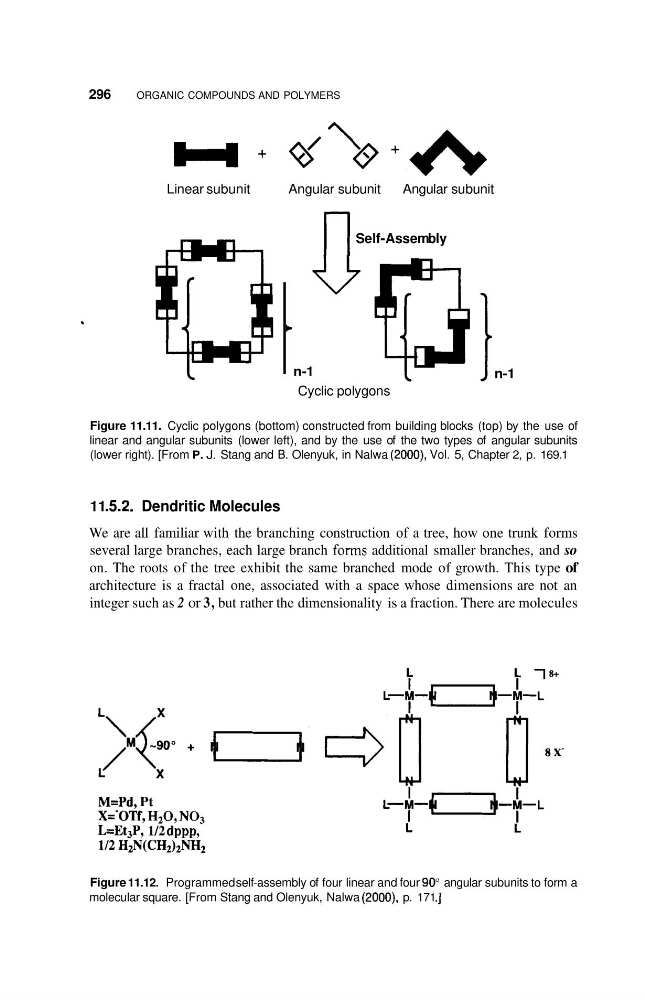
Figure 11.11. Cyclic polygons (bottom) constructed from building blocks (top) by the use of
linear and angular subunits (lower left), and by the use of the two types of angular subunits
(lower right). [From P. J. Stang and B. Olenyuk, in Nalwa (2000), Vol. 5, Chapter 2, p. 169.1
11 5 2 . Dendritic Molecules
We are all familiar with the branching construction of a tree, how one trunk forms
several large branches, each large branch forms additional smaller branches, and so
on. The roots of the tree exhibit the same branched mode of growth. This type of
architecture is a fractal one, associated with a space whose dimensions are not an
integer such as 2 or 3, but rather the dimensionality is a fraction. There are molecules
M=Pd, Pt
X=-OTf, HZO, NO,
L=EtsP, 1/2 dppp,
112 HzN(CH2)2NHZ
Figure 11.12. Programmed self-assembly of four linear and four 90” angular subunits to form a
molecular square. [From Stang and Olenyuk, Nalwa (2000), p. 171 .I
ORGANIC COMPOUNDS AND POLYMERS
\
H + Q ’ @ + A
Linear subunit
Angular subunit
Angular subunit
Self-Assem bly
n
n-1
c
n-1
Cyclic polygons
Figure 11.11. Cyclic polygons (bottom) constructed from building blocks (top) by the use of
linear and angular subunits (lower left), and by the use of the two types of angular subunits
(lower right). [From P. J. Stang and B. Olenyuk, in Nalwa (2000), Vol. 5, Chapter 2, p. 169.1
11 5 2 . Dendritic Molecules
We are all familiar with the branching construction of a tree, how one trunk forms
several large branches, each large branch forms additional smaller branches, and so
on. The roots of the tree exhibit the same branched mode of growth. This type of
architecture is a fractal one, associated with a space whose dimensions are not an
integer such as 2 or 3, but rather the dimensionality is a fraction. There are molecules
M=Pd, Pt
X=-OTf, HZO, NO,
L=EtsP, 1/2 dppp,
112 HzN(CH2)2NHZ
Figure 11.12. Programmed self-assembly of four linear and four 90” angular subunits to form a
molecular square. [From Stang and Olenyuk, Nalwa (2000), p. 171 .I