

11.3. NANOCRYSTALS
291
R’ groups are given in Fig. 11.7. The monomer for the polymer is formed by
interchanging triple and single bonds in the following manner
(11.15)
where the resulting open bonds (=) at the ends of the structure are used to attach
successive monomers to each other during the polymerization. The polymerization
process in the solid state is brought about by the application of heat, ultraviolet light,
or y irradiation (via prays), as indicated by the photon notation hv above the arrow
in Eq. (1 1.15). The polymer backbone is conjugated by its system of alternating
single, double and triple bonds. Both the solid forms and the solutions of diacetylene
polymers exhibit many bright colors: red, yellow, green, blue, and gold.
Diacetylene polymers have the capability of forming perfect crystals in the solid
state, with every polymer chain reaching from one end of the crystal to the other.
This occurs when the crystal size is less than the usual length of the polymer in a
bulk material, and it causes the polymer molecular weight to depend on the
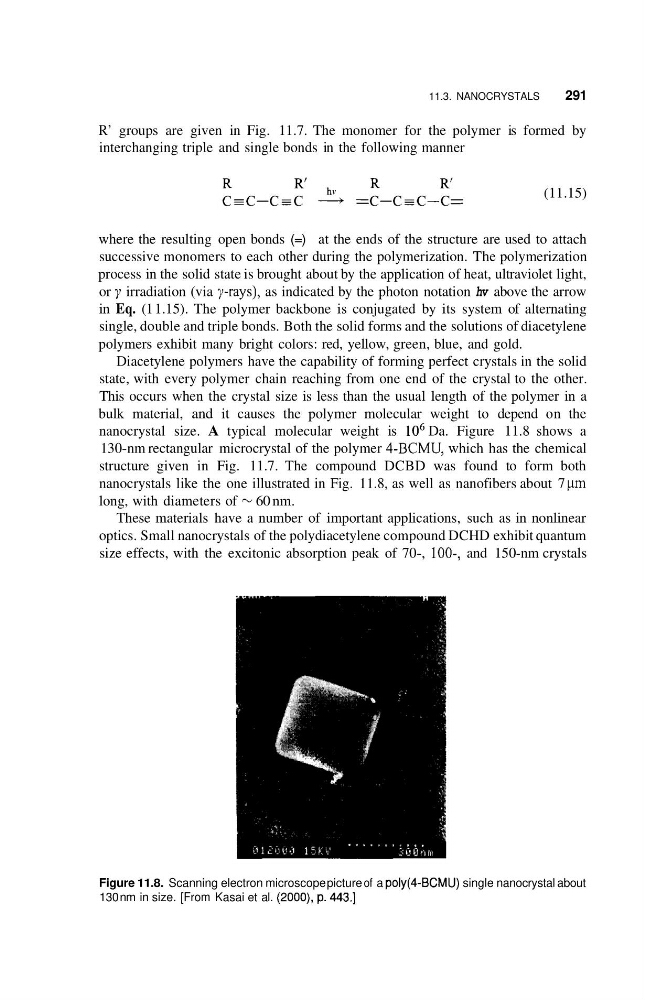
nanocrystal size. A typical molecular weight is lo6 Da. Figure 11.8 shows a
130-nm rectangular microcrystal of the polymer 4-BCMU, which has the chemical
structure given in Fig. 11.7. The compound DCBD was found to form both
nanocrystals like the one illustrated in Fig. 11.8, as well as nanofibers about 7 pm
long, with diameters of - 60 nm.
These materials have a number of important applications, such as in nonlinear
optics. Small nanocrystals of the polydiacetylene compound DCHD exhibit quantum
size effects, with the excitonic absorption peak of 70-, loo-, and 150-nm crystals
Figure 11.8. Scanning electron microscope picture of a poly(4-BCMU) single nanocrystal about
130 nm in size. [From Kasai et al. (2000), p. 443.)
291
R’ groups are given in Fig. 11.7. The monomer for the polymer is formed by
interchanging triple and single bonds in the following manner
(11.15)
where the resulting open bonds (=) at the ends of the structure are used to attach
successive monomers to each other during the polymerization. The polymerization
process in the solid state is brought about by the application of heat, ultraviolet light,
or y irradiation (via prays), as indicated by the photon notation hv above the arrow
in Eq. (1 1.15). The polymer backbone is conjugated by its system of alternating
single, double and triple bonds. Both the solid forms and the solutions of diacetylene
polymers exhibit many bright colors: red, yellow, green, blue, and gold.
Diacetylene polymers have the capability of forming perfect crystals in the solid
state, with every polymer chain reaching from one end of the crystal to the other.
This occurs when the crystal size is less than the usual length of the polymer in a
bulk material, and it causes the polymer molecular weight to depend on the
nanocrystal size. A typical molecular weight is lo6 Da. Figure 11.8 shows a
130-nm rectangular microcrystal of the polymer 4-BCMU, which has the chemical
structure given in Fig. 11.7. The compound DCBD was found to form both
nanocrystals like the one illustrated in Fig. 11.8, as well as nanofibers about 7 pm
long, with diameters of - 60 nm.
These materials have a number of important applications, such as in nonlinear
optics. Small nanocrystals of the polydiacetylene compound DCHD exhibit quantum
size effects, with the excitonic absorption peak of 70-, loo-, and 150-nm crystals
Figure 11.8. Scanning electron microscope picture of a poly(4-BCMU) single nanocrystal about
130 nm in size. [From Kasai et al. (2000), p. 443.)