

2.1. STRUCTURE
19
other, and high-frequency modes called optical modes, in which they tend to vibrate
out of phase.
A simple model for analyzing these vibratory modes is a linear chain of
alternating atoms with a large mass M and a small mass m joined to each other
by springs (-) as follows:
When one of the springs stretches or compresses by an amount Ax, a force is exerted
on the adjacent masses with the magnitude C Ax, where C is the spring constant. As
the various springs stretch and compress in step with each other, longitudinal modes
of vibration take place in which the motion of each atom is along the string direction.
Each such normal mode has a particular frequency w and a wavevector k = 271/2,
where II is the wavelength, and the energy E, associated with the mode is given by
E = fiw. There are also transverse normal modes in which the atoms vibrate back
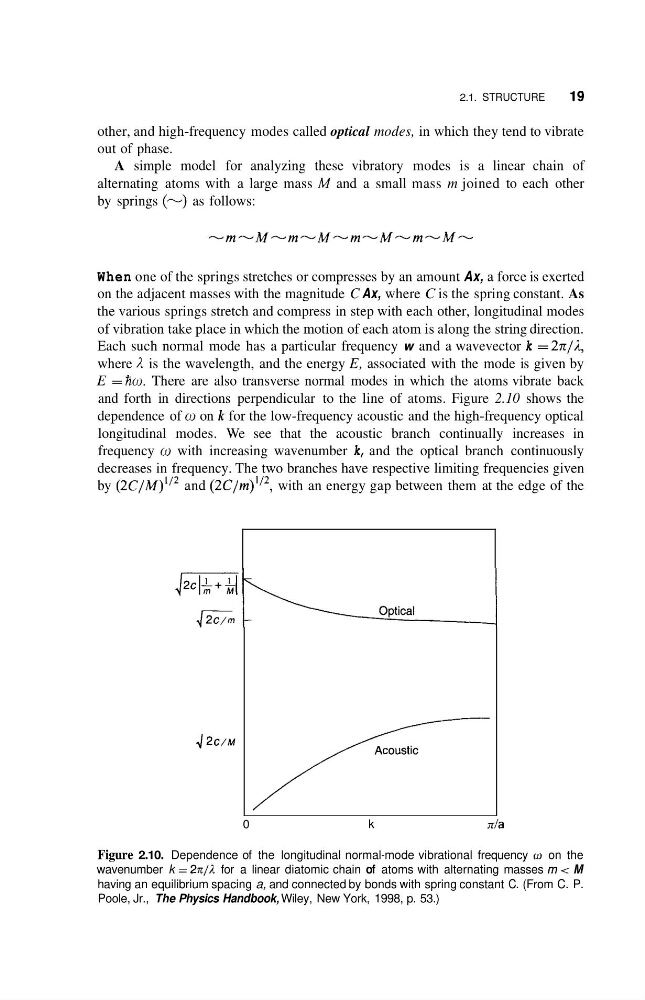
and forth in directions perpendicular to the line of atoms. Figure 2.10 shows the
dependence of w on k for the low-frequency acoustic and the high-frequency optical
longitudinal modes. We see that the acoustic branch continually increases in
frequency w with increasing wavenumber k, and the optical branch continuously
decreases in frequency. The two branches have respective limiting frequencies given
by (2C/M)‘I2 and (2C/m)’I2, with an energy gap between them at the edge of the
0
k
nla
Figure 2.10. Dependence of the longitudinal normal-mode vibrational frequency w on the
wavenumber k = 2 x / A for a linear diatomic chain of atoms with alternating masses m < M
having an equilibrium spacing a, and connected by bonds with spring constant C. (From C. P.
Poole, Jr., The Physics Handbook, Wiley, New York, 1998, p. 53.)
19
other, and high-frequency modes called optical modes, in which they tend to vibrate
out of phase.
A simple model for analyzing these vibratory modes is a linear chain of
alternating atoms with a large mass M and a small mass m joined to each other
by springs (-) as follows:
When one of the springs stretches or compresses by an amount Ax, a force is exerted
on the adjacent masses with the magnitude C Ax, where C is the spring constant. As
the various springs stretch and compress in step with each other, longitudinal modes
of vibration take place in which the motion of each atom is along the string direction.
Each such normal mode has a particular frequency w and a wavevector k = 271/2,
where II is the wavelength, and the energy E, associated with the mode is given by
E = fiw. There are also transverse normal modes in which the atoms vibrate back
and forth in directions perpendicular to the line of atoms. Figure 2.10 shows the
dependence of w on k for the low-frequency acoustic and the high-frequency optical
longitudinal modes. We see that the acoustic branch continually increases in
frequency w with increasing wavenumber k, and the optical branch continuously
decreases in frequency. The two branches have respective limiting frequencies given
by (2C/M)‘I2 and (2C/m)’I2, with an energy gap between them at the edge of the
0
k
nla
Figure 2.10. Dependence of the longitudinal normal-mode vibrational frequency w on the
wavenumber k = 2 x / A for a linear diatomic chain of atoms with alternating masses m < M
having an equilibrium spacing a, and connected by bonds with spring constant C. (From C. P.
Poole, Jr., The Physics Handbook, Wiley, New York, 1998, p. 53.)