

11.2. FORMING AND CHARACTERIZING POLYMERS
283
The present chapter emphasizes experimental aspects of polymeric nanoparticles.
Insights can also be obtained about these nanoparticles by computer simulation and
modeling, and the article by Sumpter et al. (2000) can be consulted for some details
on this approach.
11.2. FORMING AND CHARACTERIZING POLYMERS
11.2.1. Polymerization
A polymer is a compound of high molecular weight that is formed from repeating
subunits called monomers. The monomer generally has a parent compound with a
double chemical bond that opens up to form a single bond during the polymerization
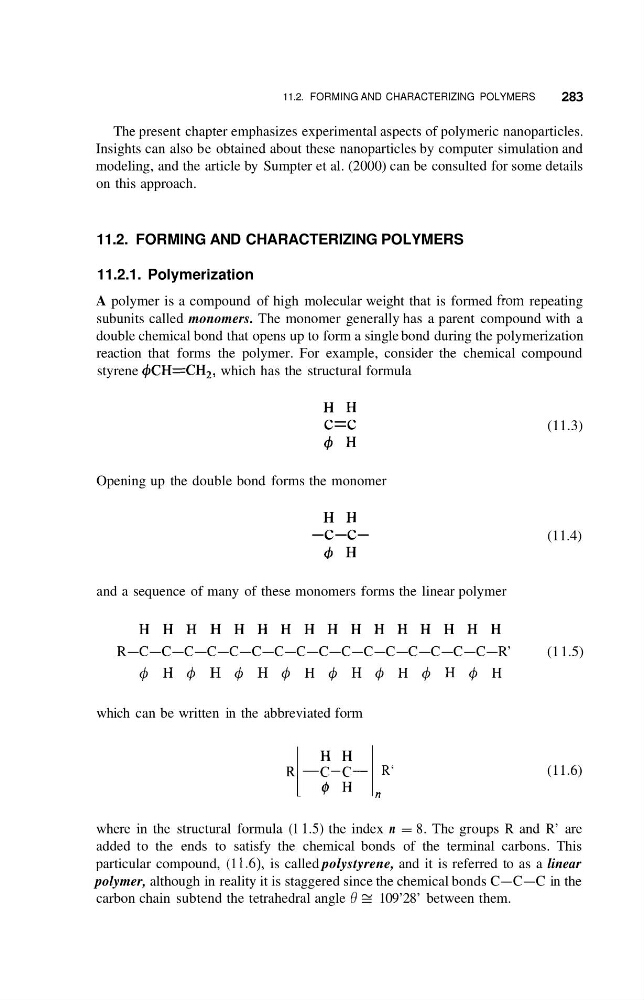
reaction that forms the polymer. For example, consider the chemical compound
styrene d)CH=CH,, which has the structural formula
H H
c=c
4 H
Opening up the double bond forms the monomer
H H
-c-cd H
(11.3)
(11.4)
and a sequence of many of these monomers forms the linear polymer
H H H H H H H H H H H H H H H H
R-C-C-C-C-C-C-C-C-C-C-C-C-C-C-C-C-R’
(1 1.5)
d ) H d ) H d ) H d ) H d ) H d ) H d ) H d ) H
which can be written in the abbreviated form
H H
R‘
(11.6)
n
where in the structural formula (1 1.5) the index n = 8. The groups R and R’ are
added to the ends to satisfy the chemical bonds of the terminal carbons. This
particular compound, (1 1.6), is called polystyrene, and it is referred to as a linear
polymer, although in reality it is staggered since the chemical bonds C-C-C in the
carbon chain subtend the tetrahedral angle 0 E 109’28’ between them.
283
The present chapter emphasizes experimental aspects of polymeric nanoparticles.
Insights can also be obtained about these nanoparticles by computer simulation and
modeling, and the article by Sumpter et al. (2000) can be consulted for some details
on this approach.
11.2. FORMING AND CHARACTERIZING POLYMERS
11.2.1. Polymerization
A polymer is a compound of high molecular weight that is formed from repeating
subunits called monomers. The monomer generally has a parent compound with a
double chemical bond that opens up to form a single bond during the polymerization
reaction that forms the polymer. For example, consider the chemical compound
styrene d)CH=CH,, which has the structural formula
H H
c=c
4 H
Opening up the double bond forms the monomer
H H
-c-cd H
(11.3)
(11.4)
and a sequence of many of these monomers forms the linear polymer
H H H H H H H H H H H H H H H H
R-C-C-C-C-C-C-C-C-C-C-C-C-C-C-C-C-R’
(1 1.5)
d ) H d ) H d ) H d ) H d ) H d ) H d ) H d ) H
which can be written in the abbreviated form
H H
R‘
(11.6)
n
where in the structural formula (1 1.5) the index n = 8. The groups R and R’ are
added to the ends to satisfy the chemical bonds of the terminal carbons. This
particular compound, (1 1.6), is called polystyrene, and it is referred to as a linear
polymer, although in reality it is staggered since the chemical bonds C-C-C in the
carbon chain subtend the tetrahedral angle 0 E 109’28’ between them.