

10.2. CATALYSIS
265
-
c
v)
C
3
._
2
9 40
e
c
.m
w
v
30z
Q
k
6 20( I ,
n
5:
10
follow, however, that catalytic activity will necessarily scale with the surface area in
the nanoparticle range of sizes. Figure 4.14, which is a plot of the reaction rate of H2
with Fe particles as a function of the particle size, does not show any trend in this
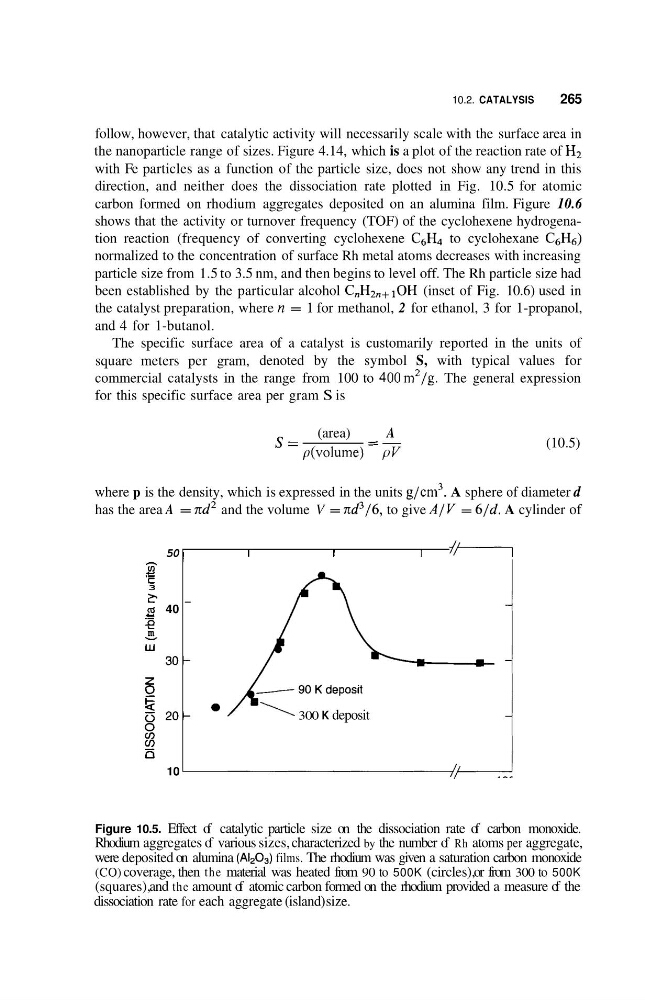
direction, and neither does the dissociation rate plotted in Fig. 10.5 for atomic
carbon formed on rhodium aggregates deposited on an alumina film. Figure 10.6
shows that the activity or turnover frequency (TOF) of the cyclohexene hydrogenation reaction (frequency of converting cyclohexene C6H4 to cyclohexane C6&)
normalized to the concentration of surface Rh metal atoms decreases with increasing
particle size from 1.5 to 3.5 nm, and then begins to level off. The Rh particle size had
been established by the particular alcohol C,H2,+10H (inset of Fig. 10.6) used in
the catalyst preparation, where n = 1 for methanol, 2 for ethanol, 3 for 1-propanol,
and 4 for 1-butanol.
The specific surface area of a catalyst is customarily reported in the units of
square meters per gram, denoted by the symbol S, with typical values for
commercial catalysts in the range from 100 to 400m2/g. The general expression
for this specific surface area per gram S is
-
\ 300 K deposit
0
(area)
A
p(voIume) - p v
-S =
(10.5)
where p is the density, which is expressed in the units g/cm3. A sphere of diameter d
has the area A = nd2 and the volume V = nd3/6, to give A / V = 6 / d . A cylinder of
50 I
I
I
I
k--Figure 10.5. Effect of catalytic particle size on the dissociation rate of carbon monoxide.
Rhodium aggregates of various sizes, characterized by the number of Rh atoms per aggregate,
were deposited on alumina (Al2O3) films. The rhodium was given a saturation carbon monoxide
(CO) coverage, then the material was heated from 90 to 500K (circles), or from 300 to 500K
(squares), and the amount of atomic carbon formed on the rhodium provided a measure of the
dissociation rate for each aggregate (island) size.
265
-
c
v)
C
3
._
2
9 40
e
c
.m
w
v
30z
Q
k
6 20( I ,
n
5:
10
follow, however, that catalytic activity will necessarily scale with the surface area in
the nanoparticle range of sizes. Figure 4.14, which is a plot of the reaction rate of H2
with Fe particles as a function of the particle size, does not show any trend in this
direction, and neither does the dissociation rate plotted in Fig. 10.5 for atomic
carbon formed on rhodium aggregates deposited on an alumina film. Figure 10.6
shows that the activity or turnover frequency (TOF) of the cyclohexene hydrogenation reaction (frequency of converting cyclohexene C6H4 to cyclohexane C6&)
normalized to the concentration of surface Rh metal atoms decreases with increasing
particle size from 1.5 to 3.5 nm, and then begins to level off. The Rh particle size had
been established by the particular alcohol C,H2,+10H (inset of Fig. 10.6) used in
the catalyst preparation, where n = 1 for methanol, 2 for ethanol, 3 for 1-propanol,
and 4 for 1-butanol.
The specific surface area of a catalyst is customarily reported in the units of
square meters per gram, denoted by the symbol S, with typical values for
commercial catalysts in the range from 100 to 400m2/g. The general expression
for this specific surface area per gram S is
-
\ 300 K deposit
0
(area)
A
p(voIume) - p v
-S =
(10.5)
where p is the density, which is expressed in the units g/cm3. A sphere of diameter d
has the area A = nd2 and the volume V = nd3/6, to give A / V = 6 / d . A cylinder of
50 I
I
I
I
k--Figure 10.5. Effect of catalytic particle size on the dissociation rate of carbon monoxide.
Rhodium aggregates of various sizes, characterized by the number of Rh atoms per aggregate,
were deposited on alumina (Al2O3) films. The rhodium was given a saturation carbon monoxide
(CO) coverage, then the material was heated from 90 to 500K (circles), or from 300 to 500K
(squares), and the amount of atomic carbon formed on the rhodium provided a measure of the
dissociation rate for each aggregate (island) size.