

16
INTRODUCTION TO PHYSICS OF THE SOLID STATE
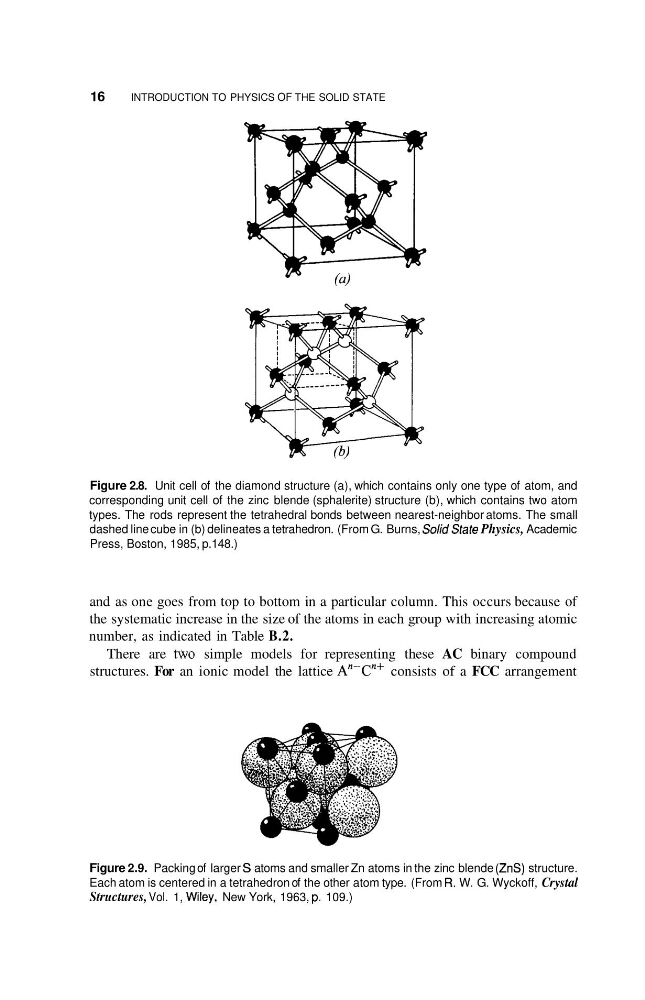
Figure 2.8. Unit cell of the diamond structure (a), which contains only one type of atom, and
corresponding unit cell of the zinc blende (sphalerite) structure (b), which contains two atom
types. The rods represent the tetrahedral bonds between nearest-neighbor atoms. The small
dashed line cube in (b) delineates a tetrahedron. (From G. Burns, Solidstate Physics, Academic
Press, Boston, 1985, p.148.)
and as one goes from top to bottom in a particular column. This occurs because of
the systematic increase in the size of the atoms in each group with increasing atomic
number, as indicated in Table B.2.
There are tiyo simple models for representing these AC binary compound
structures. For an ionic model the lattice AnPC"+ consists of a FCC arrangement
Figure 2.9. Packing of larger S atoms and smaller Zn atoms in the zinc blende (ZnS) structure.
Each atom is centered in a tetrahedron of the other atom type. (From R. W. G. Wyckoff, Crystal
Structures, Vol. 1, Wiley, New York, 1963, p. 109.)
INTRODUCTION TO PHYSICS OF THE SOLID STATE
Figure 2.8. Unit cell of the diamond structure (a), which contains only one type of atom, and
corresponding unit cell of the zinc blende (sphalerite) structure (b), which contains two atom
types. The rods represent the tetrahedral bonds between nearest-neighbor atoms. The small
dashed line cube in (b) delineates a tetrahedron. (From G. Burns, Solidstate Physics, Academic
Press, Boston, 1985, p.148.)
and as one goes from top to bottom in a particular column. This occurs because of
the systematic increase in the size of the atoms in each group with increasing atomic
number, as indicated in Table B.2.
There are tiyo simple models for representing these AC binary compound
structures. For an ionic model the lattice AnPC"+ consists of a FCC arrangement
Figure 2.9. Packing of larger S atoms and smaller Zn atoms in the zinc blende (ZnS) structure.
Each atom is centered in a tetrahedron of the other atom type. (From R. W. G. Wyckoff, Crystal
Structures, Vol. 1, Wiley, New York, 1963, p. 109.)