

9.7. SUPERCONDUCTIVITY
255
applied fields B, , -= Bcl the material acts like a type I superconductor and excludes
magnetic flux, and at high applied fields B, , > BC2 the material becomes normal. In
the intermediate range, B,, < B, , < B,,, the magnetic field penetrates into the
bulk in the form of tubes of magnetic flux, each of which contains one quantum of
flux (Do, which has the value
(9.16)
h
2e
(Do = - = 2.0678 x
Tm2
Each vortex has a core of radius 5 within which the magnetic field is fairly constant,
and an outside region of radius A where the magnetic field decays with distance r
from the core, a decay which has the exponential form exp(-r/A) at large distances
away. The length of a vortex is the thickness of the sample, which is typically in the
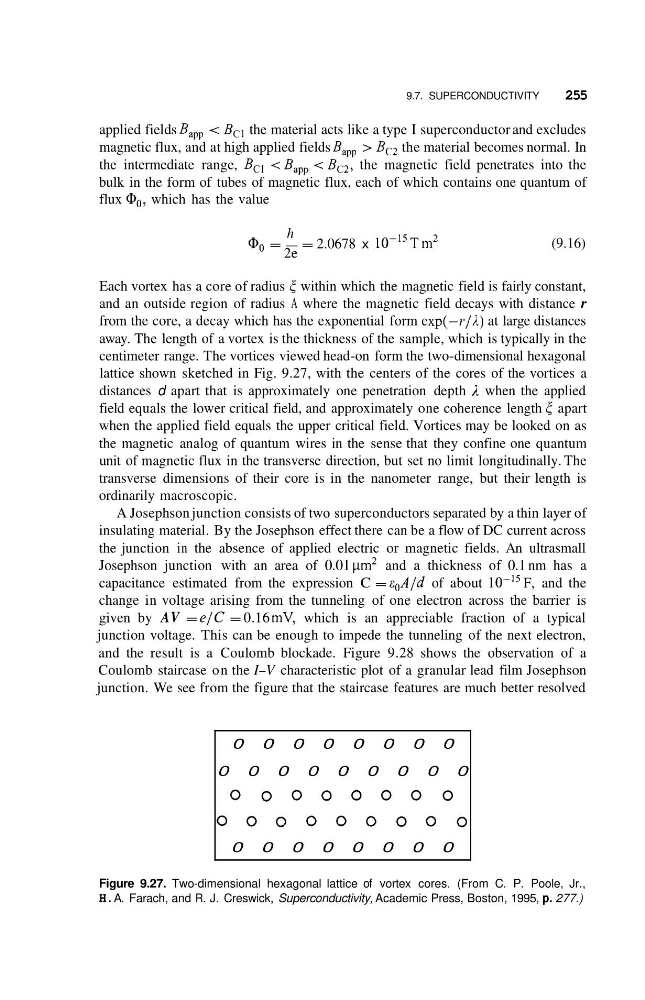
centimeter range. The vortices viewed head-on form the two-dimensional hexagonal
lattice shown sketched in Fig. 9.27, with the centers of the cores of the vortices a
distances d apart that is approximately one penetration depth ,? when the applied
field equals the lower critical field, and approximately one coherence length 5 apart
when the applied field equals the upper critical field. Vortices may be looked on as
the magnetic analog of quantum wires in the sense that they confine one quantum
unit of magnetic flux in the transverse direction, but set no limit longitudinally. The
transverse dimensions of their core is in the nanometer range, but their length is
ordinarily macroscopic.
A Josephson junction consists of two superconductors separated by a thin layer of
insulating material. By the Josephson effect there can be a flow of DC current across
the junction in the absence of applied electric or magnetic fields. An ultrasmall
Josephson junction with an area of 0.01 pm2 and a thickness of 0.1 nm has a
capacitance estimated from the expression C = EOA/d of about
F, and the
change in voltage arising from the tunneling of one electron across the barrier is
given by AV = e/C = 0.16 mV, which is an appreciable fraction of a typical
junction voltage. This can be enough to impede the tunneling of the next electron,
and the result is a Coulomb blockade. Figure 9.28 shows the observation of a
Coulomb staircase on the I-V characteristic plot of a granular lead film Josephson
junction. We see from the figure that the staircase features are much better resolved
0 0 0 0 0 0 0 0
0 0 0 0 0 0 0 0 0
0 0 0 0 0 0 0 0
0 0 0 0 0 0 0 0 0
0 0 0 0 0 0 0 0
Figure 9.27. Two-dimensional hexagonal lattice of vortex cores. (From C. P. Poole, Jr.,
H. A. Farach, and R. J. Creswick, Superconductivity, Academic Press, Boston, 1995, p. 277.)
255
applied fields B, , -= Bcl the material acts like a type I superconductor and excludes
magnetic flux, and at high applied fields B, , > BC2 the material becomes normal. In
the intermediate range, B,, < B, , < B,,, the magnetic field penetrates into the
bulk in the form of tubes of magnetic flux, each of which contains one quantum of
flux (Do, which has the value
(9.16)
h
2e
(Do = - = 2.0678 x
Tm2
Each vortex has a core of radius 5 within which the magnetic field is fairly constant,
and an outside region of radius A where the magnetic field decays with distance r
from the core, a decay which has the exponential form exp(-r/A) at large distances
away. The length of a vortex is the thickness of the sample, which is typically in the
centimeter range. The vortices viewed head-on form the two-dimensional hexagonal
lattice shown sketched in Fig. 9.27, with the centers of the cores of the vortices a
distances d apart that is approximately one penetration depth ,? when the applied
field equals the lower critical field, and approximately one coherence length 5 apart
when the applied field equals the upper critical field. Vortices may be looked on as
the magnetic analog of quantum wires in the sense that they confine one quantum
unit of magnetic flux in the transverse direction, but set no limit longitudinally. The
transverse dimensions of their core is in the nanometer range, but their length is
ordinarily macroscopic.
A Josephson junction consists of two superconductors separated by a thin layer of
insulating material. By the Josephson effect there can be a flow of DC current across
the junction in the absence of applied electric or magnetic fields. An ultrasmall
Josephson junction with an area of 0.01 pm2 and a thickness of 0.1 nm has a
capacitance estimated from the expression C = EOA/d of about
F, and the
change in voltage arising from the tunneling of one electron across the barrier is
given by AV = e/C = 0.16 mV, which is an appreciable fraction of a typical
junction voltage. This can be enough to impede the tunneling of the next electron,
and the result is a Coulomb blockade. Figure 9.28 shows the observation of a
Coulomb staircase on the I-V characteristic plot of a granular lead film Josephson
junction. We see from the figure that the staircase features are much better resolved
0 0 0 0 0 0 0 0
0 0 0 0 0 0 0 0 0
0 0 0 0 0 0 0 0
0 0 0 0 0 0 0 0 0
0 0 0 0 0 0 0 0
Figure 9.27. Two-dimensional hexagonal lattice of vortex cores. (From C. P. Poole, Jr.,
H. A. Farach, and R. J. Creswick, Superconductivity, Academic Press, Boston, 1995, p. 277.)