

248
QUANTUM WELLS, WIRES, AND DOTS
T = 4.2"K
I
I
I
4
I
- i ! J
= 22 mV
I 1
I
I
I
I
-0.2
0
0.2
v (volts)
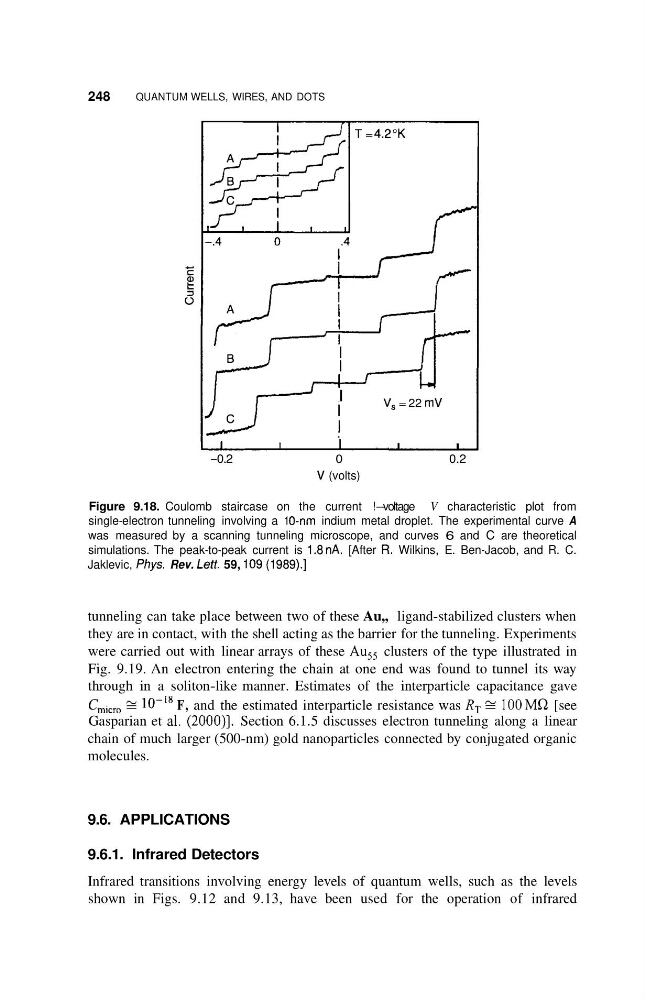
Figure 9.18. Coulomb staircase on the current !-voltage V characteristic plot from
single-electron tunneling involving a 1 0-nm indium metal droplet. The experimental curve A
was measured by a scanning tunneling microscope, and curves 6 and C are theoretical
simulations. The peak-to-peak current is 1.8nA. [After R. Wilkins, E. Ben-Jacob, and R. C.
Jaklevic, Phys. Rev. Left. 59, 109 (1989).]
tunneling can take place between two of these Au,, ligand-stabilized clusters when
they are in contact, with the shell acting as the barrier for the tunneling. Experiments
were carried out with linear arrays of these Au,, clusters of the type illustrated in
Fig. 9.19. An electron entering the chain at one end was found to tunnel its way
through in a soliton-like manner. Estimates of the interparticle capacitance gave
Cmj,,, E
F, and the estimated interparticle resistance was R, E l00MQ [see
Gasparian et al. (2000)l. Section 6.1.5 discusses electron tunneling along a linear
chain of much larger (500-nm) gold nanoparticles connected by conjugated organic
molecules.
9.6. APPLICATIONS
9.6.1. Infrared Detectors
Infrared transitions involving energy levels of quantum wells, such as the levels
shown in Figs. 9.12 and 9.13, have been used for the operation of infrared
QUANTUM WELLS, WIRES, AND DOTS
T = 4.2"K
I
I
I
4
I
- i ! J
= 22 mV
I 1
I
I
I
I
-0.2
0
0.2
v (volts)
Figure 9.18. Coulomb staircase on the current !-voltage V characteristic plot from
single-electron tunneling involving a 1 0-nm indium metal droplet. The experimental curve A
was measured by a scanning tunneling microscope, and curves 6 and C are theoretical
simulations. The peak-to-peak current is 1.8nA. [After R. Wilkins, E. Ben-Jacob, and R. C.
Jaklevic, Phys. Rev. Left. 59, 109 (1989).]
tunneling can take place between two of these Au,, ligand-stabilized clusters when
they are in contact, with the shell acting as the barrier for the tunneling. Experiments
were carried out with linear arrays of these Au,, clusters of the type illustrated in
Fig. 9.19. An electron entering the chain at one end was found to tunnel its way
through in a soliton-like manner. Estimates of the interparticle capacitance gave
Cmj,,, E
F, and the estimated interparticle resistance was R, E l00MQ [see
Gasparian et al. (2000)l. Section 6.1.5 discusses electron tunneling along a linear
chain of much larger (500-nm) gold nanoparticles connected by conjugated organic
molecules.
9.6. APPLICATIONS
9.6.1. Infrared Detectors
Infrared transitions involving energy levels of quantum wells, such as the levels
shown in Figs. 9.12 and 9.13, have been used for the operation of infrared