

242
QUANTUM WELLS, WIRES, AND DOTS
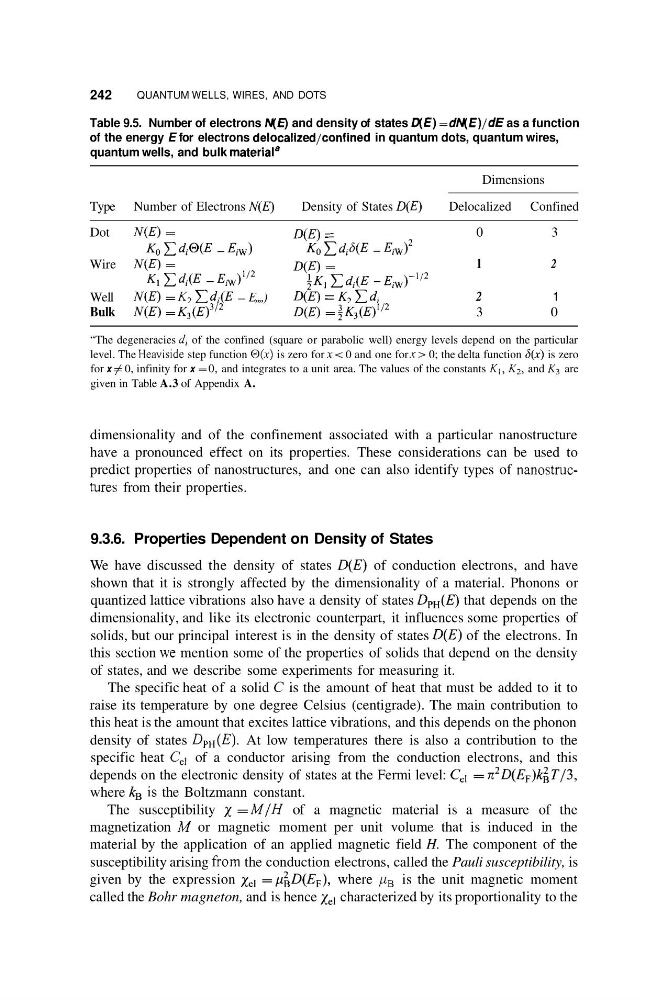
Table 9.5. Number of electrons YE) and density of states Q E ) = dM(E)/d€ as a function
of the energy E for electrons delocalized/confined in quantum dots, quantum wires,
quantum wells, and bulk material0
Dimensions
Type Number of Electrons N(E)
Density of States D(E)
Delocalized Confined
Dot
N(E) =
D(E) =
0
3
Wire N(E) =
D(E) =
1
2
Well N(E) = K2 d,(E - E,,,,)
D(E) = K2 d,
2
1
Kn C d 1 W - 4 w )
K n d l a ( ~
- ~ , w ) ’
K , c d,(E - E, )”*
t K , dl(E - Elw)-l/2
Bulk N ( E ) = K3(E)3’2
D(E) = ;K3(E)”*
3
0
“The degeneracies d, of the confined (square or parabolic well) energy levels depend on the particular
level. The Heaviside step function O(x) is zero for x < 0 and one for x > 0; the delta function 6(x) is zero
for x # 0, infinity for x = 0, and integrates to a unit area. The values of the constants K,, K2, and K , are
given in Table A.3 of Appendix A.
dimensionality and of the confinement associated with a particular nanostructure
have a pronounced effect on its properties. These considerations can be used to
predict properties of nanostructures, and one can also identify types of nanostructures from their properties.
9.3.6. Properties Dependent on Density of States
We have discussed the density of states D(E) of conduction electrons, and have
shown that it is strongly affected by the dimensionality of a material. Phonons or
quantized lattice vibrations also have a density of states DPH(E) that depends on the
dimensionality, and like its electronic counterpart, it influences some properties of
solids, but our principal interest is in the density of states D(E) of the electrons. In
this section we mention some of the properties of solids that depend on the density
of states, and we describe some experiments for measuring it.
The specific heat of a solid C is the amount of heat that must be added to it to
raise its temperature by one degree Celsius (centigrade). The main contribution to
this heat is the amount that excites lattice vibrations, and this depends on the phonon
density of states &(E). At low temperatures there is also a contribution to the
specific heat C,, of a conductor arising from the conduction electrons, and this
depends on the electronic density of states at the Fermi level: C,, = n’D(EF)kiT/3,
where kB is the Boltzmann constant.
The susceptibility x = M / H of a magnetic material is a measure of the
magnetization M or magnetic moment per unit volume that is induced in the
material by the application of an applied magnetic field H. The component of the
susceptibility arising from the conduction electrons, called the Pauli susceptibility, is
given by the expression zel = &D(EF), where pB is the unit magnetic moment
called the Bohr magneton, and is hence zel characterized by its proportionality to the
QUANTUM WELLS, WIRES, AND DOTS
Table 9.5. Number of electrons YE) and density of states Q E ) = dM(E)/d€ as a function
of the energy E for electrons delocalized/confined in quantum dots, quantum wires,
quantum wells, and bulk material0
Dimensions
Type Number of Electrons N(E)
Density of States D(E)
Delocalized Confined
Dot
N(E) =
D(E) =
0
3
Wire N(E) =
D(E) =
1
2
Well N(E) = K2 d,(E - E,,,,)
D(E) = K2 d,
2
1
Kn C d 1 W - 4 w )
K n d l a ( ~
- ~ , w ) ’
K , c d,(E - E, )”*
t K , dl(E - Elw)-l/2
Bulk N ( E ) = K3(E)3’2
D(E) = ;K3(E)”*
3
0
“The degeneracies d, of the confined (square or parabolic well) energy levels depend on the particular
level. The Heaviside step function O(x) is zero for x < 0 and one for x > 0; the delta function 6(x) is zero
for x # 0, infinity for x = 0, and integrates to a unit area. The values of the constants K,, K2, and K , are
given in Table A.3 of Appendix A.
dimensionality and of the confinement associated with a particular nanostructure
have a pronounced effect on its properties. These considerations can be used to
predict properties of nanostructures, and one can also identify types of nanostructures from their properties.
9.3.6. Properties Dependent on Density of States
We have discussed the density of states D(E) of conduction electrons, and have
shown that it is strongly affected by the dimensionality of a material. Phonons or
quantized lattice vibrations also have a density of states DPH(E) that depends on the
dimensionality, and like its electronic counterpart, it influences some properties of
solids, but our principal interest is in the density of states D(E) of the electrons. In
this section we mention some of the properties of solids that depend on the density
of states, and we describe some experiments for measuring it.
The specific heat of a solid C is the amount of heat that must be added to it to
raise its temperature by one degree Celsius (centigrade). The main contribution to
this heat is the amount that excites lattice vibrations, and this depends on the phonon
density of states &(E). At low temperatures there is also a contribution to the
specific heat C,, of a conductor arising from the conduction electrons, and this
depends on the electronic density of states at the Fermi level: C,, = n’D(EF)kiT/3,
where kB is the Boltzmann constant.
The susceptibility x = M / H of a magnetic material is a measure of the
magnetization M or magnetic moment per unit volume that is induced in the
material by the application of an applied magnetic field H. The component of the
susceptibility arising from the conduction electrons, called the Pauli susceptibility, is
given by the expression zel = &D(EF), where pB is the unit magnetic moment
called the Bohr magneton, and is hence zel characterized by its proportionality to the