

9.3. SIZE AND DIMENSIONALITY EFFECTS
239
-112 a
0
112 a
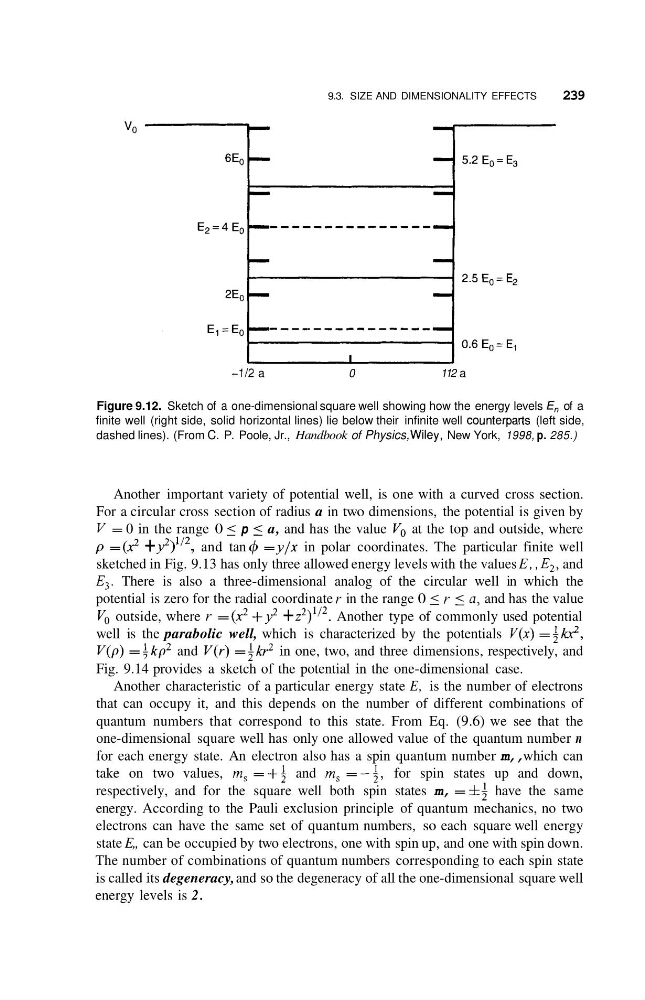
Figure 9.12. Sketch of a one-dimensional square well showing how the energy levels E,, of a
finite well (right side, solid horizontal lines) lie below their infinite well counterparts (left side,
dashed lines). (From C. P. Poole, Jr., Handbook of Physics, Wiley, New York, 1998, p. 285.)
Another important variety of potential well, is one with a curved cross section.
For a circular cross section of radius a in two dimensions, the potential is given by
V = 0 in the range 0 5 p 5 a, and has the value Vo at the top and outside, where
p = (x2 +
and tan 4 = y / x in polar coordinates. The particular finite well
sketched in Fig. 9.13 has only three allowed energy levels with the values E , , E2, and
E3. There is also a three-dimensional analog of the circular well in which the
potential is zero for the radial coordinate r in the range 0 5 r 5 u, and has the value
Vo outside, where r = (x2 +? + z*)~/~. Another type of commonly used potential
well is the parabolic well, which is characterized by the potentials V(x) = ikx2,
V(p) = + k p 2 and V ( r ) = ikr' in one, two, and three dimensions, respectively, and
Fig. 9.14 provides a sketch of the potential in the one-dimensional case.
Another characteristic of a particular energy state E, is the number of electrons
that can occupy it, and this depends on the number of different combinations of
quantum numbers that correspond to this state. From Eq. (9.6) we see that the
one-dimensional square well has only one allowed value of the quantum number n
for each energy state. An electron also has a spin quantum number m,, which can
take on two values, m, = +$ and ms = -4, for spin states up and down,
respectively, and for the square well both spin states m, =
have the same
energy. According to the Pauli exclusion principle of quantum mechanics, no two
electrons can have the same set of quantum numbers, so each square well energy
state E,, can be occupied by two electrons, one with spin up, and one with spin down.
The number of combinations of quantum numbers corresponding to each spin state
is called its degeneracy, and so the degeneracy of all the one-dimensional square well
energy levels is 2 .
239
-112 a
0
112 a
Figure 9.12. Sketch of a one-dimensional square well showing how the energy levels E,, of a
finite well (right side, solid horizontal lines) lie below their infinite well counterparts (left side,
dashed lines). (From C. P. Poole, Jr., Handbook of Physics, Wiley, New York, 1998, p. 285.)
Another important variety of potential well, is one with a curved cross section.
For a circular cross section of radius a in two dimensions, the potential is given by
V = 0 in the range 0 5 p 5 a, and has the value Vo at the top and outside, where
p = (x2 +
and tan 4 = y / x in polar coordinates. The particular finite well
sketched in Fig. 9.13 has only three allowed energy levels with the values E , , E2, and
E3. There is also a three-dimensional analog of the circular well in which the
potential is zero for the radial coordinate r in the range 0 5 r 5 u, and has the value
Vo outside, where r = (x2 +? + z*)~/~. Another type of commonly used potential
well is the parabolic well, which is characterized by the potentials V(x) = ikx2,
V(p) = + k p 2 and V ( r ) = ikr' in one, two, and three dimensions, respectively, and
Fig. 9.14 provides a sketch of the potential in the one-dimensional case.
Another characteristic of a particular energy state E, is the number of electrons
that can occupy it, and this depends on the number of different combinations of
quantum numbers that correspond to this state. From Eq. (9.6) we see that the
one-dimensional square well has only one allowed value of the quantum number n
for each energy state. An electron also has a spin quantum number m,, which can
take on two values, m, = +$ and ms = -4, for spin states up and down,
respectively, and for the square well both spin states m, =
have the same
energy. According to the Pauli exclusion principle of quantum mechanics, no two
electrons can have the same set of quantum numbers, so each square well energy
state E,, can be occupied by two electrons, one with spin up, and one with spin down.
The number of combinations of quantum numbers corresponding to each spin state
is called its degeneracy, and so the degeneracy of all the one-dimensional square well
energy levels is 2 .