

7.7. FERRQFLUlOS
191
FerroRuids can also form mapctic field tunable diffnction gratings. Difiction
is the result of interference o f two or more light waves of the same wavelength
traveling paths of slightly different lengths before arriving nt a detector such as :I
photographic film. When the pathlcngth differs by halr a wavelength, the wilves
destructivcly interfere, resulting in a tltirk band on the film. When the path lengths
difler by a wnvelengh, then the wavcs constnictively interfcrc, producing a bright
band on thc lilm. A diffraction grating consists of small slits separated by distances
of the order of the wave!ength of thc incident light. We saw above that when a DC
magnetic field of sufficient strength is applied perpendicular to ii magnetofluid film,
an equilibrium two-dimensional hexagonal lattice is formed with columns of
nanoparticles accirpyhg the lattice sitcs. This structure can act as 6 two-dimensional
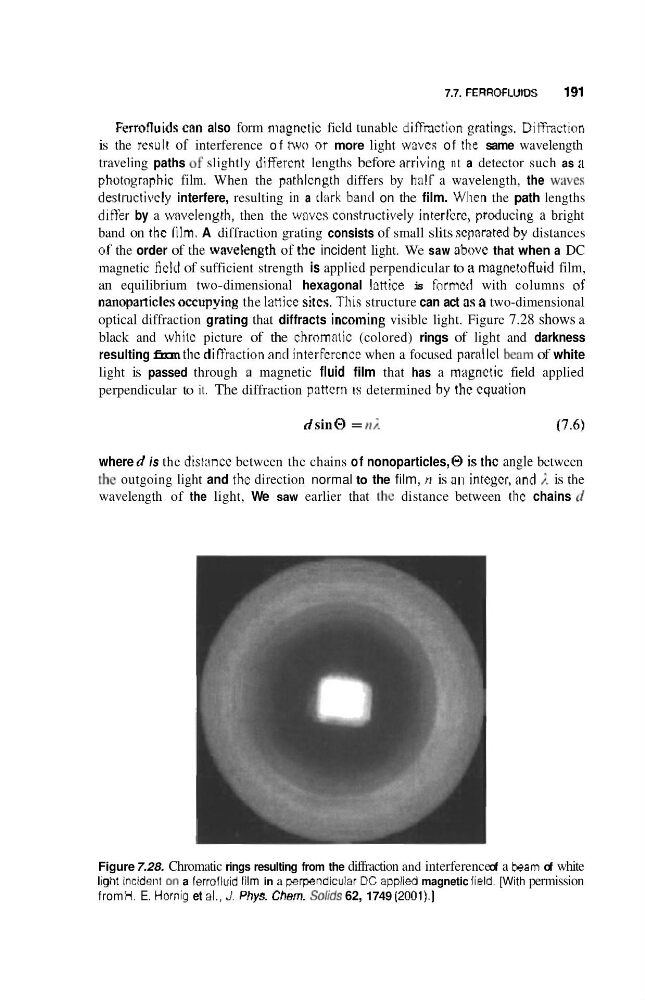
optical diffraction grating that diffracts incoining visible light. Figure 7.28 shows a
black and white picture of the chromntic (colored) rings of light and darkness
resulting from thc di ffmction and interFcrcncc when a focused pamllcl beam of white
light is passed through I magnetic fluid film that has a rnagnctic field applied
perpendicular to it. The diffraction pattcrn IS determined 'by rhc equation
d sin 0 = a;.
(7.6)
where d is the disrancc between the chains of nonoparticles, 0 is thc angle between
!he outgoing light and thc direction normal to the film, n is an integer, and j. is the
wavelength of the light, We saw earlier that [he distance between the chains d
Figure 7.28. Chromatic rings resulting from the diffraction and interference of a k a m of white
light indent on a fernfluid lilm in a perpendtcular DC applied magnetic lield. [With permission
from H. E. Hornig et al., J. Phys. Chem. So/,ds 62, 1749 (2001).]
191
FerroRuids can also form mapctic field tunable diffnction gratings. Difiction
is the result of interference o f two or more light waves of the same wavelength
traveling paths of slightly different lengths before arriving nt a detector such as :I
photographic film. When the pathlcngth differs by halr a wavelength, the wilves
destructivcly interfere, resulting in a tltirk band on the film. When the path lengths
difler by a wnvelengh, then the wavcs constnictively interfcrc, producing a bright
band on thc lilm. A diffraction grating consists of small slits separated by distances
of the order of the wave!ength of thc incident light. We saw above that when a DC
magnetic field of sufficient strength is applied perpendicular to ii magnetofluid film,
an equilibrium two-dimensional hexagonal lattice is formed with columns of
nanoparticles accirpyhg the lattice sitcs. This structure can act as 6 two-dimensional
optical diffraction grating that diffracts incoining visible light. Figure 7.28 shows a
black and white picture of the chromntic (colored) rings of light and darkness
resulting from thc di ffmction and interFcrcncc when a focused pamllcl beam of white
light is passed through I magnetic fluid film that has a rnagnctic field applied
perpendicular to it. The diffraction pattcrn IS determined 'by rhc equation
d sin 0 = a;.
(7.6)
where d is the disrancc between the chains of nonoparticles, 0 is thc angle between
!he outgoing light and thc direction normal to the film, n is an integer, and j. is the
wavelength of the light, We saw earlier that [he distance between the chains d
Figure 7.28. Chromatic rings resulting from the diffraction and interference of a k a m of white
light indent on a fernfluid lilm in a perpendtcular DC applied magnetic lield. [With permission
from H. E. Hornig et al., J. Phys. Chem. So/,ds 62, 1749 (2001).]