

7.7. FECIROFLUIDS
189
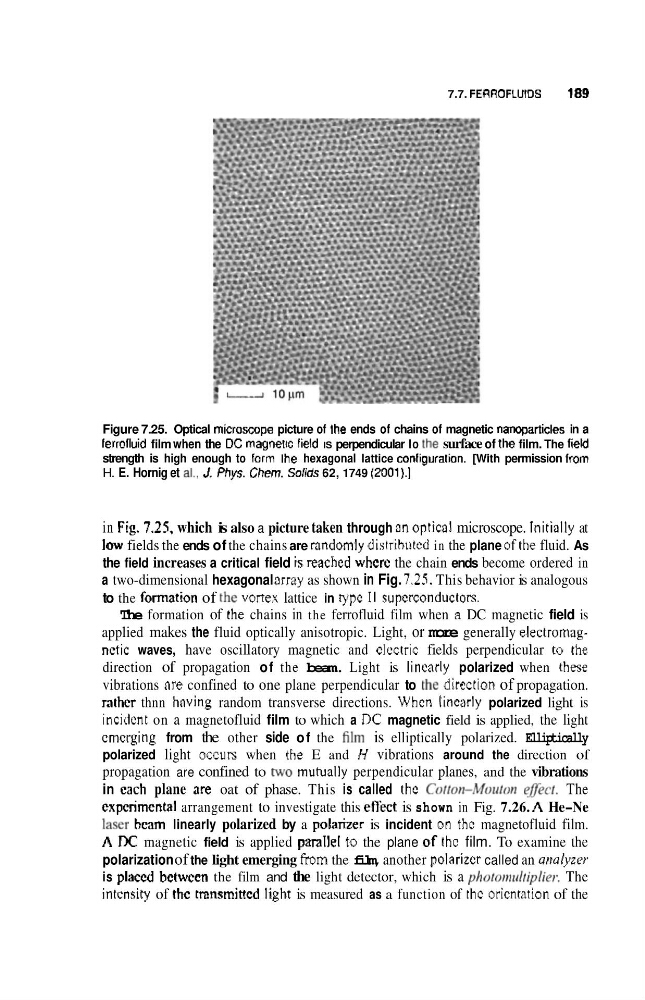
Figure 7.25. Optical microsoope picture of Ihe ends of chains of magnetic namparticles in a
ferrolluid film when the OC magnettc field IS perpendicular lo !he surface of the film. The fieH
strength is high enough to form Ihe hexagonal lattice configuration. [With permission from
H. E. Hornig et a!., J. Phys. Chem. Solids 62, 1749 (2001).]
in Fig. 7-25, which is also a picture taken through an optical microscope. Initially at
IOW fields the ends of the chains are randomly distrihutcd in the plane ofthe fluid. As
the field increases a critical field is reached whcrc the chain ends become ordered in
a two-dimensional hexagonal a m y as shown in Fig. 7-25. This behavior is analogous
to the formation of the yoflex lattice in ygc II superconductors.
The formation of the chains in the ferrofluid film when a DC magnetic field is
applied makes the fluid optically anisotropic. Light, or more generally electrornagnetic waves, have oscillatory magnetic and clt'ctric fields perpendicular to the
direction of propagation of the beam. Light is lincarly polarized when these
vibrations nre confined to one plane perpendicular to the direction of propagation.
rather thnn having random transverse directions. When linearly polarized light is
incidcnt on a magnetofluid film to which a DC magnetic field is applied, the light
cmcrging from the other side o f the film is elliptically polarized. Elliptically
polarized light occurs when the E and H vibrations around the direction of
propagation are confined to two mnutllally perpendicular planes, and the vibrations
in each plane are oat of phase. This is called thc Co!fon-Mim?on eflec/. The
expcrimcntal arrangement to investigate this eWect is shown in Fig. 7.26. A He-Ne
l a w hcam linearly polarized by a polarizer is incident QFI the magnetofluid film.
A DC magnetic field is applied parallel to the plane of thc film. To examine the
polarization of the light emerging From the film, another polarizcr called an anahzer
is placcd between the film and the light detector, which is a ~ h ~ ~ t o ~ n i ~ l ~ i p l i e ~ ~ .
The
intcnsity of thc tmnsrnittcd light is measured as a function of thc oricntation of the
189
Figure 7.25. Optical microsoope picture of Ihe ends of chains of magnetic namparticles in a
ferrolluid film when the OC magnettc field IS perpendicular lo !he surface of the film. The fieH
strength is high enough to form Ihe hexagonal lattice configuration. [With permission from
H. E. Hornig et a!., J. Phys. Chem. Solids 62, 1749 (2001).]
in Fig. 7-25, which is also a picture taken through an optical microscope. Initially at
IOW fields the ends of the chains are randomly distrihutcd in the plane ofthe fluid. As
the field increases a critical field is reached whcrc the chain ends become ordered in
a two-dimensional hexagonal a m y as shown in Fig. 7-25. This behavior is analogous
to the formation of the yoflex lattice in ygc II superconductors.
The formation of the chains in the ferrofluid film when a DC magnetic field is
applied makes the fluid optically anisotropic. Light, or more generally electrornagnetic waves, have oscillatory magnetic and clt'ctric fields perpendicular to the
direction of propagation of the beam. Light is lincarly polarized when these
vibrations nre confined to one plane perpendicular to the direction of propagation.
rather thnn having random transverse directions. When linearly polarized light is
incidcnt on a magnetofluid film to which a DC magnetic field is applied, the light
cmcrging from the other side o f the film is elliptically polarized. Elliptically
polarized light occurs when the E and H vibrations around the direction of
propagation are confined to two mnutllally perpendicular planes, and the vibrations
in each plane are oat of phase. This is called thc Co!fon-Mim?on eflec/. The
expcrimcntal arrangement to investigate this eWect is shown in Fig. 7.26. A He-Ne
l a w hcam linearly polarized by a polarizer is incident QFI the magnetofluid film.
A DC magnetic field is applied parallel to the plane of thc film. To examine the
polarization of the light emerging From the film, another polarizcr called an anahzer
is placcd between the film and the light detector, which is a ~ h ~ ~ t o ~ n i ~ l ~ i p l i e ~ ~ .
The
intcnsity of thc tmnsrnittcd light is measured as a function of thc oricntation of the