

186
NANOSTRUCTURED FERROMAGNETISM
0.02 1
/
/
’
,’
/
‘0
50 100 150 200 250 300 350
TEMPERATURE (K)
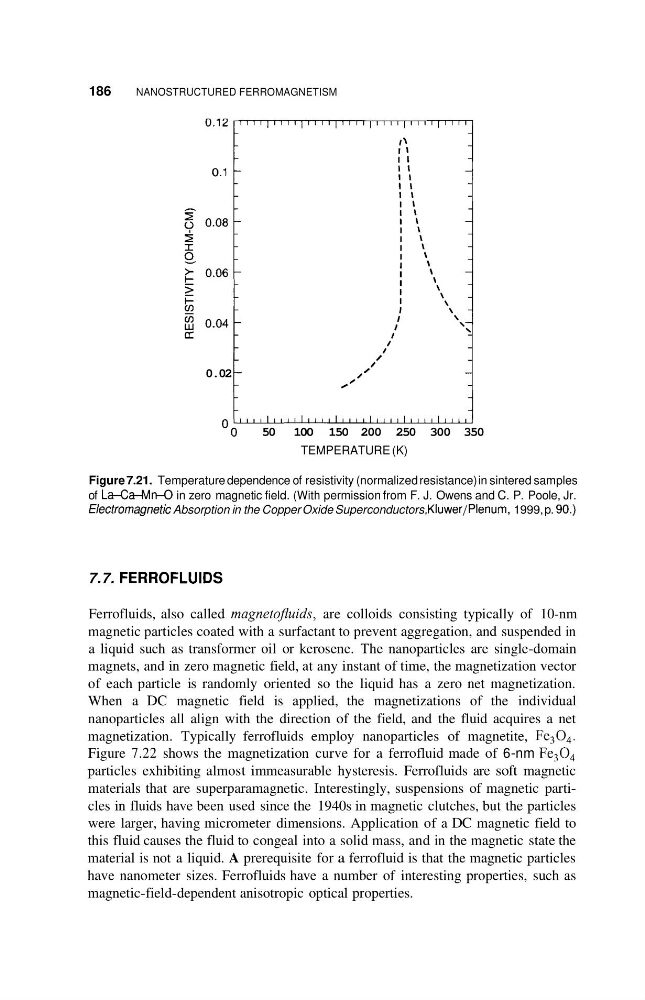
Figure 7.21. Temperature dependence of resistivity (normalized resistance) in sintered samples
of La-Ca-hh-4 in zero magnetic field. (With permission from F. J. Owens and C. P. Poole, Jr.
Electromagnetic Absorption in the Copper Oxide Superconductors, Kluwer/Plenum, 1999, p. 90.)
7.7. FERROFLUIDS
Ferrofluids, also called mugnetoJEuids, are colloids consisting typically of 10-nm
magnetic particles coated with a surfactant to prevent aggregation, and suspended in
a liquid such as transformer oil or kerosene. The nanoparticles are single-domain
magnets, and in zero magnetic field, at any instant of time, the magnetization vector
of each particle is randomly oriented so the liquid has a zero net magnetization.
When a DC magnetic field is applied, the magnetizations of the individual
nanoparticles all align with the direction of the field, and the fluid acquires a net
magnetization. Typically ferrofluids employ nanoparticles of magnetite, Fe304.
Figure 7.22 shows the magnetization curve for a ferrofluid made of 6-nm Fe304
particles exhibiting almost immeasurable hysteresis. Ferrofluids are soft magnetic
materials that are superparamagnetic. Interestingly, suspensions of magnetic particles in fluids have been used since the 1940s in magnetic clutches, but the particles
were larger, having micrometer dimensions. Application of a DC magnetic field to
this fluid causes the fluid to congeal into a solid mass, and in the magnetic state the
material is not a liquid. A prerequisite for a ferrofluid is that the magnetic particles
have nanometer sizes. Ferrofluids have a number of interesting properties, such as
magnetic-field-dependent anisotropic optical properties.
NANOSTRUCTURED FERROMAGNETISM
0.02 1
/
/
’
,’
/
‘0
50 100 150 200 250 300 350
TEMPERATURE (K)
Figure 7.21. Temperature dependence of resistivity (normalized resistance) in sintered samples
of La-Ca-hh-4 in zero magnetic field. (With permission from F. J. Owens and C. P. Poole, Jr.
Electromagnetic Absorption in the Copper Oxide Superconductors, Kluwer/Plenum, 1999, p. 90.)
7.7. FERROFLUIDS
Ferrofluids, also called mugnetoJEuids, are colloids consisting typically of 10-nm
magnetic particles coated with a surfactant to prevent aggregation, and suspended in
a liquid such as transformer oil or kerosene. The nanoparticles are single-domain
magnets, and in zero magnetic field, at any instant of time, the magnetization vector
of each particle is randomly oriented so the liquid has a zero net magnetization.
When a DC magnetic field is applied, the magnetizations of the individual
nanoparticles all align with the direction of the field, and the fluid acquires a net
magnetization. Typically ferrofluids employ nanoparticles of magnetite, Fe304.
Figure 7.22 shows the magnetization curve for a ferrofluid made of 6-nm Fe304
particles exhibiting almost immeasurable hysteresis. Ferrofluids are soft magnetic
materials that are superparamagnetic. Interestingly, suspensions of magnetic particles in fluids have been used since the 1940s in magnetic clutches, but the particles
were larger, having micrometer dimensions. Application of a DC magnetic field to
this fluid causes the fluid to congeal into a solid mass, and in the magnetic state the
material is not a liquid. A prerequisite for a ferrofluid is that the magnetic particles
have nanometer sizes. Ferrofluids have a number of interesting properties, such as
magnetic-field-dependent anisotropic optical properties.