

184
NANOSTRUCTURED FERROMAGNETISM
20
0
s
Q
10
5
-
'0
2 4 6 8 10 12 14 16 18 20
MAGNETIC FIELD (KOe)
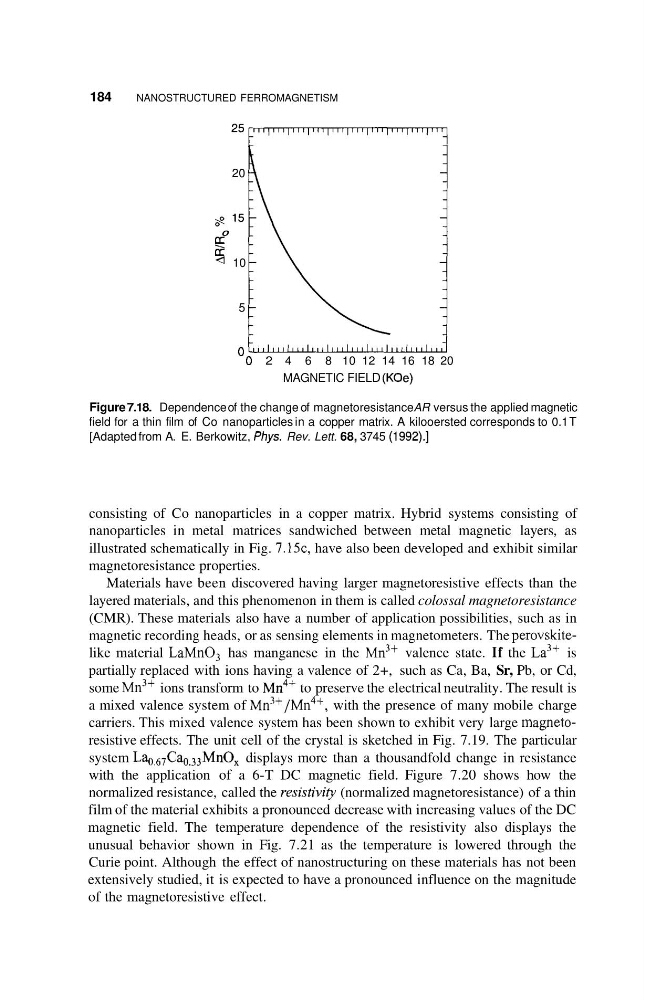
Figure 7.18. Dependence of the change of magnetoresistance AR versus the applied magnetic
field for a thin film of Co nanoparticles in a copper matrix. A kilooersted corresponds to 0.1 T
[Adapted from A. E. Berkowitz, fhys. Rev. Lett. 68, 3745 (1992).]
consisting of Co nanoparticles in a copper matrix. Hybrid systems consisting of
nanoparticles in metal matrices sandwiched between metal magnetic layers, as
illustrated schematically in Fig. 7.15c, have also been developed and exhibit similar
magnetoresistance properties.
Materials have been discovered having larger magnetoresistive effects than the
layered materials, and this phenomenon in them is called colossal magnetoresistance
(CMR). These materials also have a number of application possibilities, such as in
magnetic recording heads, or as sensing elements in magnetometers. The perovskitelike material LaMnO, has manganese in the Mn3+ valence state. If the La3+ is
partially replaced with ions having a valence of 2+, such as Ca, Ba, Sr, Pb, or Cd,
some Mn3+ ions transform to Mn4t to preserve the electrical neutrality. The result is
a mixed valence system of Mn3+/Mn4+, with the presence of many mobile charge
carriers. This mixed valence system has been shown to exhibit very large magnetoresistive effects. The unit cell of the crystal is sketched in Fig. 7.19. The particular
system La,..,,Ca,,33Mn0, displays more than a thousandfold change in resistance
with the application of a 6-T DC magnetic field. Figure 7.20 shows how the
normalized resistance, called the re.szstivi@ (normalized magnetoresistance) of a thin
film of the material exhibits a pronounced decrease with increasing values of the DC
magnetic field. The temperature dependence of the resistivity also displays the
unusual behavior shown in Fig. 7.21 as the temperature is lowered through the
Curie point. Although the effect of nanostructuring on these materials has not been
extensively studied, it is expected to have a pronounced influence on the magnitude
of the magnetoresistive effect.
NANOSTRUCTURED FERROMAGNETISM
20
0
s
Q
10
5
-
'0
2 4 6 8 10 12 14 16 18 20
MAGNETIC FIELD (KOe)
Figure 7.18. Dependence of the change of magnetoresistance AR versus the applied magnetic
field for a thin film of Co nanoparticles in a copper matrix. A kilooersted corresponds to 0.1 T
[Adapted from A. E. Berkowitz, fhys. Rev. Lett. 68, 3745 (1992).]
consisting of Co nanoparticles in a copper matrix. Hybrid systems consisting of
nanoparticles in metal matrices sandwiched between metal magnetic layers, as
illustrated schematically in Fig. 7.15c, have also been developed and exhibit similar
magnetoresistance properties.
Materials have been discovered having larger magnetoresistive effects than the
layered materials, and this phenomenon in them is called colossal magnetoresistance
(CMR). These materials also have a number of application possibilities, such as in
magnetic recording heads, or as sensing elements in magnetometers. The perovskitelike material LaMnO, has manganese in the Mn3+ valence state. If the La3+ is
partially replaced with ions having a valence of 2+, such as Ca, Ba, Sr, Pb, or Cd,
some Mn3+ ions transform to Mn4t to preserve the electrical neutrality. The result is
a mixed valence system of Mn3+/Mn4+, with the presence of many mobile charge
carriers. This mixed valence system has been shown to exhibit very large magnetoresistive effects. The unit cell of the crystal is sketched in Fig. 7.19. The particular
system La,..,,Ca,,33Mn0, displays more than a thousandfold change in resistance
with the application of a 6-T DC magnetic field. Figure 7.20 shows how the
normalized resistance, called the re.szstivi@ (normalized magnetoresistance) of a thin
film of the material exhibits a pronounced decrease with increasing values of the DC
magnetic field. The temperature dependence of the resistivity also displays the
unusual behavior shown in Fig. 7.21 as the temperature is lowered through the
Curie point. Although the effect of nanostructuring on these materials has not been
extensively studied, it is expected to have a pronounced influence on the magnitude
of the magnetoresistive effect.