

182
NANOSTRUCTURED FERROMAGNETISM
NON MAGNETIC METAL
NON MAGNETIC METAL
0
NiFe 4
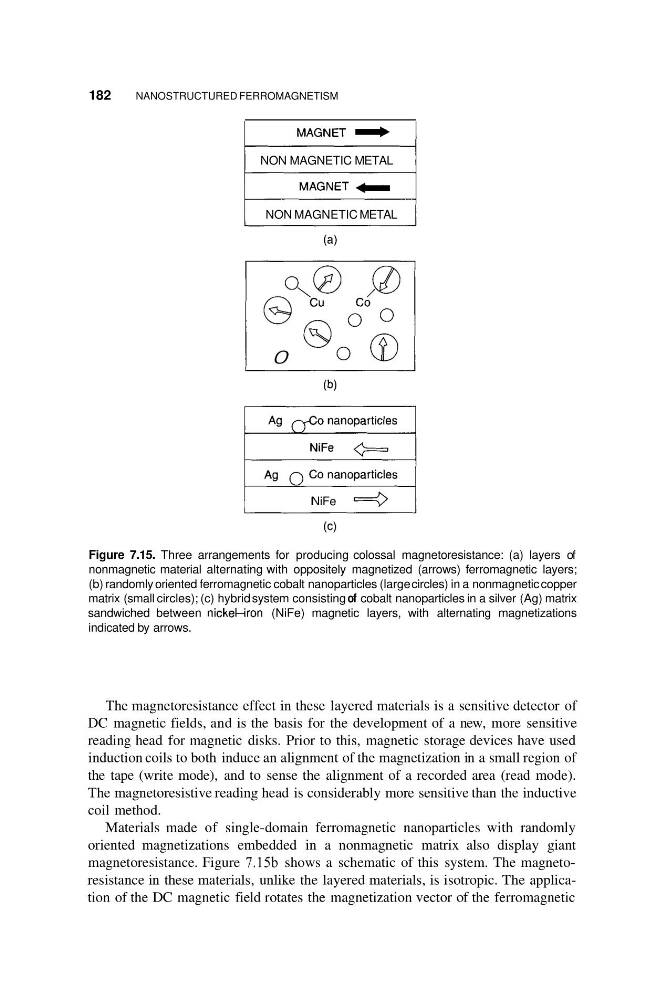
Figure 7.15. Three arrangements for producing colossal magnetoresistance: (a) layers of
nonmagnetic material alternating with oppositely magnetized (arrows) ferromagnetic layers;
(b) randomly oriented ferromagnetic cobalt nanoparticles (large circles) in a nonmagnetic copper
matrix (small circles); (c) hybrid system consisting of cobalt nanoparticles in a silver (Ag) matrix
sandwiched between nickeliron (NiFe) magnetic layers, with alternating magnetizations
indicated by arrows.
The magnetoresistance effect in these layered materials is a sensitive detector of
DC magnetic fields, and is the basis for the development of a new, more sensitive
reading head for magnetic disks. Prior to this, magnetic storage devices have used
induction coils to both induce an alignment of the magnetization in a small region of
the tape (write mode), and to sense the alignment of a recorded area (read mode).
The magnetoresistive reading head is considerably more sensitive than the inductive
coil method.
Materials made of single-domain ferromagnetic nanoparticles with randomly
oriented magnetizations embedded in a nonmagnetic matrix also display giant
magnetoresistance. Figure 7.15b shows a schematic of this system. The magnetoresistance in these materials, unlike the layered materials, is isotropic. The application of the DC magnetic field rotates the magnetization vector of the ferromagnetic
NANOSTRUCTURED FERROMAGNETISM
NON MAGNETIC METAL
NON MAGNETIC METAL
0
NiFe 4
Figure 7.15. Three arrangements for producing colossal magnetoresistance: (a) layers of
nonmagnetic material alternating with oppositely magnetized (arrows) ferromagnetic layers;
(b) randomly oriented ferromagnetic cobalt nanoparticles (large circles) in a nonmagnetic copper
matrix (small circles); (c) hybrid system consisting of cobalt nanoparticles in a silver (Ag) matrix
sandwiched between nickeliron (NiFe) magnetic layers, with alternating magnetizations
indicated by arrows.
The magnetoresistance effect in these layered materials is a sensitive detector of
DC magnetic fields, and is the basis for the development of a new, more sensitive
reading head for magnetic disks. Prior to this, magnetic storage devices have used
induction coils to both induce an alignment of the magnetization in a small region of
the tape (write mode), and to sense the alignment of a recorded area (read mode).
The magnetoresistive reading head is considerably more sensitive than the inductive
coil method.
Materials made of single-domain ferromagnetic nanoparticles with randomly
oriented magnetizations embedded in a nonmagnetic matrix also display giant
magnetoresistance. Figure 7.15b shows a schematic of this system. The magnetoresistance in these materials, unlike the layered materials, is isotropic. The application of the DC magnetic field rotates the magnetization vector of the ferromagnetic