

154
BULK NANOSTRUCTURED MATERIALS
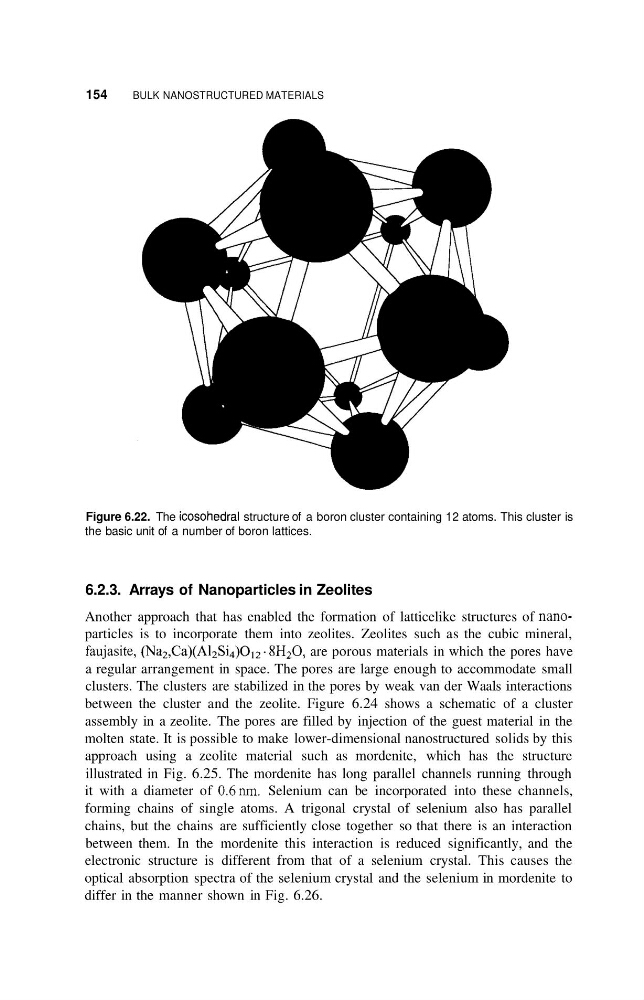
Figure 6.22. The icosohedral structure of a boron cluster containing 12 atoms. This cluster is
the basic unit of a number of boron lattices.
6.2.3. Arrays of Nanoparticles in Zeolites
Another approach that has enabled the formation of latticelike structures of nanoparticles is to incorporate them into zeolites. Zeolites such as the cubic mineral,
faujasite, (Na2,Ca)(A12Si4)OI2. 8H20, are porous materials in which the pores have
a regular arrangement in space. The pores are large enough to accommodate small
clusters. The clusters are stabilized in the pores by weak van der Waals interactions
between the cluster and the zeolite. Figure 6.24 shows a schematic of a cluster
assembly in a zeolite. The pores are filled by injection of the guest material in the
molten state. It is possible to make lower-dimensional nanostructured solids by this
approach using a zeolite material such as mordenite, which has the structure
illustrated in Fig. 6.25. The mordenite has long parallel channels running through
it with a diameter of 0.6nm. Selenium can be incorporated into these channels,
forming chains of single atoms. A trigonal crystal of selenium also has parallel
chains, but the chains are sufficiently close together so that there is an interaction
between them. In the mordenite this interaction is reduced significantly, and the
electronic structure is different from that of a selenium crystal. This causes the
optical absorption spectra of the selenium crystal and the selenium in mordenite to
differ in the manner shown in Fig. 6.26.
BULK NANOSTRUCTURED MATERIALS
Figure 6.22. The icosohedral structure of a boron cluster containing 12 atoms. This cluster is
the basic unit of a number of boron lattices.
6.2.3. Arrays of Nanoparticles in Zeolites
Another approach that has enabled the formation of latticelike structures of nanoparticles is to incorporate them into zeolites. Zeolites such as the cubic mineral,
faujasite, (Na2,Ca)(A12Si4)OI2. 8H20, are porous materials in which the pores have
a regular arrangement in space. The pores are large enough to accommodate small
clusters. The clusters are stabilized in the pores by weak van der Waals interactions
between the cluster and the zeolite. Figure 6.24 shows a schematic of a cluster
assembly in a zeolite. The pores are filled by injection of the guest material in the
molten state. It is possible to make lower-dimensional nanostructured solids by this
approach using a zeolite material such as mordenite, which has the structure
illustrated in Fig. 6.25. The mordenite has long parallel channels running through
it with a diameter of 0.6nm. Selenium can be incorporated into these channels,
forming chains of single atoms. A trigonal crystal of selenium also has parallel
chains, but the chains are sufficiently close together so that there is an interaction
between them. In the mordenite this interaction is reduced significantly, and the
electronic structure is different from that of a selenium crystal. This causes the
optical absorption spectra of the selenium crystal and the selenium in mordenite to
differ in the manner shown in Fig. 6.26.