

6.1. SOLID DISORDERED NANOSTRUCTURES
139
along the dislocation are weaker. One method of increasing the stress at which the
brittle-to-ductile transition occurs is to impede the movement of the dislocations by
introducing tiny particles of another material into the lattice. This process is used to
harden steel, where particles of iron carbide are precipitated into the steel. The iron
carbide particles block the movement of the dislocations.
6.1.3. Mechanical Properties
The intrinsic elastic modulus of a nanostructured material is essentially the same as
that of the bulk material having micrometer-sized grains until the grain size becomes
very small, less than 5 nm. As we saw in Chapter 5, Young’s modulus is the factor
relating stress and strain. It is the slope of the stress-strain curve in the linear region.
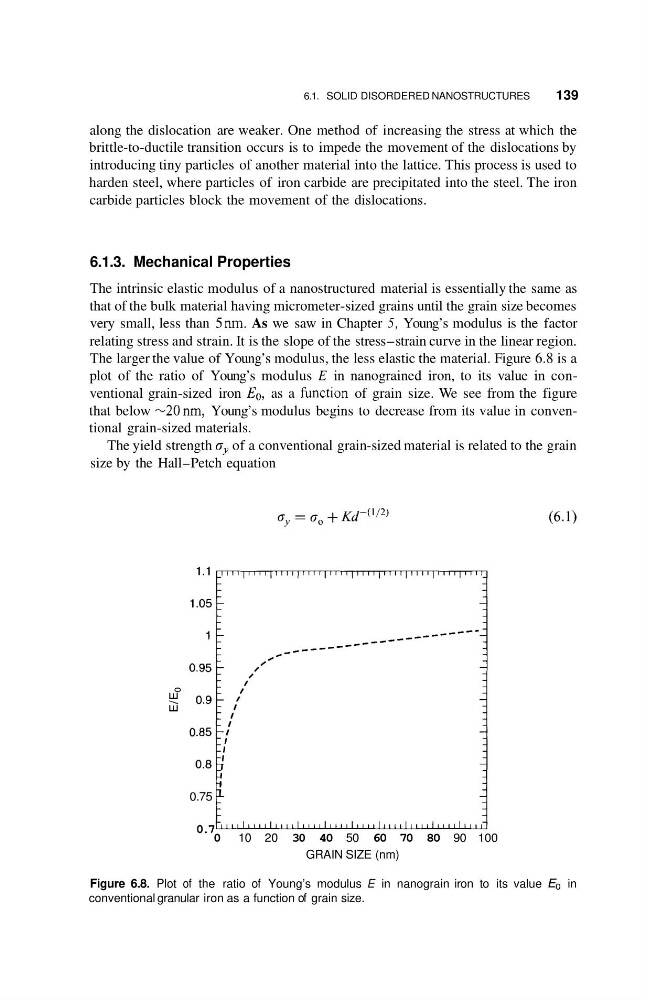
The larger the value of Young’s modulus, the less elastic the material. Figure 6.8 is a
plot of the ratio of Young’s modulus E in nanograined iron, to its value in conventional grain-sized iron Eo, as a function of grain size. We see from the figure
that below -20nm, Young’s modulus begins to decrease from its value in conventional grain-sized materials.
The yield strength oy of a conventional grain-sized material is related to the grain
size by the Hall-Petch equation
0.75 1
0.7
0 10 20 30 40 50 60 70 80 90 100
GRAIN SIZE (nm)
Figure 6.8. Plot of the ratio of Young’s modulus E in nanograin iron to its value Eo in
conventional granular iron as a function of grain size.
139
along the dislocation are weaker. One method of increasing the stress at which the
brittle-to-ductile transition occurs is to impede the movement of the dislocations by
introducing tiny particles of another material into the lattice. This process is used to
harden steel, where particles of iron carbide are precipitated into the steel. The iron
carbide particles block the movement of the dislocations.
6.1.3. Mechanical Properties
The intrinsic elastic modulus of a nanostructured material is essentially the same as
that of the bulk material having micrometer-sized grains until the grain size becomes
very small, less than 5 nm. As we saw in Chapter 5, Young’s modulus is the factor
relating stress and strain. It is the slope of the stress-strain curve in the linear region.
The larger the value of Young’s modulus, the less elastic the material. Figure 6.8 is a
plot of the ratio of Young’s modulus E in nanograined iron, to its value in conventional grain-sized iron Eo, as a function of grain size. We see from the figure
that below -20nm, Young’s modulus begins to decrease from its value in conventional grain-sized materials.
The yield strength oy of a conventional grain-sized material is related to the grain
size by the Hall-Petch equation
0.75 1
0.7
0 10 20 30 40 50 60 70 80 90 100
GRAIN SIZE (nm)
Figure 6.8. Plot of the ratio of Young’s modulus E in nanograin iron to its value Eo in
conventional granular iron as a function of grain size.