

136
BULK NANOSTRUCTURED MATERIALS
materials having nanosized grains is one of the most important properties of such
materials. Making materials with nanosized grains has the potential to provide
significant increases in yield stress, and has many useful applications such as
stronger materials for automobile bodies. The reasons for the changes in mechanical
properties of nanostructured materials will be discussed below.
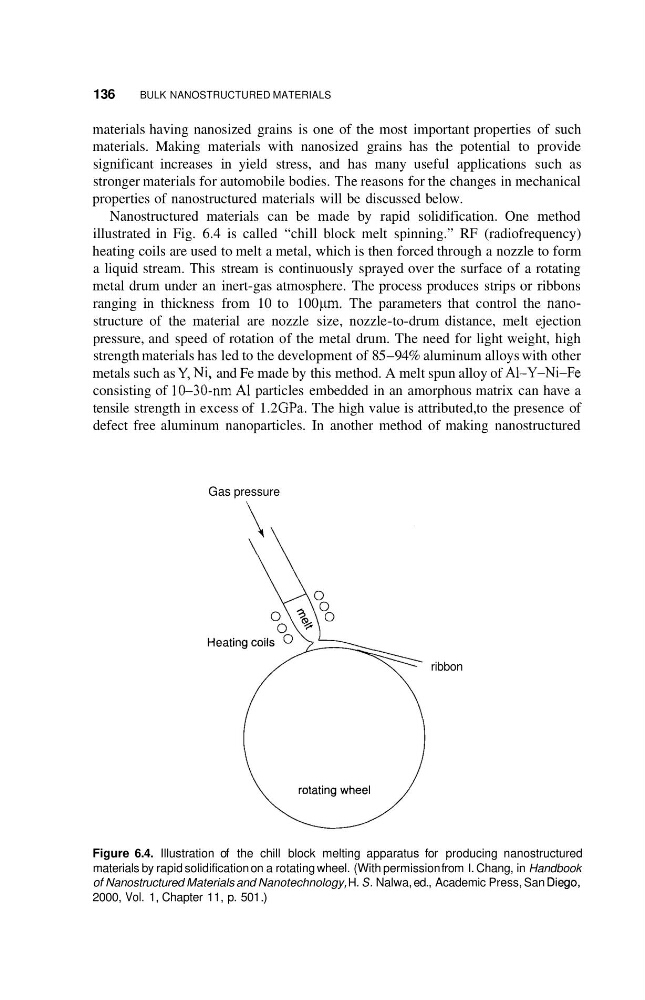
Nanostructured materials can be made by rapid solidification. One method
illustrated in Fig. 6.4 is called “chill block melt spinning.” RF (radiofrequency)
heating coils are used to melt a metal, which is then forced through a nozzle to form
a liquid stream. This stream is continuously sprayed over the surface of a rotating
metal drum under an inert-gas atmosphere. The process produces strips or ribbons
ranging in thickness from 10 to 100 pm. The parameters that control the nanostructure of the material are nozzle size, nozzle-to-drum distance, melt ejection
pressure, and speed of rotation of the metal drum. The need for light weight, high
strength materials has led to the development of 85-94% aluminum alloys with other
metals such as Y, Ni, and Fe made by this method. A melt spun alloy of AI-Y-Ni-Fe
consisting of 10-30-nm A1 particles embedded in an amorphous matrix can have a
tensile strength in excess of 1.2 GPa. The high value is attributed, to the presence of
defect free aluminum nanoparticles. In another method of making nanostructured
Gas pressure
\
ribbon
Figure 6.4. Illustration of the chill block melting apparatus for producing nanostructured
materials by rapid solidification on a rotating wheel. (With permission from I. Chang, in Handbook
of Nanostructured Materials and Nanotechnology, H. S. Nalwa, ed., Academic Press, San Diego,
2000, Vol. 1, Chapter 11, p. 501 .)
BULK NANOSTRUCTURED MATERIALS
materials having nanosized grains is one of the most important properties of such
materials. Making materials with nanosized grains has the potential to provide
significant increases in yield stress, and has many useful applications such as
stronger materials for automobile bodies. The reasons for the changes in mechanical
properties of nanostructured materials will be discussed below.
Nanostructured materials can be made by rapid solidification. One method
illustrated in Fig. 6.4 is called “chill block melt spinning.” RF (radiofrequency)
heating coils are used to melt a metal, which is then forced through a nozzle to form
a liquid stream. This stream is continuously sprayed over the surface of a rotating
metal drum under an inert-gas atmosphere. The process produces strips or ribbons
ranging in thickness from 10 to 100 pm. The parameters that control the nanostructure of the material are nozzle size, nozzle-to-drum distance, melt ejection
pressure, and speed of rotation of the metal drum. The need for light weight, high
strength materials has led to the development of 85-94% aluminum alloys with other
metals such as Y, Ni, and Fe made by this method. A melt spun alloy of AI-Y-Ni-Fe
consisting of 10-30-nm A1 particles embedded in an amorphous matrix can have a
tensile strength in excess of 1.2 GPa. The high value is attributed, to the presence of
defect free aluminum nanoparticles. In another method of making nanostructured
Gas pressure
\
ribbon
Figure 6.4. Illustration of the chill block melting apparatus for producing nanostructured
materials by rapid solidification on a rotating wheel. (With permission from I. Chang, in Handbook
of Nanostructured Materials and Nanotechnology, H. S. Nalwa, ed., Academic Press, San Diego,
2000, Vol. 1, Chapter 11, p. 501 .)