

5.4. CARBON NANOTUBES
123
stretch consists of out-of-phase stretches of the C=O bond length, where one bond
length increases while the other decreases. Similarly carbon nanotubes also have
normal modes of vibration. Figure 5.19 illustrates two of the normal modes of
nanotubes. One mode, labeled AI,, involves an “in and out” oscillation of the
diameter of the tube. Another mode, the E2, mode, involves a squashing of the tube
where it squeezes down in one direction and expands in the perpendicular direction
essentially oscillating between a sphere and an ellipse. The frequencies of these two
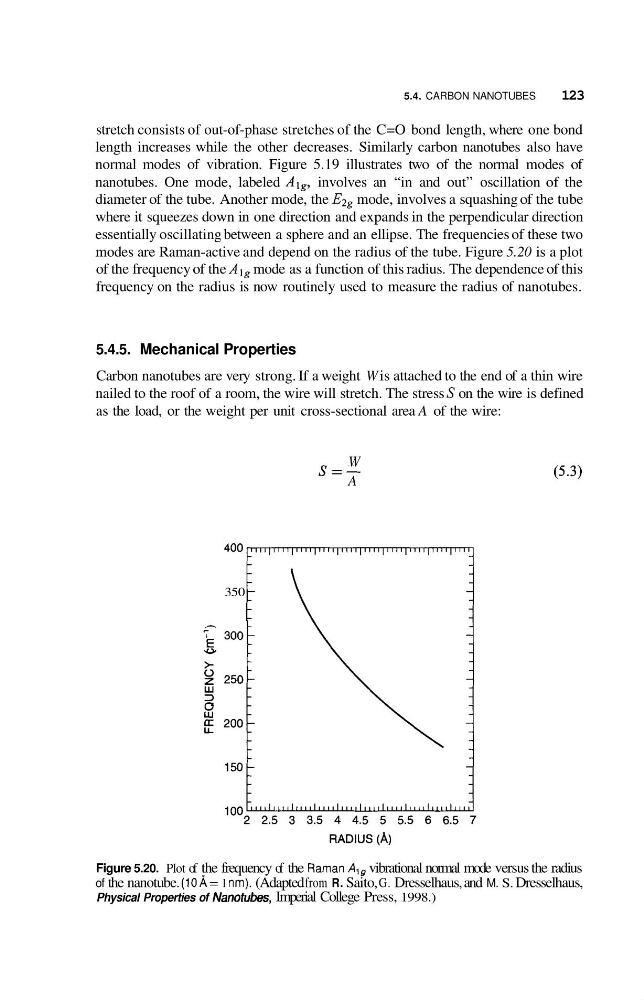
modes are Raman-active and depend on the radius of the tube. Figure 5.20 is a plot
of the frequency of the Al, mode as a function of this radius. The dependence of this
frequency on the radius is now routinely used to measure the radius of nanotubes.
5.4.5. Mechanical Properties
Carbon nanotubes are very strong. If a weight W is attached to the end of a thin wire
nailed to the roof of a room, the wire will stretch. The stress S on the wire is defined
as the load, or the weight per unit cross-sectional area A of the wire:
W
S = -
A
350 1
f 3 0 0 1
v E,
(5.3)
Figure 5.20. Plot of the frequency of the Raman A,, vibrational normal mode versus the radius
of the nanotube. ( l O A = 1 nm). (Adapted from R. Saito, G. Dresselhaus, and M. S. Dresselhaus,
Physical Properties of Nanotubes, Imperial College Press, 1998.)
123
stretch consists of out-of-phase stretches of the C=O bond length, where one bond
length increases while the other decreases. Similarly carbon nanotubes also have
normal modes of vibration. Figure 5.19 illustrates two of the normal modes of
nanotubes. One mode, labeled AI,, involves an “in and out” oscillation of the
diameter of the tube. Another mode, the E2, mode, involves a squashing of the tube
where it squeezes down in one direction and expands in the perpendicular direction
essentially oscillating between a sphere and an ellipse. The frequencies of these two
modes are Raman-active and depend on the radius of the tube. Figure 5.20 is a plot
of the frequency of the Al, mode as a function of this radius. The dependence of this
frequency on the radius is now routinely used to measure the radius of nanotubes.
5.4.5. Mechanical Properties
Carbon nanotubes are very strong. If a weight W is attached to the end of a thin wire
nailed to the roof of a room, the wire will stretch. The stress S on the wire is defined
as the load, or the weight per unit cross-sectional area A of the wire:
W
S = -
A
350 1
f 3 0 0 1
v E,
(5.3)
Figure 5.20. Plot of the frequency of the Raman A,, vibrational normal mode versus the radius
of the nanotube. ( l O A = 1 nm). (Adapted from R. Saito, G. Dresselhaus, and M. S. Dresselhaus,
Physical Properties of Nanotubes, Imperial College Press, 1998.)