

E1C03 09/14/2010
15:24:52 Page 84
is valid only at static equilibrium. This is because most real measurement systems possess inertial or
storage capabilities that require higher-order differential equations to correctly model their timedependent behavior to dynamic input signals.
Determination of K
The static sensitivity is found from the static calibration of the measurement system. It is the slope of
the calibration curve, K ¼ dy/dx.
Example 3.2
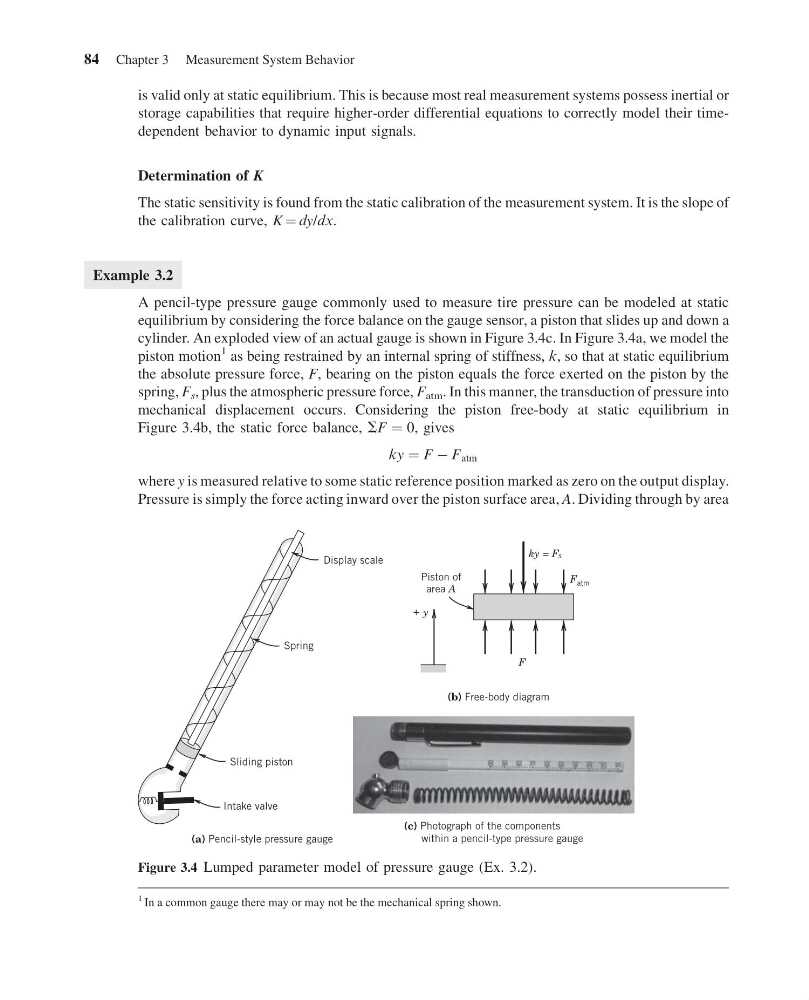
A pencil-type pressure gauge commonly used to measure tire pressure can be modeled at static
equilibrium by considering the force balance on the gauge sensor, a piston that slides up and down a
cylinder. An exploded view of an actual gauge is shown in Figure 3.4c. In Figure 3.4a, we model the
piston motion
1 as being restrained by an internal spring of stiffness, k, so that at static equilibrium
the absolute pressure force, F, bearing on the piston equals the force exerted on the piston by the
spring, F s , plus the atmospheric pressure force, F atm . In this manner, the transduction of pressure into
mechanical displacement occurs. Considering the piston free-body at static equilibrium in
Figure 3.4b, the static force balance, SF ¼ 0, gives
ky ¼ F À F atm
where y is measured relative to some static reference position marked as zero on the output display.
Pressure is simply the force acting inward over the piston surface area, A. Dividing through by area
1 In a common gauge there may or may not be the mechanical spring shown.
y
(a) Pencil-style pressure gauge
(b) Free-body diagram
(c) Photograph of the components
within a pencil-type pressure gauge
ky = F
F
F atm
s
Display scale
Spring
Piston of
area A
+
Sliding piston
Intake valve
Figure 3.4 Lumped parameter model of pressure gauge (Ex. 3.2).
84 Chapter 3 Measurement System Behavior
15:24:52 Page 84
is valid only at static equilibrium. This is because most real measurement systems possess inertial or
storage capabilities that require higher-order differential equations to correctly model their timedependent behavior to dynamic input signals.
Determination of K
The static sensitivity is found from the static calibration of the measurement system. It is the slope of
the calibration curve, K ¼ dy/dx.
Example 3.2
A pencil-type pressure gauge commonly used to measure tire pressure can be modeled at static
equilibrium by considering the force balance on the gauge sensor, a piston that slides up and down a
cylinder. An exploded view of an actual gauge is shown in Figure 3.4c. In Figure 3.4a, we model the
piston motion
1 as being restrained by an internal spring of stiffness, k, so that at static equilibrium
the absolute pressure force, F, bearing on the piston equals the force exerted on the piston by the
spring, F s , plus the atmospheric pressure force, F atm . In this manner, the transduction of pressure into
mechanical displacement occurs. Considering the piston free-body at static equilibrium in
Figure 3.4b, the static force balance, SF ¼ 0, gives
ky ¼ F À F atm
where y is measured relative to some static reference position marked as zero on the output display.
Pressure is simply the force acting inward over the piston surface area, A. Dividing through by area
1 In a common gauge there may or may not be the mechanical spring shown.
y
(a) Pencil-style pressure gauge
(b) Free-body diagram
(c) Photograph of the components
within a pencil-type pressure gauge
ky = F
F
F atm
s
Display scale
Spring
Piston of
area A
+
Sliding piston
Intake valve
Figure 3.4 Lumped parameter model of pressure gauge (Ex. 3.2).
84 Chapter 3 Measurement System Behavior