

E1C02 09/14/2010
13:35:17 Page 48
Direct Current Offset
When the AC component of the signal is of primary interest, the DC component can be removed.
This procedure often allows a change of scale in the display or plotting of a signal such that
fluctuations that were a small percentage of the DC signal can be more clearly observed without the
superposition of the large DC component. The enhancement of fluctuations through the subtraction
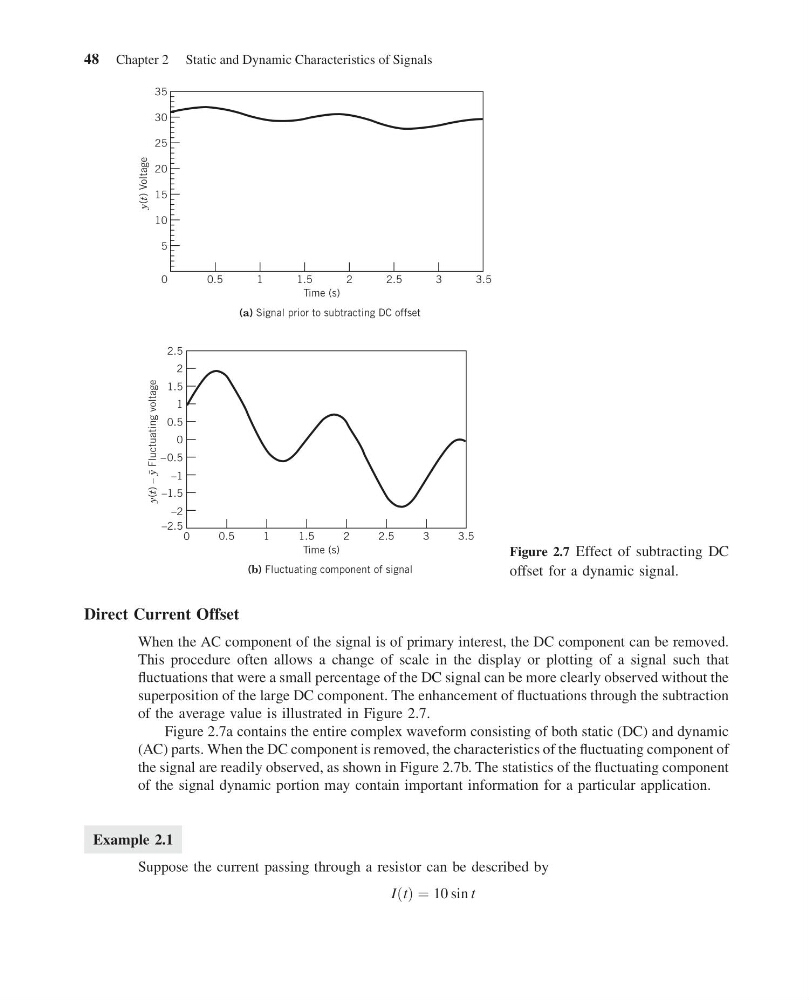
of the average value is illustrated in Figure 2.7.
Figure 2.7a contains the entire complex waveform consisting of both static (DC) and dynamic
(AC) parts. When the DC component is removed, the characteristics of the fluctuating component of
the signal are readily observed, as shown in Figure 2.7b. The statistics of the fluctuating component
of the signal dynamic portion may contain important information for a particular application.
Example 2.1
Suppose the current passing through a resistor can be described by
I t
ð Þ ¼ 10 sin t
3.5
3
2.5
2
1.5
1
0.5
0
Time (s)
y(t) Voltage
5
10
15
20
25
30
35
(a) Signal prior to subtracting DC offset
–2.5
–2
–1.5
–1
–0.5
0
0.5
1
1.5
2
2.5
0
Time (s)
y(t) –
y Fluctuating voltage
0.5
1
1.5
2
2.5
3
3.5
(b) Fluctuating component of signal
Figure 2.7 Effect of subtracting DC
offset for a dynamic signal.
48 Chapter 2 Static and Dynamic Characteristics of Signals
13:35:17 Page 48
Direct Current Offset
When the AC component of the signal is of primary interest, the DC component can be removed.
This procedure often allows a change of scale in the display or plotting of a signal such that
fluctuations that were a small percentage of the DC signal can be more clearly observed without the
superposition of the large DC component. The enhancement of fluctuations through the subtraction
of the average value is illustrated in Figure 2.7.
Figure 2.7a contains the entire complex waveform consisting of both static (DC) and dynamic
(AC) parts. When the DC component is removed, the characteristics of the fluctuating component of
the signal are readily observed, as shown in Figure 2.7b. The statistics of the fluctuating component
of the signal dynamic portion may contain important information for a particular application.
Example 2.1
Suppose the current passing through a resistor can be described by
I t
ð Þ ¼ 10 sin t
3.5
3
2.5
2
1.5
1
0.5
0
Time (s)
y(t) Voltage
5
10
15
20
25
30
35
(a) Signal prior to subtracting DC offset
–2.5
–2
–1.5
–1
–0.5
0
0.5
1
1.5
2
2.5
0
Time (s)
y(t) –
y Fluctuating voltage
0.5
1
1.5
2
2.5
3
3.5
(b) Fluctuating component of signal
Figure 2.7 Effect of subtracting DC
offset for a dynamic signal.
48 Chapter 2 Static and Dynamic Characteristics of Signals